Hotel prices have surged in key European cities, as hundreds of thousands of tourists flock to see the first total eclipse visible from the continent this century.
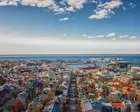
Iceland’s capital Reykjavík has seen one of the biggest jumps in hotel room prices, being one of the few accessible locations to see the full eclipse before evening light descends on Wednesday.
The latest figures show tourists there have been shelling out more than $793 (£587) on average to secure a room on 12 August, marking a 98% jump compared with the same day last year, according to data from the travel and hospitality data group Lighthouse Intelligence.
Spain is also steeling itself for an influx of tourists, being one of the best places on the European continent to view the total solar eclipse. The finance ministry said on Monday that it expected 460,000 overseas tourists to visit specifically to see the eclipse.
The rate for a room in A Coruña in the north of Spain was up 135% compared with last year to $451 on average, while prices in Mallorca, where the eclipse is expected to be visible on the horizon at sunset, were up by 24% at about $448. In Santiago de Compostela and Bilbao, hotel room prices have risen 34% and 67% respectively.
Accommodation in small towns and villages in the eclipse’s path, as well as makeshift observatories set up by local enthusiasts, have been booked for months. There have also been reports of US travellers taking part in house exchanges with people living in Spain’s Castilla y León, which is one of the best regions to view the eclipse.
However, authorities in Spain are worried about an increased risk of fires, with police expecting 1.5m more car journeys than usual on Wednesday.
They have warned that extraordinarily dry temperatures mean that the smallest spark could lead to devastating forest fires, while traffic could end up blocking access for emergency vehicles if fires break out in rural areas.
Authorities will roll out a massive police operation and safety campaign, with plans to deploy 35,000 officers to help minimise risks. “We’ve had an extremely tough summer in Spain, with yet another series of major forest fires. That’s why we must restrict any kind of activity that could generate a spark,” Virginia Barcones, the secretary-general for civil protection and emergencies at Spain’s interior ministry, said.
Parking on hard shoulders or close to dry vegetation has already been banned in Spain, as have barbecues and fireworks. The València region has closed its natural parks and banned walking on rural footpaths.
As of Monday evening, three large wildfires were burning in the provinces of Huelva, Segovia and Huesca. Fires have already scorched about 200,000 hectares this year – six times more than by the same date in 2025, according to the environment ministry.
For those unable to make the journey, the US space agency Nasa has installed four high-powered telescopes in the small village of Villalibado in north-west Spain in order to live stream the eclipse to more than 10 million people.
A partial solar eclipse will also be visible across the UK on Wednesday, where it will reach its maximum coverage at 7.12pm in London.