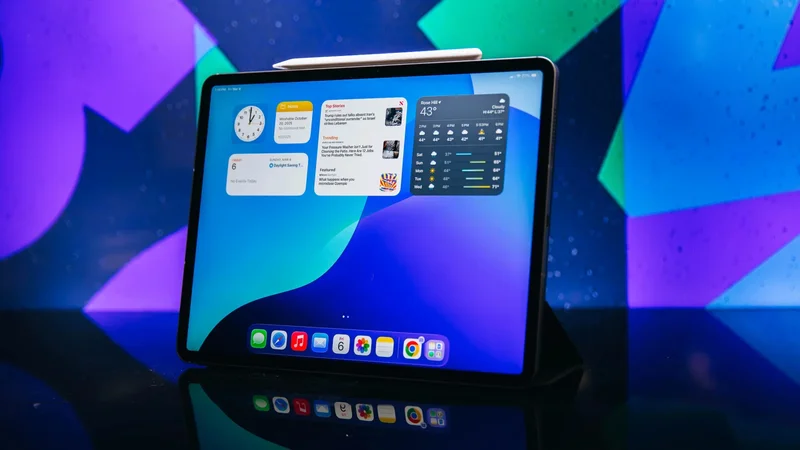
Even if you have a very capable smartphone and a nice laptop, a tablet can still be worth adding to your tech arsenal. A touchscreen that can be carried anywhere makes for a portable studio for creatives, a crucial sidekick for frequent travelers, and an e-reader for book lovers. These days, tablets are basically just laptops anyway.
Overview
These are the tech, tools, and products — from laptops to e-readers, from earbuds to robovacs, and more — that Mashable ranks best in class.
Table of Contents
Whether you're looking for a kid-friendly tablet or a compact laptop replacement, there are plenty of excellent options out there. If you're not exactly sure which tablet you should buy, we've got one simple question to help narrow down your search: Are you an Apple person? We tested the entire iPad lineup, and though iPads are our preferred tablets in 2026, we also love some of the best tablets from Samsung, OnePlus, and Microsoft. So, whatever your preferences, we've got a tablet to recommend.
The Good & The Bad
- Thin and lightweight body
- Gorgeous Liquid Retina displays
- Fast performance powered by M4
- Comes in 11- and 13-inch models
-
RAM upgrade capable of handling AI tasks
-
Very similar to previous generation
- Touchscreen display still collects fingerprints
Our review
Who it's for
The iPad Air is not just the best iPad, it's the best tablet. It will be your new go-to device for streaming, reading, or creative projects. And if you plan on using your tablet as a substitute for a laptop, it'll work for that, too, especially when paired with the new Magic Keyboard for iPad Air or Apple Pencil Pro. Both are sold separately, but add useful versatility to the tablet, essentially transforming it into a full workstation.
It's fast, moves smoothly between apps thanks to the M4 chip with 12GB of RAM, and has a stunning high-definition display.
While we prefer the iPad Pro for creatives, the iPad Air is a more budget-friendly option that still handles tough design jobs.
When we first published this guide, the iPad Air cost just $599. In the face of the global memory crisis, it's increased to $749. While this does impact its overall value, considering most other tech prices are on the rise, it's still well-positioned in the market.
Why we picked this
To kick off 2026, Apple upgraded the iPad Air to include the M4 chip. While the update didn't feel necessary in light of the already powerful iPad with M3 chip, we'll never say no to more computing power, especially with no price increase.
The iPad Air bridges the gap between tablet and laptop, yet it still remains affordable and user-friendly. With the M4 chip upgrade, the iPad Air got a performance boost, now scoring 13,176 on the Geekbench 6 test, up from its previous score of 11,464.
While the iPad Pro is technically slightly thinner and lighter, the iPad Air still lives up to its name. It's a great tablet to bring on the go due to its light weight, which helps avoid wrist strain when holding the device.
It has a crisp display for brilliant graphics, and one of its most surprising upgrades in the 2026 model is more memory. Now with 12GB of RAM, it's better equipped as a gaming device, too. For creatives too, the extra memory makes it even more capable of creative tasks, whether that be in Final Cut Pro or while doing design work with the Apple Pencil.
Details
The Good & The Bad
- Comes with case, keyboard, and stylus
- Bright, high-resolution display
-
Solid computing power
-
Expensive when not on sale
- The cover is a little wonky
Who it's for
Looking for an Android tablet? Our pick is the Lenovo Yoga Tab. It's an exceptional value that performs on par with Apple's iPads. It's a fast-moving tablet, delivering laptop-quality speeds, and almost feels like one with the included keyboard and pen.
If you think you need an iPad for writing and drawing on a tablet, think again. The Lenovo Yoga Tab is the best writing experience on any tablet we've tested.
Why we picked this
Right off the bat, I liked the Lenovo Yoga Tab. Setting it up is a breeze, and the apps downloaded quickly. After an initial charge, the Lenovo Yoga Tab's battery life lasted nearly an entire week when I used it a couple of hours per day.
Its performance was undeniable, and the Geekbench 6 confirmed that. The Lenovo Yoga Tab's multi-core score was 5,799, on par with the iPad's 6,233 score and nearly double the OnePlus Pad Go 2's 3,030 score.
What I like best about the Lenovo writing experience is the haptic feedback. While the screen is smooth and glossy like any tablet, the pen has a roughed tip that makes it feel like an actual pen on paper. It's easily the best writing experience I've had on a tablet, and that's not to mention Lenovo's built-in note-taking app has a better user interface than both Apple and Samsung.
Each Yoga Tab includes a keyboard case and pen, so you're getting more than just a tablet. On Lenovo's site, it's given an estimated value of $619.99, but I've never seen it priced higher than $419.99. That's an amazing deal, considering an iPad with equivalent accessories will run you $677.
I should say, I don't love the case on the Lenovo Yoga Tab, finding it stiff and not the most well-balanced. The keyboard and stylus, though, are far superior in design.
Details
The Good & The Bad
- Great, compact screen size
- Clear resolution
-
Extremely affordable
-
Tinny speakers
- Screen could be brighter
- A little laggy
Who it's for
Amazon Fire tablets aren't our favorite, but they get the job done. Having tested several models, the best one also happens to be the cheapest. The Amazon Fire HD 8 is great if you just want the basics, like access to social media and streaming services. Just keep in mind that the Amazon Appstore doesn't have the most extensive app selection.
Why we picked this
The 8-inch screen on the Fire HD 8 is the ideal tablet size. It's comfortable to hold for hours of reading, but still has plenty of space for watching shows. However, the screen brightness on the HD 8 was surprisingly dim even at its max.
Since the HD 8 is the newest model among Amazon's Fire tablets, it's also the fastest, despite being the most affordable. Compared to more technically advanced models like the Amazon Fire Max 11, the HD 8 was even faster, experiencing little lag time when downloading and switching between apps.
Don't expect the Fire HD 8 to handle large tasks, though. Compared to the iPad 11th generation, which has 6GB RAM, and the Lenovo Yoga Tab with 12GB RAM, the Fire HD 8 just has a measly 3GB or 4GB. Not to mention, as an Amazon device, it's loaded with ads, especially on the home and lock screens.
Details
The Good & The Bad
- Well-priced
- Plenty of storage space
- Decent processor and multitasking capabilities
- Touch ID
-
Compatible with iPadOS 26
-
No M-series chip
- Cameras are so-so
- No 1 TB storage option
Who it's for
If you prefer saving money over splurging on the latest tech, the Apple iPad (11th generation) gets the job done. It's the base model, meaning it won't have the fastest processor like the iPad Air's M4 chip or the latest features like Apple Intelligence. However, it is the most affordable Apple tablet. With the M4 iPad Air and M5 iPad Pro models, this iPad's price dropped to $349 — a real steal for Apple.
Even though its tech is basic compared to the advanced iPad Air and Pro, it's great for someone who wants a portable screen for streaming, playing games, and reading. It's also a nice choice if you're interested in using your tablet as a laptop, but don't want to spend a ton of money. It's compatible with the Magic Keyboard Folio and together costs $598 — the same price as the iPad Air.
Plus, it's especially great for kids if you want to get them a tablet but don't want to spend a fortune on it.
Why we picked this
Most of Apple's iPads now have the M-series of chips; however, the classic iPad has the A-series, typically found in iPhones. That being said, the 11th-generation iPad still offers enough processing power for everyday use thanks to its A16 Bionic chip. You'll be able to multitask without the system sputtering out, whether you're watching YouTube videos, playing your favorite high-res games, or just have a habit of leaving your apps running in the background. It also packs a decent amount of storage space. The base model starts at 128GB, so there's no need to pick and choose what apps and pictures you want to keep. Speaking of, it sports 12MP front and rear cameras with Center Stage, a feature that keeps you in frame during FaceTime calls.
Combine all these features with the functionality of iPadOS 26 (yes, the A16 iPad is compatible with iPadOS 26), and you have an iPad that looks unassuming but is anything but — and all for a pretty unbeatable price point. It's a fine choice if you're just dipping your toes into tablets; however, creative professionals might prefer the power of the iPad Air or Pro.
Details
The Good & The Bad
- Geekbench 6 scores that compete with MacBooks
- 12-hour battery life
- Runs livestreams with ease
-
Multiple USB-C ports
-
Included case is flimsy and overcomplicated
- Occasionally unresponsive screen
Who it's for
Gamers looking for a tablet may get stumped. Most can tackle mobile games, but what about full video games with extensive graphics? For that, there's the Lenovo Legion Tab Gen 5, which is designed for gaming. With over 12 hours of battery life, impressive processing, and a designated gaming hub.
Why we picked this
Lenovo makes tablets that compete with not just iPads but MacBooks, too. That's thanks to the Snapdragon chip at the heart of the Lenovo Legion Tab Gen 5. Having tested previous generations of the Lenovo Legion Tab, we have a soft spot for this lineup. It has a compact 8.8-inch screen, which makes it ultra portable and comfortable for handheld gaming, but I didn't expect this tablet to be so powerful.
On the Geekbench 6 test, the Lenovo Legion Tab Gen 5 had a 3,655 single-core score and a 10,758 multi-core score. That single-core score puts it on par with MacBooks. Plus, the Gen 5's 10,758 multi-core score is a huge boost over the Gen 3's score of 6,674. It handles livestreams like a pro, playing clear high-resolution video without any buffering. Plus, with 12 hours and 24 minutes of battery life, it outlasts most gaming laptops. It's outfitted with two USB-C ports, too, so you can plug in a charger and a controller simultaneously.
My only concern with the Lenovo Legion Tab Gen 5 is its touchscreen, which occasionally had some response time issues. This is a larger issue for games utilizing touchscreen, but less of a concern if you're using a controller.
Details
The Good & The Bad
- Contains Apple's powerful M5 chip
- Extra-long battery life
- Razor-thin design
- Impressive performance
-
Brilliant XDR display (can play HDR video)
-
Nano-texture glass costs extra
- Starting price of $999
Our review
Who it's for
Professionals looking for an iPad should go for the iPad Pro with M5 chip. Released in 2025, the new iPad Pro is loaded with Apple's fastest M5 chip, giving it way more power than the average user really needs. Most people won't need this much power, which is why the iPad Air is our top pick.
Graphic designers can store all of their creative work on the device, which has up to 2TB of storage. It's also a smart choice for video editors, though the premium nano-texture glass, which prevents glare while working in any environment, even full sun, will cost extra. Plus, the XDR Retina display lets you play back HDR video and use this tablet as a reference monitor.
For creative professionals, the Apple iPad Pro is a dream come true. It's also compatible with the Apple Pencil Pro, a tool that features a unique squeezable design and a barrel roll feature, enhancing precision and control in design work.
Why we picked this
While the iPad Air is going to be the best for most people, the iPad Pro levels things up for professionals.
The 2025 iPad Pro isn't just a great tablet but an outstanding laptop. Loaded with Apple's latest M5 processing chip, it's one of the most advanced options from Apple. When running the Geekbench 6 tests, it scored between 16,200 and 16,400. That puts it in the top 8 percent of all laptops we've tested. That's miraculous levels of power for such a sleek, razor-thin package.
You can often find 1TB of storage in computers, but 2TB is rare in a laptop and nearly unheard of with a tablet, so it can store large files without a problem.
Details
The Good & The Bad
- User-friendly interface
- Easy set-up
- Long battery life
-
Vibrant, clear displays
-
Speakers are a little tinny
- Weak computing power
Who it's for
Not a fan of Apple products? No problem. While we do find that iPads are the pinnacle of value with their performance and affordability, there are suitable budget Androids. Our preferred model is the OnePlus Pad Go 2, priced at $399.99, just $50 more than Apple's base iPad. It's a straightforward, reliable tablet that tackles all your needs from streaming to reading to gaming.
Why we picked this
The OnePlus Pad Go 2 is a suitable tablet for anyone, regardless of your preference for iOS or Android. With Google integration, setup is a breeze; all you need is a Google account. It has a well-organized home page that's easy to navigate with pre-downloaded apps.
For basic tablet needs, I consider it to be a master of streaming, reading, and gaming. It zipped through mobile games without any lag, but keep in mind I wasn't playing anything more demanding than Subway Surfers. Reading was no issue either; however, I did find it a little too large and cumbersome to do so, as I do on most tablets with 10-inch or larger screens.
But I most appreciated how it handled streaming demands. It has bright, high-resolution displays that played all my shows in vivid color. My only complaint is that the speakers could be better; the sound is fine, often a little tinny.
The cameras are disappointing on the OnePlus Pad Go 2, so you won't be using it for photography; however, both front and rear cameras will be totally fine for taking video calls. Don't expect this tablet to handle big tasks either. While the OnePlus Pad Go 2 technically has more RAM than the Apple iPad, it has a fraction of the computing power. The Pad Go 2 has a multi-core score of 3,030 on the Geekbench 6 test, compared to the Apple iPad's multi-core score of 6,233.
Details
The Good & The Bad
- Quick processing
- Stylus included
- Features split screen
-
Insanely long battery life
-
Large screen is a little overkill
Who it's for
If you're an Android user who's seeking out a tablet that is well-equipped to handle all the tasks of a laptop, let us point you in the direction of the Samsung Galaxy Tab S11 Ultra. It has a beautiful AMOLED screen that enhances contrast and color depth and the 120Hz refresh rates makes everything from scrolling to handwriting smoother. While we wish the MediaTex processor was stronger, it still handles multiple apps at a time, allowing you to split the screen between apps. It even comes with a stylus for illustration or note-taking.
Why we picked this
The Samsung Galaxy Tab S11 Ultra is one of the largest tablets out there, with a 14.6-inch screen. The screen size admittedly feels overkill, making it difficult to use when you're just trying to watch a show or browse the internet. But on the upside, with that giant screen, you can use multiple apps at once, allowing you to watch and play games at the same time. However, reading on the S11 Ultra is difficult, simply because the device is just so oversized that it's hard to hold, and there's just too much screen size unless you shrink the window.
But it's built for much more than reading. It starts with 12GB of RAM and 256GB of storage, but goes up to 16GB of RAM and 1TB of storage. The S11 Ultra tablet has a MediaTek Dimensity 9400+ processor and a Geekbench 6 multi-core score of 8,797. That makes it not quite as powerful as Apple's iPad Pro or Air, but the most powerful Android tablet we've tested. Not to mention it scores higher than the standard iPad's Geekbench 6 score.
Its battery life is extremely impressive. When conducting a battery rundown test, it lasted 16 hours and 6 minutes, potentially allowing you to work on it for two days before needing a charge.
The stylus comes included with the S11 Ultra, and it's a lightweight pencil with a button to control the settings with a simple click. It writes beautifully and allows for a lot of precision, though some might prefer something with a bit more heft behind it.
If you are going to do work on the device, I recommend getting a keyboard and cover that doubles as a stand. Since the tablet is just so large, it's awkward to hold and type on. The keyboard and stand, however, make it feel like a great laptop while still maintaining the convenience of a tablet.
Details
What's new in this guide?
With ever-evolving technology, this guide is never done. We're continuing to test new tablets for inclusion in this guide. At the end of 2025, we added the Samsung Galaxy S11 Ultra to this guide.
As of March 2026, we've updated this guide to include the iPad Air with M4 chip, replacing the previous Air model. We also added the iPad Pro (M5) as the best iPad for professionals, as well as the OnePlus Pad Go 2 as the best budget Android tablet.
In June 2026, we added the Lenovo Yoga Tab as our new favorite Android tablet. The Amazon Fire HD 8 was also added as our favorite Amazon Fire tablet.
And our latest update in August 2026 sees the addition of the Lenovo Legion Tab Gen 5.
Frequently Asked Questions
Taking a refurbished device off the market is a great way to save money — and save that device from going where e-waste goes to die. Refurbished or renewed tablets are often next to impossible to tell apart from a brand new one. Cosmetic dings are a possibility, but unless stated otherwise, the devices have been reworked and tested to run like new. iPads are probably the easiest tablet to find refurbished (at Amazon, Best Buy, and the Apple Store).
Most tablets made specifically for kids will already be equipped with built-in parental accounts, timers, and pre-selected websites or apps that are strictly for kids.
General-purpose tablets aren't a bad choice, either — many sites name the Apple iPad as one of the best tablets for kids even though it's an everyone tablet. These won't have any parental guardrails baked in, so you'll need to get creative if you'd rather your kid not have unlimited access to the internet. Apple and Android have features that can filter or block content and prevent purchases, but the closest thing you'll be able to get to close monitoring is by installing parental control software. Such monitoring features are easy to toggle off or uninstall as your kid gets older or if the family is sharing the device. In the latter case, Osmo is a neat snap-on kit that connects to iPads and Fire tablets for augmented reality-ish learning exercises and games. When your kid moves a physical piece in real life, the same piece moves on the screen. There's always the option of a kids edition tablet too or simply finding the most robust android tablet for younger children.
Apple is a commanding presence in the best tablet field, offering the high-end iPad Pro, the lightweight iPad Air, and the compact iPad mini, but its models come at a premium. They also don't ship with their own accessories (like Apple Pencils or Magic Keyboards), which is an additional cost to consider if you plan on doing a lot of writing or drawing.
In contrast, some Android tablets like the Samsung Galaxy Tab S9 include a stylus pen (the $59.99 Samsung S Pen); there's no additional fee to pay there.
You also need to think about what operating system you prefer. iOS is great to use, but if all your other devices are Android-based, you may prefer to stick with Android. A third option is to consider a ChromeOS-based tablet — but again, you probably want it to play nicely with other devices. Go with what you're comfortable with.
Tablets are a great middle-ground between laptops and smartphones. If you've ever felt like you need more real estate than your smartphone's screen to watch your favorite show, draw a design, or simply browse the internet, a good tablet means you don't have to worry about digging out your laptop. The best tablet blends the convenience of a laptop with the lightweight nature of a phone. Easy to toss into your bag and take traveling, they can entertain your kids or give you something to do while on the move, all without being as full-on as a PC.
If you buy an Apple iPad, you can use FaceTime to call friends and enjoy video chats with them. You can also use iMessage through your iPad with such functionality extending across the range from iPad mini to iPad Pro. However, if you go for an Android tablet, you will need to use a third-party app like WhatsApp, Skype, or Signal to call friends and family.
Our guide features the latest tablets tested by Mashable reviewers based on their speed, design, display, operating system, and ease of use.
We looked at the specs of each product including their processors, operating systems, memory and storage. We could not use Geekbench tests to compare computing power as not all devices had Geekbench 6 available to use.
Tablets are one big screen so displays matter. We assessed the GPU and resolution of each device. In the case of gaming tablets, we also considered refresh rates.
Through daily use, we inspected the usability of each tablet. We assessed things like screen size, placement of front-facing cameras, ports, weight, and how useful special features were.
Not all tablets are created equal so we assessed the special features on different models. This includes parental controls for kids tablets or smart home compatibility.
Leah Stodart is a Philadelphia-based Senior Shopping Reporter at Mashable where she covers and tests essential home tech like vacuums, TVs, beauty devices, and eco-friendly hacks. Her ever-evolving experience in these categories helps her make thoughtful recommendations for how to spend your money during shopping holidays like Black Friday, which Leah has been covering for Mashable since 2017.
Timothy Beck Werth is the Tech Editor at Mashable, where he leads coverage and assignments for the Tech and Shopping verticals. Tim has over 15 years of experience as a journalist and editor, and he has particular experience covering and testing consumer technology, smart home gadgets, and men’s grooming and style products. Previously, he was the Managing Editor and then Site Director of SPY.com, a men's product review and lifestyle website. As a writer for GQ, he covered everything from bull-riding competitions to the best Legos for adults, and he’s also contributed to publications such as The Daily Beast, Gear Patrol, and The Awl.
Tim studied print journalism at the University of Southern California. He currently splits his time between Brooklyn, NY and Charleston, SC. He's currently working on his second novel, a science-fiction book.