Colombia · Politics
Key Facts
—Event date. July 20, 2026, during Colombia’s Independence Day events in Bogotá.
—What happened. Military leaders left the stage before President Petro’s speech, as scheduled.
—Official reason. The Ministry of Defence said the military does not participate in politics.
—Petro’s response. Petro confirmed on social media that the exit was negotiated beforehand.
—Term end. Petro’s presidency ends on August 7, 2026, when Abelardo de la Espriella takes office.
Colombia military Petro tensions drew international attention on July 20, 2026, when the entire military command left the stage before outgoing President Gustavo Petro delivered his farewell speech in Bogotá’s Ciudad Bolívar district.
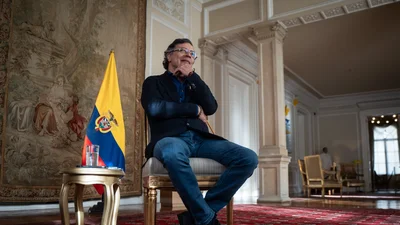
President Gustavo Petro, whose term ends in 2026, at the presidential palace in Bogota.
One-stop reference
Company Intelligence
Every listed company in Latin America — financials, ownership and structure for 1,450+ companies across 26 exchanges, in one place.
RTAsk Rio TimesCost of living, safety, visas across Latin America›
A Scheduled Departure, Not a Walkout
The Ministry of Defence and the Armed Forces stated the exit was scheduled in advance because the official program had ended.
They emphasized that the military does not participate in politics at any event, framing the move as institutional neutrality rather than a snub.
The ceremony took place during Colombia’s Independence Day, a national holiday marked by a traditional military parade that showcases the country’s armed forces to the public.
For foreign observers unfamiliar with local protocol, such prearranged exits are common in countries where the military seeks to visibly separate itself from political acts, especially during tense transitions.
Petro Confirms Prior Agreement
President Petro himself confirmed the prearranged nature of the departure on social media shortly after the event sparked speculation.
He wrote that he agreed with the command because the Public Force should not participate in politics, aligning his account with the military’s statement.
This public confirmation from Petro, Colombia’s first leftist president, was crucial in calming immediate fears of a breakdown in civil-military relations.
His willingness to endorse the military’s version of events signaled to both domestic and international audiences that the chain of command remained intact, at least procedurally.
Broader Colombia Military Petro Context
The procedural exit occurred amid heightened civil-military tension as Petro’s term nears its August 7 end.
Petro has questioned the legitimacy of the June 2026 presidential election, which was narrowly won by hard-right candidate Abelardo de la Espriella.
De la Espriella, a conservative lawyer and former journalist, defeated Petro’s chosen successor Iván Cepeda in a polarizing race that deepened the country’s ideological divide.
Adding to the friction, journalist Ricardo Ospina claimed an unconfirmed message from the military said, ‘Either you leave, or we remove you,’ though this has not been officially verified by either the military or the government.
International pressure has also mounted, with U.S. President Donald Trump suggesting a U.S. military operation against Colombia ‘sounds good,’ prompting Petro to call for nationwide protests to defend sovereignty.
Military’s Constitutional Stance
Under General Hugo López, the Armed Forces commander, the military has publicly reaffirmed its duty to uphold the Constitution and the electoral outcome.
Petro has rejected de la Espriella’s proposal to move the inauguration to a military base and announced he will not attend the ceremony.
General López represents the institutional voice of Colombia’s military, which has historically positioned itself as a guarantor of constitutional order rather than a political actor.
For expats and investors watching Colombia, this public commitment to the rule of law is a stabilizing signal, even as rhetorical battles between the outgoing and incoming presidents escalate.
What Happens Next in the Transition
Petro has promised a peaceful transition but called for a ‘general mobilisation’ on July 20 to demand continuity of his social reforms before leaving office.
De la Espriella criticized Petro’s calls for civil disobedience as ‘urban terrorism’ and vowed ‘no leniency’ for anyone challenging constitutional order.
The incoming president’s hardline stance sets the stage for potential street-level confrontations between Petro’s supporters and state security forces in the weeks surrounding the handover.
For foreign tourists and business travelers, the period between now and the August 7 inauguration may see increased protest activity in major cities, particularly Bogotá, requiring careful attention to local security advisories.
What It Means for Expats and Investors
The prearranged nature of the military’s exit suggests that, despite fiery political rhetoric, institutional protocols are holding firm during this sensitive transition.
Investors concerned about democratic stability can take some reassurance from the military’s repeated emphasis on its non-partisan, constitutional role under General López’s leadership.
However, Petro’s refusal to attend the inauguration and his questioning of the election result introduce uncertainty that could affect market confidence and the investment climate in the short term.
Expats living in Colombia should monitor local news for protest locations and avoid areas where ‘general mobilisation’ activities are planned, while understanding that the military’s posture remains professionally neutral.
Frequently Asked Questions
Did Colombia’s military walk out in protest during Petro’s speech?
No. The military command left the stage before the speech began, and both the Ministry of Defence and President Petro confirmed the departure was prearranged to maintain political neutrality. The move was scheduled because the official program had ended, not as a reaction to anything Petro said or did.
When does Gustavo Petro’s term as president end?
Petro’s term officially ends on August 7, 2026, when president-elect Abelardo de la Espriella is scheduled to take office. Petro has announced he will not attend the inauguration ceremony, though he has promised a peaceful transfer of power.
Why are there tensions between Petro and the military?
Tensions stem from Petro questioning the June 2026 election results, while the military under General Hugo López has publicly pledged to uphold the constitutional order and the electoral outcome. Unverified reports of military ultimatums and external pressure from the United States have further strained the atmosphere, though the military insists it remains non-partisan.