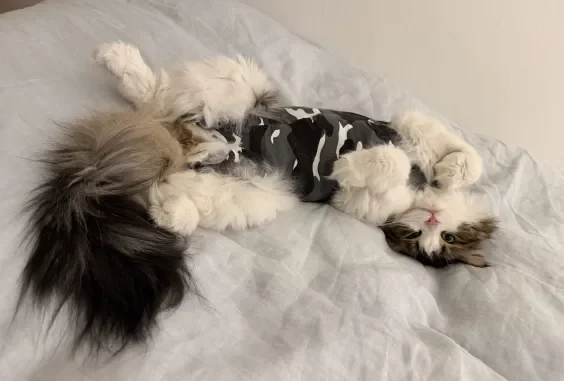
For a month this spring, Melon was truly living up to her name. She had always been a round cat but never quite this gourd-like—small neck billowing out to a majestic corpulence. This sudden plump came with an attitude. She had abandoned her sweet old habits: sitting on the toilet seat to watch me shower, running back and forth across my apartment until she panted, and leaping on my back to scope out unreachable shelves. I chalked this up to the fact that Melon, now 4 years old, was growing up. Maybe our close bond, which had always felt ineffable to me in ways I cannot articulate without sounding like a TikTok cat mystic, was not actually special, but rather the relationship of a child who needed her parent until, one day, she didn't.
There were other warning signs. Melon had become less and less interested in eating. But she'd always been picky, and I had gone through some drastic life changes—a breakup that came with a division of our two cats—to which I assumed she was still adjusting. Her mane looked terrible, limp and stringy and unkempt, but Melon had never been fastidious about her personal grooming. She'd gotten her annual checkup a few months earlier and left with a clean bill of health. Besides, I was busy, distracted by said life changes and preparing for a vacation and a month off work to write a book. I dropped Melon off at my ex's place, splashed around in Puerto Rico, then came home and picked her up. Neither of us had any idea that anything was wrong. Later that week, my friend Elaine, a fellow cat freak, watched as Melon turned her nose up from a fresh can of wet food. "You know," she said, "we learned Hamlet had cancer when he stopped eating."
My mind began to spin. Hamlet was older when he got cancer, I told myself. Maybe her hunger strike was her acting out for me going on vacation. Friday night, Melon wobbled onto the bed with me and narrowed her eyes into slits. I lay down next to her and studied her face. I tossed, turned, and then spirited us to the emergency animal hospital, empty at 1 a.m. They whisked Melon to the back and I read a book, anticipating the relief I would feel when they would send us home soon with an expensive but clean bill of health. But then I finished my book, and started another. By 3 a.m., I had become too worried to read. I paced my waiting-room cell, decorated only with an ominous daguerreotype of a tuxedo cat.
Finally the vet arrived, visibly grim. She explained that Melon's belly was not fat, but full of fluid. The fluid might stem from any number of things, and she listed the options like death sentences: heart failure, late-stage liver disease, pancreatitis, cancer. It could also be a disease called feline infectious peritonitis, or FIP, the vet explained, which has historically been fatal to cats but now can be treated in some cases by an experimental drug. She said they would extract some of Melon's fluid and send it out for tests. Then she sent us home with appetite stimulants and anti-nausea meds. All I could do, she said, was wait for the results.
Later that morning, Melon slunk off under the bed. I lay on my stomach and watched her, having read that cats hide under beds when they are dying. They seek comfort in the quiet, the dark, the seclusion. When Elaine woke up, she reminded me that her kitten had gotten FIP a few years ago. She told me I didn't have time to wait for the lab results, that I should find meds immediately. She gave me the name of a Facebook group that could help. Elaine said that if Melon didn't have FIP, the meds wouldn't harm her. But if she did, they could save her life.
When veterinarians described FIP in 1963, the disease was considered incurable. FIP is caused by a feline coronavirus, or FCoV, that only infects cats. In most cases, FCoV causes no symptoms, except a little diarrhea. But in less than five percent of cats—most often those with immune systems compromised by age, health, or inbreeding—the coronavirus mutates into a more harmful virus, which can infect white blood cells and cause FIP. The disease takes two forms. In wet FIP, the cat's body swells with fluid. In dry FIP, the cat's organs, such as the brain or eyes, become severely inflamed. Once a cat has FIP, they deteriorate rapidly. For a long time, the only treatment for FIP was palliative: pain relief, and then euthanasia.
All this changed with Niels Pedersen, now a professor emeritus at the University of California, Davis. Pedersen started vet school in the 1960s, when FIP had just been described, and eventually devoted his research to the disease. FIP was identified as a coronavirus in 1970, and for decades researchers tried and failed to find a vaccine. Then, in the 1990s, Pedersen wondered if antivirals might work. When he tested a batch of molecules from Gilead, a biopharmaceutical company specializing in antivirals, two very similar compounds appeared to block FIP's spread in cat cells: GS-441524 and GS-5734 (which is now known as remdesivir.) As Sarah Zhang explained in The Atlantic, the molecules trick the coronavirus by mimicking one of the building blocks of the virus. When the virus tries to incorporate GS-441524 instead of the actual building block, replication goes awry and the virus fizzles out.
Because both molecules halted the spread of FIP, Pedersen went forward with the simpler one, GS-441524. The drug was easy to make. It worked in a round of experimental infections, and then again in trials of naturally infected cats. When Pedersen published his results in papers in 2017 and 2019, a world where cats could be cured of this fatal disease seemed within reach.
But as you might have guessed, this world arguably has not yet arrived. The COVID-19 pandemic emerged soon after Pedersen's papers, and Gilead wanted to synthesize remdesivir as an experimental COVID-19 drug in people. Because GS-441524 and remdesivir are so similar, Gilead argued that licensing GS-441524 for use in cats could interfere with the approval and roll-out of remdesivir; in the company's eyes, any negative results in the cat drug could jeopardize the human drug. So even though Pedersen had the recipe for a cure for FIP, it could not be legally prescribed as long as Gilead had the patent for GS-441524, which expires in 2029. The cats, it seemed, would continue to be euthanized.
While Melon lay dying under my bed, I contacted the Facebook group. FIP Warriors was founded in 2019 by a woman named Robin Kintz and now numbers in the tens of thousands. FIP Warriors is both a hub of community wisdom from cat lovers and also an international underground operation peddling GS-441524 from pharmacies in China. The group experienced a major drug profiteering scandal that I cannot get into in the scope of this blog, but if you want to learn more I highly recommend this three-part podcast from Hyperfixed and Reveal.
I did not know this when I reached out. I posted about Melon's symptoms and conditions, and an admin connected me with someone nearby who could sell me black-market vials of GS-441524. I made plans to meet him that afternoon. By this time, Melon was under the far corner of my bed, totally unmoving. She seemed to have deteriorated rapidly since the night before, or was she just traumatized by the ER? I was alone and panicked and probably hungry and unable to think straight. I was worried she would die within hours. She hadn't eaten in two days. I brought her back to the ER, where they admitted her overnight. Then I took a car to Harlem.
The FIP Warriors contact met me in the lobby of their building wearing a knit cap with cat ears. They proceeded to demonstrate how to deliver the medicine on their stuffed cat, Edward. I watched as they manipulated the stuffed toy, lifting up pockets in Edward's "skin" into which I was to drive a 22-gauge needle at an angle into subcutaneous tissue. I paid $50 for two vials of injectable GS-441524, which was acidic to keep it shelf-stable. This acidity, the contact warned me, meant the injections burned. "It's really best if you have help," they told me. "Will you have help?" No, I told them. My ex was out of town and it was just me and Melon. "Well, you'll figure something out," they said. I would have to.
I took my meds straight to the animal hospital, where I begged Melon's vet—already someone new, as the doctors rotated out after each shift—to inject her with the medication. She was extremely reluctant to shoot up my dying cat with injectables of unknown provenance. She pushed me to wait until I had a diagnosis. But I pleaded desperately until she relented, although she told me she would not administer the dose calculated by my FIP Warriors admin, but rather a smaller dose. This felt better than nothing. And after all, I did not know who I should trust more. When I left the hospital, I panicked, realizing she could have been lying to me. I should have asked to watch her inject Melon. But I was scared. I hadn't yet remembered that I would have to inject her myself.
When Melon came home with me the next day, I bundled her in a towel, pinched the skin by her shoulder blades, and drove in the needle. It was not as difficult as I anticipated, if only because she was too weak to squirm—a convenience, I guess, of dying. Despite her torpor, she screamed. She would scream every single time I injected her, twice a day for the first 10 days.
I had been told that if Melon had FIP, the meds would kick in immediately. Cats deathly ill with FIP are often found bounding around within a day or two of initial treatment. But Melon remained sluggish. She refused food despite the three appetite stimulants and anti-nausea meds I slugged down her throat and rubbed in her ear twice a day. I had resorted to force-feeding her a high-calorie emergency slush, which I syringed down her throat. She still wobbled as she walked. The only thing she wanted to eat was her own litter. I watched helplessly as she trudged to her box and ate the filthy pebbles.
Melon went to the ER five times that first week. I took her two more times after the vets prescribed a new appetite stimulant, Elura, that caused her to hyperventilate, heaving ragged, rapid breaths in my lap as her eyes fluttered worryingly to a close. After the second incident, we stopped the Elura. By Wednesday afternoon, five days after our first ER visit, I got an email: Melon was positive for FIP. An emergency vet called me to say this was the best possible outcome. She was already being treated for FIP, the vet reassured me—against your hospital's explicit advisement! I wanted to say—and so now all I could do was continue giving Melon her GS-441524 and hope that she might improve.
When I reread my journals to reconstruct the timeline of that first week for this piece, I realized I wrote nothing that first month. I had been in a fugue state. I feared that writing down Melon's diagnosis would make it more real, as if acknowledging it would condemn her. But luckily I was not as alone as I thought I'd be. My ex had come back to the city and helped me give Melon her shots, as did the person I had started dating. My friends sat with me, sent food. After six excruciating days, she nibbled at her food. She scratched her post. She sat on my lap. By the end of the week, she chased after a toy mouse, her fluid-filled belly swinging like a pendulum. She still hid under the bed, but at least now she came out on her own.
Although progress often stalled, Melon seemed to be improving, even if she had developed a heinous and untraceable stench that was worse, somehow, than her obscenely odorous shits. Maybe, I thought, I was calm enough to start working on my book. And then Melon jumped into my lap, I lifted my hand to pet her, and I froze. There, at the center of her back, her fur had evaporated, leaving behind a pink bald patch with a center as yellow as butter. I took seconds to register what I was seeing. The yellow was not her flesh, but her fat. Her skin had split open to reveal a bloodless patch of tissue as wide as a lychee.
Heart racing, I scooped her into her carrier, and again we went to the hospital. After they took her back, I wracked my brain for how this could have happened. I knew the GS-441524 was acidic, and I had been careful to wipe away any liquid that might have escaped the shot, which happened occasionally now that Melon was getting stronger and subsequently more wiggly. But this wound had emerged right in the middle of her back, where I'd never injected her. Hours later, a new emergency vet emerged to say that Melon's flesh had likely been rotting under the skin since her first injection, and the sore had only broken the skin today. So the stench was not filth, but necrotic tissue. The vets gave Melon a crop top made of a bandage, which she managed to rip off within an hour of being home. I ordered a recovery suit—a Suitical—and after I squeezed her inside, Melon was so upset that she lay on her side like a tipped cow for hours, her chin glumly fixed to the carpet. We were both miserable.
A few days later, Melon's open sore, now the size of a dried apricot, had become infected, sluiced with pus. The vet gave her an antibiotic shot and ointment and sent me home with a traditional Chinese salve meant for dogs, cats, and horses. Every other day, I was to peel off Melon's scab like pepperoni on a pizza and smear the brown paste on the pink and bloody substrate underneath her skin. At least this didn't make her scream, only hiss. She wore her Suitical for a month until pale pink skin sealed the wound. But within hours of her release, Melon licked the spot so hard that she reopened her sore. Back on came the dreaded Suitical until the new skin was indistinguishable from the old skin, which took several more weeks. When Melon finally got free, the Suitical had matted so much fur that the vet shaved her entire back, belly, and several patches around her legs until she resembled an avant-garde poodle. The shave revealed she'd had at least three other injection sores, which had fortunately healed on their own under her fur. I worried that if Melon survived this, she would hate me for all the pain I put her through—every injection, every trip to the ER or vet, every scab removal and blood draw. I apologized to her constantly. I told her I loved her each time she looked in my eyes.
To avoid more sores, Melon's vet recommended I switch from GS-441524 injections to oral medicine, which I was able to buy from an actual compounded pharmacy in the U.S. My vet had prescribed the oral meds before Melon got her official diagnosis, but the prescription took a few days to arrive. And the FIP admins had advised me it was best to stick with twice-a-day injections with cats as ill as Melon, at least for the first two weeks. They said injections do a better job at crossing the blood-brain barrier, and I felt too overwhelmed to fact-check this claim. The oral meds, which cost more than $2,000 for Melon's 84-day treatment plan, were prescribed off-label, which meant my pet insurance did not cover the cost. For the next 70 days, I gave Melon a syringe of tuna-flavored oil every 12 hours, fasting her for an hour before and after. I tracked every dose in an excel spreadsheet. I weighed her every day to ensure I was giving her the correct amount, as under-dosing FIP medicine fails to eliminate the virus and can even lead to drug resistance.
From all the cats I've had and loved, I've learned that one of the most rewarding parts of having a pet is getting to know them as an individual. It has been a joy and an honor to learn about Melon's many idiosyncrasies. I know the face she makes when she wants me to bend down so she can jump on my back. I know how she likes my legs to be arranged under her favorite blanket when we watch TV on the couch. I know her ideal dimensions of a cardboard box. The healthier Melon got, bouncing back from nine to 13 pounds and resuming her usual goblin-like behavior, the more I blamed myself for not realizing she had gotten so sick in the first place. The cat I'd known better than any other animal had become a ghost of herself. Although she could not explicitly tell me what was wrong, all the signs had been there.
I felt relief after I gave Melon her final dose in June. In six months, her bloodwork will hopefully confirm she is in remission. But anxiety still lurks. The medicine is still so new. As I watch her gambol about the apartment, slipping on the white tufts of her paws, I can't quiet the fear in the back of my mind that she could relapse, that the FIP could come back. Some studies suggest complications in treated cats, such as heart inflammation and lymphoma. But I try to remember this: During one of her checkups, Melon's vet told me in plain words that if I'd listened to the emergency vets and waited for a diagnosis before treating her, Melon would likely have died. "She is so lucky to have you advocating for her," he told me, and I cried our whole walk home.
One of the great ironies of this experience was that my first real reckoning with DIY healthcare revolved around my cat. Despite my years of experience with transsexuality, a condition historically made possible by underground care, I had always gotten my hormones through the gender clinic. This is common for many trans people now, although some of my friends have transitioned at least in part outside the auspices of the clinic. When our insurance lapses or healthcare bureaucracy stalls, we are often each other's safety net; I have given friends my testosterone and been given theirs in these times of scarcity. Yet FIP marked the first time that the only way I could procure life-saving medication was through extralegal avenues, and the uncertainty of everything unmoored me.
Throughout Melon's treatment I'd been bombarded with conflicting advice from the emergency vet, Melon's vets, and the FIP admins. The admins, for example, insisted I keep Melon on injections for at least two weeks to ensure the medicine breached the blood-brain barrier, whereas Melon's vet told me to switch to oral meds to avoid further injection sores and the needless trauma of being bundled up in a blanket and stabbed daily with a burning needle. I didn't know who I should trust—the doctors, the admins, or even myself. I lost hours reading reddit threads and scientific papers. Had I made the right choices? I understood the FIP admins trusted the black market that had served them for years, and that Melon's various vets would not recommend black-market treatments over legal ones. I bought the black-market GS-441524 from a pharmacy I knew nothing about that I could only access through a password-protected site. I knew almost nothing about where it came from, save for the name of the brand, and that it was my only option.
And yet it seems obvious that FIP Warriors, despite its drug-profiteering past and lack of regulatory oversight, saved Melon's life. Although GS-441524 can now be legally prescribed through regulated pharmacies, there are still enormous knowledge gaps around FIP in veterinary medicine. It is baffling to me that none of the four emergency vets who saw Melon told me about these underground Facebook groups. I know that Melon might not be alive today if my friend Elaine hadn't happened to stay with me during Melon's sickest week and tell me immediately what to do. I know that Melon is alive because I advocated for her, but also because of serendipity. By the end of Melon's treatment, I'd spent around $3,500 on her care, which would have been nearly $7,000 without pet insurance. I think about all the other cats with FIP whose owners never learn about the drug or can't afford it. A cat should not need serendipity to survive.
In the second month of Melon's treatment, I switched my hormones from testosterone gel to injections, partly because injecting Melon made me feel more able to inject myself. Each week, I draw my syringe on the same table where I once drew syringes for Melon. She always joins me, stuck to me like a burr, once again my shadow in every room—perched on the toilet when I shower, seated on the other pillow when I wake up. Her fur has mostly grown back and her belly is soft now with fat, not fluid. When she watches me, I wonder if she recognizes the needle, if she has any memory of what I did to her for nearly two weeks when she could barely walk. Her placid face betrays nothing. Then I slide the needle into the fat of my stomach and pop it in the cherry-red container that still holds both of our sharps.
Whenever I spiral about the uncertainty of Melon's future or whether the decisions I made around her care were the right ones, my friends kindly remind me that I saved Melon's life. It is true that I was there for her in her time of need. And yet I know now I was just returning the favor, refusing to abandon the girl who refuses to abandon me even when I would not mind some distance, such as when I am on the toilet. But even now, as she watches me pee, I am simply grateful that nothing is keeping us apart.