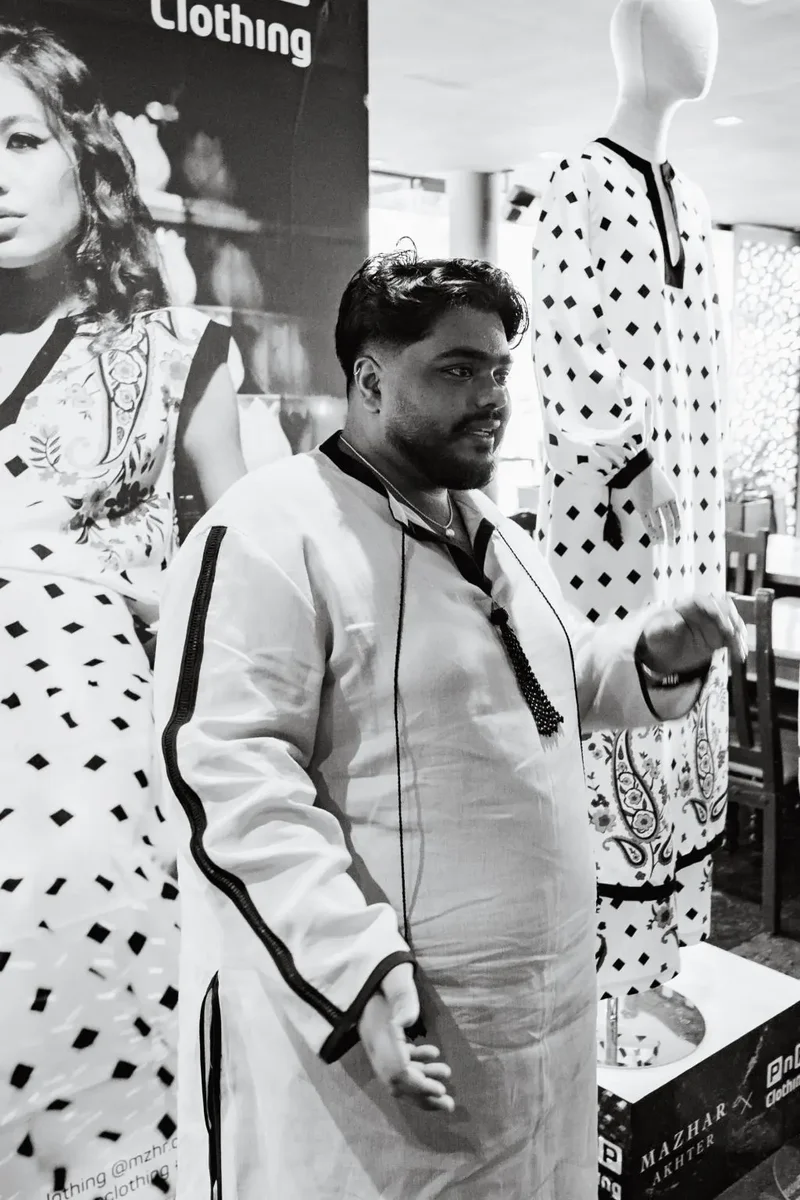
Mazhar Akhter was 13 when he knew he wanted to be a fashion designer.
The fascination had begun much earlier. His mother owned a salon and brought home copies of Glamour magazine. He devoured them. As a child, he dressed his cousins’ dolls and chose his mother’s outfits.
By his early teens, there was no question in his mind.
“This is what I want to be and this is who I am,” he remembers thinking.
His mother had other ideas. She wanted him to study law and even applied on his behalf. He heard the familiar refrain that fashion could remain a hobby while he pursued a degree and a more conventional career.
His father needed no convincing.
When his 13-year-old son said he wanted to design clothes, he listened. He would sit with Akhter, look at his drawings and discuss his designs. His mother came around too and is now, he says, one of his biggest supporters.
Eleven years later, clothes bearing Akhter’s name are hanging in Pick n Pay Clothing stores across the country.
His collection, released through the retailer’s Futurewear programme, is the first commercial range he has produced.
Spend time with Akhter and it becomes apparent that the clothes are part of a wider curiosity. He moves easily in conversation between history and culture, fabrics and craftsmanship, family and the business he hopes to build one day.
“I love history. I love culture. I love learning about so many cultures, and not just my own culture. Other cultures inspire me.”
He drew the print for the Futurewear collection himself, finding inspiration in tiles, florals and paisley. His South African-Indian heritage is part of his visual language but not its limit. He talks with equal enthusiasm about other cultural traditions and how they might inform his work.
“For me, my design aesthetic is nostalgia. I love the past,” he says. “I feel like that’s how we drive the future.”
The textile traditions of the Indian subcontinent hold a fascination for him — the fabrics, weaving and craftsmanship that have travelled across generations and continents.
“As South African Indians, it’s our duty to also continue that legacy in a South African way for everybody to enjoy.”
His graduate collection involved extensive handwork, including appliqué and embellishment. He favours natural fibres, particularly linen and cotton, and becomes animated when talking about deadstock and old textiles.
A friend once gave him a suitcase filled with her mother’s old saris. He remembers finding beautiful raw silk and woven fabrics in Durban markets and imagining what else they could become.
He would eventually turn old saris, deadstock and forgotten pieces of fabric into new garments — beautifully lined, carefully finished pieces that carry some of the history of the material from which they were made.
He talks, too, about mothers and daughters sharing wardrobes and about making clothes that outlive a season or an occasion.
“I want clothes that you can pass down.”
Long before Akhter met Gavin Rajah, he knew his work from the pages of Glamour.
The magazine introduced him to South African designers at an age when he was beginning to imagine what his own future might look like. Rajah stood out. He was an Indian South African man who had built a formidable career in fashion.
“I saw so much of myself in him.”
Years later, when Akhter needed to complete an internship as part of his fashion studies, he decided he wanted to work for the designer he had grown up admiring.
He sent Rajah a message. Nothing.
He emailed him. Nothing.
He found Rajah’s personal assistant and tried again. When an interview was suggested but appeared to stall, Akhter followed up.
Eventually, persistence got him through the door and the designer he had admired as a boy became his mentor.
It was also Rajah who delivered what Akhter briefly believed was devastating news.
Akhter was working at Rajah’s office and waiting to hear whether he had been selected for the Futurewear programme when Rajah told him he hadn't got it.
Inside, Akhter wanted to cry. He tried to take it well. Perhaps it wasn't meant to be, he told himself. At least he had tried.
Rajah let him believe it before revealing that he was joking.
Akhter screamed.
“Okay, Miss Universe, you can stop,” he remembers Rajah telling him.
Getting the collection was one thing. Making it was another.
Almost a year passed between the early work and the finished clothes. There were samples and mock-ups, fabrics to source, prints to adjust, collars and necklines to reconsider.
Some of that was the process of translating a designer’s idea into clothing that could be produced at scale. Some of it was Akhter.
“I second-guess a lot,” he admits. “I am such a perfectionist when it comes to putting things out there.”
He could revisit a neckline again and again. Pick n Pay Clothing, he says, was patient.
Managing director of Pick n Pay Clothing, Hazel Pillay, says Akhter’s style caught her attention during the selection process.
“I particularly liked his style of work,” she says, adding that he brought “a very fresh approach to Futurewear” in the range and the way he conceptualised new products.
The programme takes designers beyond the creative process and into the mechanics of producing clothing commercially. Pillay says the aim is to preserve the original concept while working out how it can be produced locally and sold at an accessible price.
“We don’t really deconstruct; we reconstruct the garments so that they can become affordable and can be manufactured locally,” she says.
The designers remain involved in development, quality assurance, working with suppliers and signing off the product.
For Pillay, this is where many talented young designers encounter difficulty.
“It’s not only about a beautiful product,” she says.
They have to understand manufacturing, suppliers, customers and the business of turning creativity into a sustainable career.
For Akhter, much of that was new.
Before the collection was released, he says, he did not fully grasp the scale of the opportunity. Then came the launch at Bukhara in Cape Town. The range went online and into stores and his name began appearing in places he had never expected to see it.
“I realised, damn, this is big.”
But it was watching people choose the clothes that affected him most.
“The most exciting thing about this whole journey was seeing people buy the clothes and wear the clothes,” he says. “For me, that gave me all the faith to know that, okay, this is the right industry that I’m in.”
After the launch, he went to Pick n Pay Clothing at Mall of the South to see how customers were responding. A staff member told him the pieces were selling quickly. Within days, someone had approached him about buying a piece from his graduate collection and another client had commissioned him privately.
The collection has barely had time to settle on the rails and Akhter is thinking about what comes next.
“I don’t want to, like, after the Pick n Pay launch happens, there’s just crickets under my name.”
For now, he wants more time with Rajah, to “marinate a little bit more as a designer”, but he is also conscious that momentum can disappear quickly.
Ultimately, he wants to create under his own name and build a business around the kind of clothes he believes in.
“I want the clothes to be affordable, wearable.”
He talks about good fabrics, craftsmanship and clothes that earn their place in a wardrobe — pieces worn often, shared and kept.
Pillay hopes the Futurewear experience will give him the grounding to do just that, describing it as a potential “catapult into running something on his own”.
Where that something will eventually be based is another question.
Cape Town became part of Akhter’s life unexpectedly. He had been studying fashion in Johannesburg when his school announced that its campus would close. To complete the three-year course, he had to move to Cape Town.
It was not what he had planned but he now believes the move changed him.
“I would have never grown, I feel, as much as I did had I not moved.”
He is now weighing whether to establish himself in Cape Town or return to Johannesburg, closer to his family and to Johannesburg and Durban, where he sees a natural market for his work.
The decision is about more than business.
“Our parents don’t live forever. Our grandparents don’t live forever.”
Losses among people close to his family have made him conscious of time and how easily ambition can consume it. However far his work takes him, he wants his family to be part of the life he builds and present for its milestones.
One of the milestones has arrived.
After the Futurewear collection reached stores, Akhter took his father to see it.
Eleven years earlier, his father had sat with a 13-year-old boy and taken seriously the drawings he made and his certainty that fashion would be his life.
Now they stood together in a store, looking at clothes carrying the name Mazhar Akhter.
“He told me it was the best day of his life.”
Akhter pauses when he recounts it.
“I’m just very proud of myself. And that’s something I didn’t know I could say.”