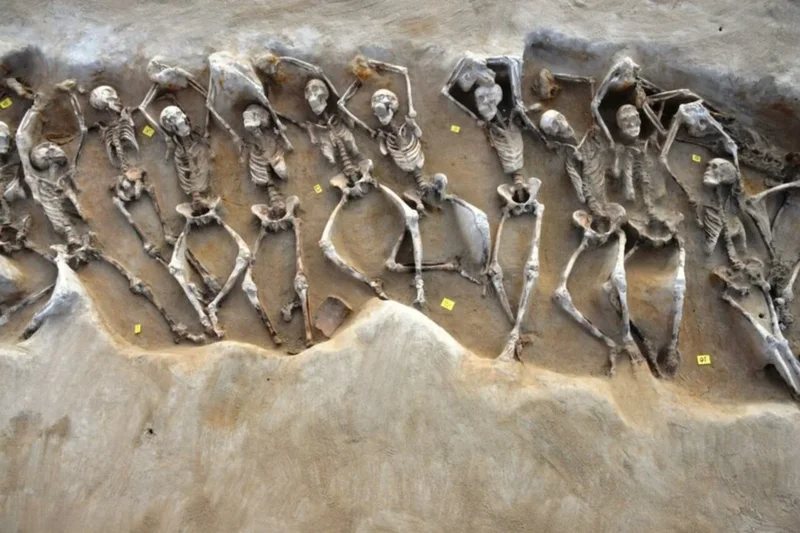
In 2016, archaeologists in Athens uncovered an Ancient Greek mass grave full of men buried in a heartbreakingly vulnerable position: with their wrists shackled and raised over their heads. We now have a better sense of who they were. Â
Researchers conducted isotopic analyses on 66 men from the so-called Esplanada grave, which dates back to the Archaic Period (~700 to 460 BCE), and discovered something surprisingâmost were from the surrounding region of Attica. In other words, they were locals, according to a study published last month in the Journal of Archaeological Science. The findings shed light on the identities of the victims but also hold broader implications for our understanding of the political and societal dynamics taking place in Athens right before ancient Greeceâs famous Classical Period (479-323 BCE).Â
Local or foreign victims?
All the major themes related to the Classical Periodâsuch as, most famously, democracyâactually develop out of the Archaic Period. âThatâs the first time democracy takes place in Athens,â Julianne Stamer, a bioarchaeologist at Arizona State University and lead author of the study, told Gizmodo. But not everyone agreed with this form of rule, and archaic Athens saw intense disagreement over whether the future city-state should be presided over by an aristocratic tyrant or the public.
Still, when the Esplanada grave came to light with its 79 men arranged in three parallel rows, researchers werenât sure what to make of it. Were they victims of these domestic conflicts? Or perhaps defeated foreign invaders? To settle the matter, Stamer and her colleagues turned to radiogenic strontium analysis.Â
âStrontum is an element that is found in the ground in relative abundance based on how old the rocks are and what kind of rocks they are,â Stamer explained. âBecause strontium isotopes get into our water and into our food, we all have some strontium isotopes in our teeth and bones,â she added. By measuring those isotopes, âwe can tell where people are from based on the geology of the surrounding area.âÂ
Very few outsiders
The team conducted radiogenic strontium analysis on 66 of the Esplanada men as well as 97 other people from the broader Phaleron burial ground that includes the mass grave. Their work revealed that the vast majority of them were locals. Among the men in the mass grave specifically, the analyses identified only two of them as outsiders.Â
âWe found that most people have a strontium isotope signature that appears to be from the wider Attica region,â said Stamer, bolstering the theory of them being victims of internal political violence. Still, âwe were very surprised about that because in this period, Athens and Greece in general are becoming more interconnected. We have a lot more trade going on.â This dynamic is, once again, a precursor to the sort of connections that later contribute to making Athens a mighty Classical power.Â
The Archaic burial ground itself is strongly associated with trade and travel. The Phaleron burial ground is right next to Athensâ ancient port, Phaleron, from which it takes its name. And yet the people buried there donât represent the sort of diversity one would expect from the years leading up to Athensâ extremely well-connected Classical Period.Â
Archaic dynamics
Not that Classical Athenians particularly liked diversity, either. In fact, they had very strict citizenship laws, but historians donât know if this was true during the previous Archaic Period, too. The isotopic analyses indicate that Attica might not have received many immigrants during this period. Perhaps this represents a dislike of foreigners during the Archaic Period that continues into the Classical Period despite the intense trade going on.Â
Moving forward, Stamer and the team are taking an even deeper dive into the identities of those buried at Phaleron, including what they ate.Â
By revealing where the Esplanada men were from, the recent study provides additional clues about what social and political life in Athens might have been like in the centuries preceding its most famous time period. And itâs pretty clear that it had some seriously dark moments whether or not you were an immigrant.Â