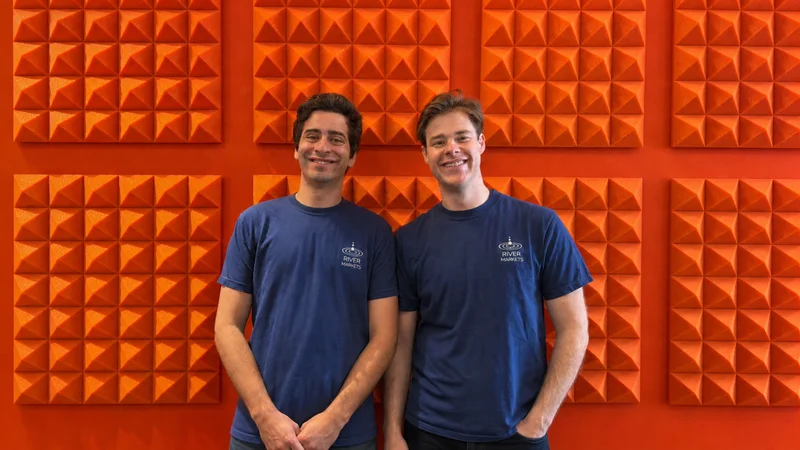
Prediction markets are getting serious. Once confined to casual betting, financial institutions now view them as valuable tools to hedge risks and trade on economic events. Yet this fast-growing industry remains scattered across numerous venues. That’s why startup River Markets launched a platform that gives professional traders a single place to trade across multiple prediction markets.
Co-founded by CEO Oscar Levy and CTO Antonin Parrot, River Markets announced Tuesday that it raised $8.5 million in a seed round led by Haun Ventures that closed in July. Y Combinator and Coinbase Ventures also participated in the fundraise, along with institutional backers like Qube Research Technologies and angel investors that work at Google, Nvidia, Novig, JPMorgan and Citadel. The founders declined to specify the valuation at which they raised the capital.
“This transition from mainstream retail to institutional can’t really be achieved with today’s consumer interfaces. That’s [why] somebody like us needs to come in and spend the time to make these accessible and familiar for all of these existing institutions and large traders,” Levy told Fortune.
The announcement aligns with a broader industry trend as institutions increasingly view prediction markets as financial tools. Kalshi, one of the industry’s largest platforms, said in May that institutional trading volume on its exchange had increased 800% over the previous six months. The shift is also showing up in the kinds of trades the platforms can handle. In April, Kalshi completed a block trade—a large, privately negotiated deal that lets a firm trade at size without moving prices in the public market—for a Houston environmental hedge fund seeking to trade on the outcome of a California carbon-allowance auction. In June, Polymarket completed a similar deal tied to GPU-rental prices, allowing a firm to hedge its exposure to computing costs.
According to River Markets’ founders, meeting that demand at scale requires technology that lets firms trade across platforms and handle larger orders. Since launching in May, the company has provided the software, data links, and risk-management tools firms need to do so, while its algorithms aim to limit price swings caused by large trades. Levy said the platform is on track to exceed hundreds of millions of dollars in annualized trading volume by year-end.
Building for institutional traders
Levy and Parrot met as students at UC Berkeley, where they became close friends over poker games and nights spent trading Japanese stocks. After graduation, both built careers in Wall Street’s quantitative-trading world: Levy became a vice president and quantitative specialist at BlackRock, working on multibillion-dollar portfolios, while Parrot focused on electronic trading at Morgan Stanley before becoming a quantitative researcher in high-frequency trading at Valkyrie Trading.
The pair came up with the idea for River Markets in 2023. While working full time, they spent weekends building trading software for platforms such as Kalshi and Polymarket. The technology soon generated seven figures in trading profits, prompting the duo to adapt it into an enterprise platform. But their own trading also exposed a major problem: the market was split across separate exchanges. Even when two platforms offered contracts on the same event, traders could not easily manage them together, making the process slower and more complicated.
Levy and Parrot believed most firms would need six to nine months to build the necessary software from scratch. So they turned their tool into River Markets to give institutions more reliable ways to trade.
“They have this ability to speak both to this esoteric market language and… solve the problems that traders are facing today in prediction markets, but they’re [also] thinking about it in a way that is informed by the experience they had building traditional trading tech,” said Mark Beylin, an investor at Haun Ventures.
The company plans to use the new capital to hire engineers, build faster and more secure trading systems, and expand its sales and operations teams as it adds professional clients. It also aims to develop tools that help institutions manage money and trade at a larger scale across prediction markets.
breaks the traditional barrier between audience and newsroom. The show transforms
Fortune DailyFortune’s trusted reporting into actionable, conversational, and entertaining insights for an emerging class of business leaders.
Watch here.