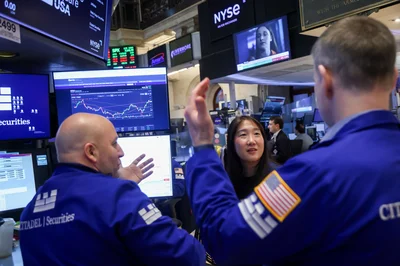
Here are the stocks moving in premarket trading: Nebius, Calix
Nebius and Calix are among the stocks making moves before the U.S. market opens as investors look ahead to a busy earnings week, which will see Alphabet, IBM, and Tesla report.
Take a look at the key stocks making moves in premarket trading on Tuesday:
- Nebius last surged nearly 6% after chip giant Nvidia disclosed a 9.3% passive stake in the AI infrastructure and cloud computing firm.
- Calix, the telecommunications firm, plummeted 15% after reporting second-quarter earnings on Monday.
— Sawdah Bhaimiya
Silver up 5%; Gold prices rise Tuesday as oil falls
Gold and silver prices rose on Tuesday as diplomatic efforts aimed at easing the U.S.-Iran conflict got underway.
Spot gold rose 1.3% to $4,059 per ounce shortly after 4:50 a.m. ET, while U.S. gold futures for August delivery were up 1.43% to $4,067 per ounce. Spot silver prices extended earlier gains to add 5%.
It comes as analysts say uncertainty over Fed policy grows amid persistent inflation linked to the U.S.-Iran war.
"We believe the gold market is still digesting hawkish signals from Fed Chair Kevin Warsh and the fixed income market's expectations for higher U.S. policy rates," UBS wrote in a note on Monday.
"Should US economic activity surprise to the upside, with new jobs indicating a tightening labor market and oil prices edging higher, the near-term outlook for gold would remain challenging, putting prices under renewed downward pressure."
— Joseph Wilkins
UK defense stocks rise after Healey named finance minister
U.K. defense and aerospace stocks jumped on Tuesday morning after John Healey was named finance minister by new prime minister Andy Burnham.
Babcock International surged 7.3% in morning trade, with Qinetiq rising about 3.8%. BAE Systems rose 3.3%, and Rolls-Royce Holdings added 1.6%.
Citi analysts said in a note that investors would see Healey's appointment as a positive for the defense sector.
Stock Chart IconStock chart icon
Babcock International.
Healey last month quit as defense secretary following a dispute over funding for the U.K.'s armed forces. In a blow to then-prime minister Keir Starmer, Healey accusing the government of being unable to commit resources to the U.K.'s defense and security amid rising global threats.
—Hugh Leask
Novartis shares jump after solid second quarter
Novartis shares rose 1.7% shortly after 8:30 a.m. in London (3:30 E.T.) after the Swiss pharma giant posted a beat on second-quarter core operating profits, amid strong sales of its cancer and multiple sclerosis treatments. It came as the rest of the European pharma sector traded broadly lower.
It comes as the drug maker continues to navigate patents expiring for key products.
Rajesh Kumar, Head of European Life Sciences \& Healthcare Equity Research at HSBC hailed the company's cost controls and its execution, but told CNBC there remains a risk over its clinical trial profile.
"The main risk now is around their readout in Pelacarsen, which has been delayed from last year to now first quarter, now second quarter, now hopefully this quarter," Kumar said. "That remains the main risk... for the bull case for Novartis. It's a very well run company. Execution is solid. It's just the clinical trial profile which is a bit of a risk here."
Abu Dhabi approves $6.2 billion gas project to boost UAE supply
Abu Dhabi's National Oil Company will invest $6.2 billion to develop the Umm Shaif Gas Cap, a massive offshore oil and gas field, as part of its strategy to expand natural gas production and liquefied natural gas exports.
Disruptions in the Strait of Hormuz, usually an avenue for around 20% of the world's LNG trade, have underscored the importance of the project and highlighted the vulnerability of global energy supplies.
Umm Shaif, Abu Dhabi's longest-operating offshore field, is being developed alongside TotalEnergies, Eni and China National Petroleum Corporation.
European equities open Tuesday's session higher
The pan-European Stoxx 600 advanced 0.14% shortly after 8:10 a.m. in London (3:10 E.T.).
Most major bourses on the continent notched early gains, with the Italian FTSE MIB rising 0.55%, Germany's DAX up 0.19%, and the French CAC 40 adding 0.15%. The U.K.'s FTSE 100 was down 0.31%.
Regional sectors were mixed, with technology stocks and mining names both up about 1.2%, while media companies tumbled 0.9%.
Asia-Pacific markets close in the green
Asia-Pacific markets closed in the green. Japan's Nikkei 225 added over 3% to 66,232.19, while the Topix rose 2.44% to 4,014.95. South Korea's Kospi advanced 3.56% to 6,747.95 while the Kosdaq edged up 0.49% to 753.34.
Australia's benchmark S\&P/ASX 200 was little changed at 8,793.3.
Mainland China's CSI 300 was up over 3% at 4,739.23, while Hong Kong's Hang Seng index rose 0.25% in the last hour of trade.
—Lee Ying Shan
European markets set for mixed open
European stock markets are set to start Tuesday's session in mixed territory.
London, the FTSE 100 was seen 0.56% lower ahead of the opening bell, dragged lower by the presence of several energy majors on the U.K. index as oil prices headed lower.
France's CAC 40 was set to open 0.17% lower in Paris, while Germany's DAX was flat ahead of the market open in Frankfurt. The Italian FTSE MIB was in positive territory, up 0.26% in Milan.
Futures tied to the Stoxx 50 were seen 0.1% higher.
— Hugh Leask
New U.K. finance minister Healey a ‘safe pair of hands’ amid fiscal pressure
Britain's former defense secretary John Healey leaves 10 Downing Street in London July 20, 2026 as cabinet appointments are being made after Andy Burnham became Britain's new Prime Minister.
Henry Nicholls \| Afp \| Getty Images
The U.K.'s new finance minister John Healey faces a formidable fiscal challenge as Prime Minister Andy Burnham looks to reshape Britain's economic model.
Healey — who was previously the U.K.'s defense minister, having previously held a junior role at the Treasury — replaces Rachel Reeves as Chancellor, in a surprise move by Burnham. Home Secretary Shabana Mahmood had earlier been widely expected to be handed the role, but will remain in her current post.
"Healey is widely regarded as a safe pair of hands who is likely to deliver on Burnham's agenda rather than pursue an agenda of his own," said Harry Woolman, global capital markets analyst at Validus Risk Management.
New Prime Minister Burnham took office on Monday, promising a "new economic model" for Britain, with a 10-year plan involving the reindustrialization of the country, and a more collaborative approach to politics. He is expected to outline further policy measures aimed at easing the U.K.'s cost-of-living burden, and how these will be funded, in a speech later Tuesday.
"This will no doubt be high on the new Chancellor's agenda for the foreseeable future," Woolman said.
However, Sanjay Raja, chief U.K. economist at Deutsche Bank, said the U.K.'s new Chancellor faces a tighter fiscal backdrop, with the looming Autumn Budget now set to be one of the important domestic policy events for markets this year.
"Headroom appears limited, with earlier buffers partly eroded by higher rates, a softer macro-outlook and renewed geopolitical risks," Raja said. "Energy prices have eased from their peaks, but renewed upward pressure remains a key risk."
— Hugh Leask
Treasury yields edge lower; analysts see room for rally despite geopolitical risks
U.S. Treasury yields edged lower across the curve on Tuesday. The benchmark 10-year Treasury yield slipped 0.6 basis point to 4.592%, while the two-year yield fell 1.1 basis points to 4.204%. The 30-year bond yield eased 0.3 basis point to 5.115%. Bond yields move inversely to prices.
BMO Capital Markets said the Treasury market has remained relatively steady despite the latest escalation in the Middle East, as signs of possible mediation tempered the initial jump in oil prices. With little U.S. economic data due this week, however, strategists warned that government bonds could remain vulnerable to abrupt moves in energy prices and developments in the Iran conflict.
"The degree to which nominal yields can decline will be tempered by the market's ongoing focus on the energy sector and geopolitical tensions," the BMO strategists said, adding that July and August inflation reports would be needed before investors could conclude that energy-driven inflation pressures had peaked.
—Lee Ying Shan
Oil prices ease as mediation hopes offset fresh Middle East tensions
Oil prices edged lower on Tuesday as investors balanced reports that the U.S. and Iran could be exploring mediation efforts against fresh military exchanges and new threats from Yemen's Houthis to impose a naval blockade on Saudi Arabia.
U.S. crude futures for August delivery fell 0.3% to $82.98 per barrel, while international Brent crude futures for September delivery declined 0.56% to $88.72 per barrel.
"While the Houthis have not yet clarified how the blockade would be enforced, their previous campaign against commercial vessels demonstrates both the capability and willingness to disrupt Red Sea shipping," Rystad Energy senior vice president Jorge Leon wrote in a note published Tuesday.
—Lee Ying Shan
China stocks slip, but Deutsche Bank sees structural tailwinds supporting second-half gains
Mainland China's CSI 300 was down 0.18%, while Hong Kong's Hang Seng index declined 0.18% in the first hour of trading.
Deutsche Bank chief investment officer for emerging markets Jacky Tang told CNBC he remains constructive on Chinese equities in the second half of the year, citing a combination of artificial intelligence, energy security investment, state-owned enterprise reforms and export-oriented companies as key tailwinds.
"We actually identified a few structural drivers to push the Chinese financial market in the second half of the year," he said, adding, "We think that China in the second half will continue to do well."
Year-to-date, the Hang Seng Index is down around 1.8% while the CSI 300 is about 0.3% lower, data from LSEG showed.
—Lee Ying Shan
Asia-Pacific markets open mixed
Asia-Pacific markets opened mixed on Tuesday.
Japan's Nikkei 225 added 0.8%, while the Topix rose 0.86%. South Korea's Kospi advanced 0.1% while the Kosdaq declined 0.72%.
Australia's benchmark S\&P/ASX 200 was down 0.58%.
— Lee Ying Shan
Asia markets set for mixed open as investors weigh Middle East tensions, fresh U.S. tariffs on Canada
Asia-Pacific markets were set for a mixed open on Tuesday as investors weighed rising geopolitical tensions in the Middle East, fresh U.S. tariffs on Canadian imports and higher oil prices.
Japan's benchmark Nikkei 225 was set to open higher, with the futures contract in Chicago at 64,965 against the index's last close of 64,141.12.
Futures for Hong Kong's Hang Seng index last traded at 25,099 compared to the index's last close of 25,143.05.
Futures for Australia's benchmark S\&P/ASX 200 were last at 8,717 compared to its close of 8,791.3.
U.S. President Donald Trump vowed Iran would face consequences following the deaths of three American service members, while Yemen's Houthi militants announced a maritime embargo on Saudi Arabia, raising fresh concerns over energy supplies.
Separately, the Trump administration unveiled an additional 50% tariff on a range of Canadian imports, accusing Ottawa of unfair trade practices across several U.S. industries.
Trump signed three proclamations imposing the higher duties on Canadian motor vehicles, alcohol and dairy products, with administration officials saying the measures were intended to address what Washington views as discriminatory treatment of U.S. exports.
— Lee Ying Shan
Stock futures open flat
U.S. equity futures were little changed to begin trading on Monday night. Futures tied to the Dow Jones Industrial Average ticked up 12 points, or 0.02%. S\&P 500 futures and Nasdaq 100 futures were down by 0.05% and 0.01%, respectively.
— Tanaya Macheel