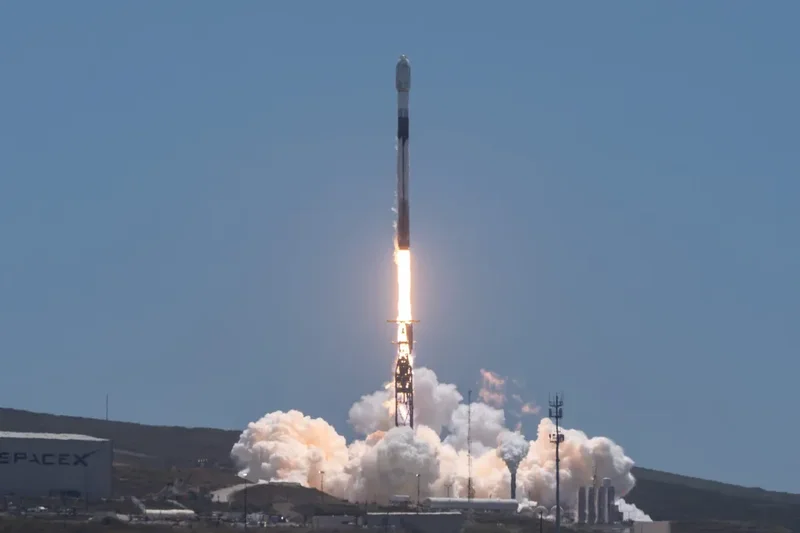
HUNTSVILLE, Ala. — The 2026 Space & Missile Defense Symposium opens this week against a backdrop that would have seemed unlikely only a few years ago: SpaceX is no longer simply the Pentagon’s dominant launch provider but is also becoming a central supplier of the satellite networks and communications infrastructure underpinning the military’s next-generation missile defense architecture.
Walking the exhibition floor, visitors still encounter a defense industry dominated by traditional missile and radar contractors. But as more missile defense functions migrate into space, more of the Pentagon investment is flowing to companies whose roots are in the commercial space sector, led by SpaceX.
Recent Space Force awards totaling roughly $8.1 billion place the company at the center of the Pentagon’s push under the Golden Dome program to build a layered missile-defense architecture.
The deals with SpaceX arrived in rapid succession.
In May, the Space Force awarded SpaceX a $2.29 billion contract to build the initial backbone of the Space Data Network, a secure, high-capacity communications architecture in low Earth orbit designed to move data among military sensors, command systems and weapons. The service expects a fully operational prototype by the end of 2027, an aggressive schedule that favored a company with an existing satellite platform, optical communications network and high-rate production capability.
Days later, the Space Force selected SpaceX for a separate $4.16 billion contract to build the initial constellation for its space-based Airborne Moving Target Indicator, or AMTI, program. The satellites are intended to provide persistent tracking of aircraft and other airborne targets from orbit, shifting a mission traditionally performed by surveillance aircraft into space.
The momentum continued in late July when the Space Force placed an order worth $1.6 billion for 18 Falcon 9 launches under National Security Space Launch Phase 3 Lane 1 to deploy satellites supporting its Space-Based Sensing and Targeting portfolio through the end of 2027. Service officials completed the acquisition in roughly two months, an unusually compressed timeline for a procurement of that size.
Starshield business
In its first quarterly financial report last week as a public company SpaceX identified Starshield as a rapidly growing government business, citing more than $6 billion in multiyear awards for military communications and sensing networks. By grouping the Space Data Network and AMTI contracts under the same national security business, the company signaled that it sees those programs as part of a common military architecture rather than separate procurements.
SpaceX manufactures satellite buses and optical communications terminals, develops military spacecraft through Starshield and launches those satellites. Much of the integration work that historically required multiple contractors occurs within a single company.
In Golden Dome, that integration could prove to be an advantage.
Because SpaceX builds satellites, manufactures key communications hardware and launches its own spacecraft, it can coordinate production schedules, launch manifests and constellation deployment in ways that conventional procurement models, where separate companies provide satellites and launch services, often cannot.
The Pentagon nevertheless maintains that competition remains a central objective.
Space Force officials have said they intend to field modular architectures supported by multiple suppliers. But near-term acquisition decisions emphasize mature technology, lower nonrecurring engineering costs and delivery schedules measured in months rather than years.
With the Space Force seeking to field an operational Space Data Network backbone by the end of 2027, officials have little room for developmental risk.
At the same time, the service is taking steps to broaden the industrial base to avoid relying exclusively on any one supplier.
The Space Force last week announced contracts totaling $615 million to Rocket Lab, Systems & Technology Research and a third undisclosed company as part of a second task order under the AMTI program. While far smaller than SpaceX’s award for the initial constellation, the contracts are intended to evaluate alternative sensing approaches and expand the program’s supplier base.
“The core focus of this second task order is diversifying our capabilities and ensuring we don’t rely on a single technical solution,” Col. Ryan Frazier, acting portfolio acquisition executive for Space-Based Sensing and Targeting, said when the awards were announced. The additional companies are intended to explore “fundamentally different ways” of accomplishing the mission while preserving long-term competition as the architecture evolves.