Inside the growing rift between Iran’s dealmakers and ultraconservatives
Iran’s political landscape appears to have entered a new phase as two competing camps emerge: those advocating a deal with the United States and those determined to block any agreement.
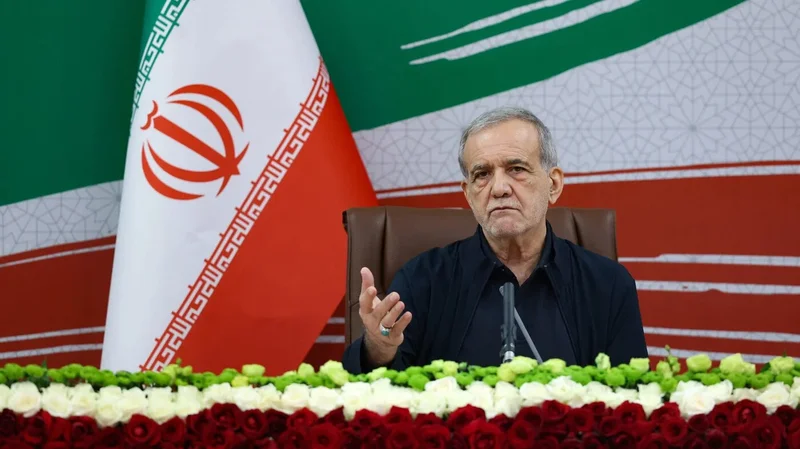
Principlists have intensified their pressure on reformist President Masoud Pezeshkian and conservative Parliament Speaker Mohammad Baqer Ghalibaf, both of whom are seeking to reach an agreement with Washington and bring an end to almost six months of hostilities.
Principlists fear that any deal could marginalise them politically and weaken their influence over Iran’s future direction.
It was in this climate that a leaked video of Mohammad-Bagher Kharrazi, the brother-in-law of Masoud Khamenei, the younger brother of Iran’s supreme leader, emerged as part of what critics describe as a broader hard-line campaign.
In the video, Kharrazi claimed that Supreme Leader Mojtaba Khamenei had “formally and publicly announced” that if Pezeshkian attempts to resign one more time, his resignation would be accepted.
Kharrazi said that Pezeshkian, who he said had threatened resignation “27 or 28 times”, “no longer dares” to raise the issue.
He added that Foreign Minister Abbas Araghchi had been completely sidelined from negotiations with the United States after an order from Khamenei.
In response, the public relations office of the supreme leader denied, without directly naming Kharrazi, the reported remarks attributed to him regarding the president’s resignation.
Soon afterward, however, another audio file surfaced in which Ali Saeedi, a conservative senior figure close to the Khamenei's office, claimed that the supreme leader had expressed support for the negotiations and criticised hard-line opposition to diplomacy.
According to Saeedi, Khamenei told one of his brothers: “I have never opposed negotiations, and I still do not. I was the one who authorised the negotiations, and I am not satisfied with the hard-line positions adopted by some people.”
Saeedi also claimed that Khamenei supports Ghalibaf, saying: “He is like [the late Quds Force commander] Haj Qassem Soleimani.”
Behind the curtain of the power struggle
A senior reformist source told Middle East Eye that principlists had not initially wanted Khamenei to succeed his father, instead favouring their own candidates for Iran’s top leadership post.
According to the source, their preferred options included the late president Ebrahim Raisi, who was killed in a helicopter crash, and hard-line cleric Mohammad Mahdi Mirbaqeri, who advocates a civilisational confrontation with the West and views many forms of modernity and western-origin technology negatively.
The source added that, in recent years, principlists had repeatedly targeted members of Khamenei’s inner circle, including Mahdi Khamoushi, who has been tipped as a possible future chief of staff to the supreme leader, accusing them of corruption in an effort to undermine their credibility.
'They want to turn Pezeshkian and Ghalibaf into political outcasts and ultimately push the supreme leader into turning against them'
- Reformist political analyst
“Mojtaba may also hold some hard-line views,” the source said, “but he was not the figure leading ultraconservatives over the past decade.”
“Instead, he was involved in a succession struggle in which influential hard-line figures, including Raisi’s camp, acted against him. However, [US President Donald] Trump’s war changed the political dynamics and created a more favourable environment for Mojtaba.”
A conservative source told MEE that principlists are now attempting to mobilise conservative and hard-line supporters against Ghalibaf, portraying themselves in the eyes of Khamenei and religious class as the only reliable protectors of the leader.
The source said that, as part of this strategy, principlists have repeatedly attempted to weaken Ghalibaf by accusing him of bypassing the supreme leader.
However, Khamenei continues to trust and support Ghalibaf, the source said, adding that if the supreme leader had lost confidence in him, he would have removed him from his role overseeing negotiations with the US.
Political outcasts
A political analyst at a reformist newspaper told MEE that principlists are determined to preserve their grip on power, and that their most effective strategy is to remove Ghalibaf and Pezeshkian from the political equation.
“They want to turn these two figures into political outcasts and ultimately push the supreme leader into turning against them,” he said.
The analyst said ultraconservatives are also likely to continue obstructing negotiations, because they believe any agreement with the US would significantly weaken their influence by empowering more moderate political forces.
"But the ultraconservatives lack sufficient influence within Iran’s key centres of power to achieve this on their own," the analyst said. "As a result, they have increasingly relied on their grassroots base to fill that gap.
“It is in this context that they have staged a series of angry sit-ins and protests targeting the negotiators, seeking to raise the political cost for both Pezeshkian and Ghalibaf.”