There are things a body remembers long after the mind has stopped speaking about them. Like the weight of a wet sari, smell of cotton after rain or the feel of soil beneath fingernails. A body can carry a village, and a history.
The eighth act of At the Still Point (ATSP), a community-funded dance platform that fosters important conversations through the work of contemporary artists, was themed Be.long.ing and held on July 31 and August 1 at Kolkata’s Urban Theatre Project and Goethe-Institut, Max Mueller Bhavan. The programme explored performance practices rooted in soil, sovereignty, Nature and community, featuring the Gram Art Project from Madhya Pradesh, and Manipuri artist Surjit Nongmeikapam.
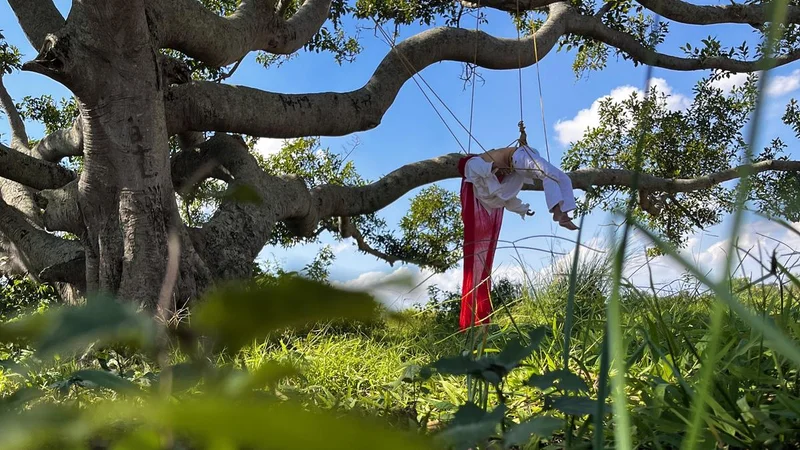
The two works presented this year, are Cotton Stainers, a performance by the women of the Gram Art Project collective , where they bring their own lives into the performance, and Fountain, where Manipuri contemporary dancer and performance artiste Surjit suspends himself mid air, turning the body into an unspeaking yet silently eloquent instrument of resistance.
Two performances, two spectrums
Gram Art Project’s performance is a collective testimony. Paramita Saha, curator and director, At the Still Point reads out what the women wish to say through their act, “We, the women, from the Gram Art Project Collective, are sharing our hopes, dreams, memories, secrets, burdens and stories of the brunt we have borne for being rural women of an average Indian village.”
They come from Paradsinga, a village in Madhya Pradesh’s Chhindwara district where migration, poverty, patriarchy, aspiration and tradition exist alongside one another. Young people leave in search of work, families remain tied to farming even when farming becomes increasingly difficult. Old beliefs persist and new ambitions arrive. The women are not using an imagined rural India as a backdrop, they are speaking from inside it.
The performance holds these contradictions together. Before the women of Gram Art Project began their deeply evocative dance performance, a sindoori seed (Bixa orellana )was placed in the palm of each one in the audience.
Brought from the jungle, or the very ecosystem that the women inhabit, the audience is asked to hold it, dip it in water and spend a little time with it. By this time someone in the audience has even consumed it. This prelude to the performance changes the room. One is no longer just a passive spectator, the very earth, the sky and the winds that have reverberated around the seed become part of the atmosphere of that one evening in Kolkata.
The Gram Art collective’s Tanmay Joshi and Aditi Bhattad then go on to speak of koos ghas, or spear grass, whose seed can take root almost anywhere, even in barren land. It is highly inflammable. Fire can consume what is above the ground but the roots survive the flames. With the first drop of rain, the seed is said to become “jagruk” or conscious quite literally. For, it moves towards water. It “dances”, “walks towards the rain”, “sews itself”. The seed exhibits a form of intelligence that does not need human intervention or navigation.
This idea sits at the heart of Cotton Stainers, a dance performance held in two slots on July 31 at The Urban Theatre Project in South Kolkata’s Bhowanipore area.
The women from the dollective are all farmers and artistes. And they like to mention the two professions interchangeably because, as Paramita points out, “farming too is an art, a dance, isn’t it?”
Their 60-minute performance was deeply unsettling in a way that asks us difficult, terrible and real questions on being tethered, untethered and about who we as people belong to. Nothing was said out loud, only a handful of dates were spoken, along with locations which were different quarters of the home where acts of violence had taken place.
One moment was particularly arresting. Shweta Bhattad, one of the performers of the collective, held a gun while the event photographer raised his camera. For a few suspended seconds, they looked directly at each other, collapsing the fragile boundary between performance and reality, between the act of witnessing and the act being witnessed. Then two shots from the camera and the gun rang out leaving thoughtful reverberations across the room.
The second performance was by artiste and contemporary dancer Surjit Nongmeikapam from Manipur’s Imphal. His practice has long moved between movement, memory, identity and the cultural life of the place he comes from. He calls his approach Yangshak Movement — The Art of Practice, a phrase that suggests something unfinished: movement as research, as discipline, as a way of asking questions.
In his performance called Fountain, the body becomes suspended between worlds . Around him comes the sound of his environment. The work uses sounds by Chaoba Thiyam and NAF collective sounds, with text by Babina Chabungbam and Suresh Khurajam. Video footage from Nongmeikapam’s own works enters the piece.
The artiste describes his work as a “body experimental performance”, a form that begins where words sometimes fail. When an experience is too difficult, too intimate or too complex to articulate, he suggests, the body finds its own language.
For much of the performance, Surjit levitates, his body suspended between ground and air. It is a striking physical image, but it carries the weight of something larger. The work subtly echoes the troubles that have unsettled Manipur for years, leaving people caught in a state of uncertainty and dislocation. Surjit’s body seems to inhabit that same condition for it is unable to settle, unable to descend and remains held in suspension.
In Surjit’s performance, levitation becomes a metaphor for a people denied the simple assurance of firm ground beneath their feet.
An art platform that asks us to listen
At the Still Point (ATSP) was founded by Artsforward, the arts wing of Paramita’s practise and they call themselves India’s first community financed formal arts platform. ATSP asks audiences to become stakeholders in the making of art. Its history has included works by artists such as Mandeep Raikhy, Diya Naidu, Avantika Bahl, Satakshi Nandy and Ronita Mookerji, among others.
Paramita says that when commercial logic determines the work, difficult questions can become difficult to fund. ATSP’s crowd funded model proposes that communities can decide what kinds of artistic conversations they want to sustain. Cotton Stainers
One performance begins with seeds in hand, the other with a body that cannot find the ground. One asks what the earth gives us, the other, what happens when the earth no longer feels certain beneath us. Two distant worlds arrive and they meet somewhere in the small, tender country of the watching eye.
Published - August 11, 2026 08:06 pm IST