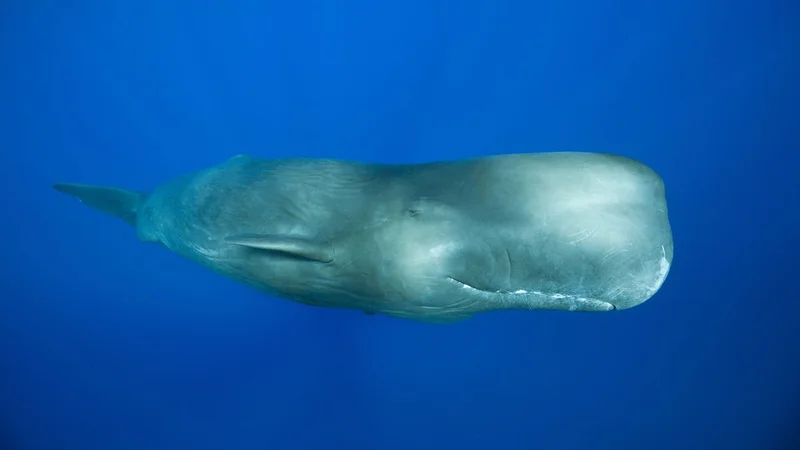
Sperm whales make the loudest communication sound of any animal on Earth, researchers find — but they aren't sure why.
In a new study, researchers investigated the mysterious, low-frequency clangs made by male sperm whales and found that they were louder than any known sperm whale communication signal, with the potential to be heard by other whales around 43 miles (70 kilometers) away.
They are very loud and metallic sounds that almost sound "like a jail door slamming," which is "why they are also called clangs," study first author Simone Videsen and co-author Peter Teglberg Madsen, biologists at the Center for Active Sensing with Sound at Aarhus University in Denmark, told Live Science in an email. "You feel small as a human when you hear them, as they are clearly made by something bigger than you," they said.
Sperm whales (Physeter macrocephalus) are the largest toothed predators, growing up to around 59 feet (18 meters) long. They dive deep into the ocean to hunt giant squid (Architeuthis dux) and other prey that dwell as low as 1.9 miles (3 km) below the ocean surface.
The distinctive clangs, first reported in the 1980s, are the loudest communication signal that sperm whales make, although they can produce even louder echolocation clicks to locate prey during hunts. The clangs are unusual because they are made only by males and represent an extreme form of communication that scientists still can't fully explain.
In the latest study, the researchers used hydrophones (underwater microphones) off the Seychelles to measure the sound level of the clangs. They also studied the rhythm of the signals in recordings collected in other locations, including off Sri Lanka, Norway and Scotland.
The recordings revealed that the whales kept up a slow, low-frequency rhythm, unlike the short, rhythmic clicks that both males and females make for typical social communication or the clicks used in echolocation. In fact, the rhythm was so slow that males left a gap of 5 to 10 seconds between each clang. That might not sound that impressive — but as far as we know, whales can't count to 10, so they are using another means to keep up this rhythm. According to the study, the whales might be relying on the echoes of the clangs bouncing off the seafloor.
Get the world’s most fascinating discoveries delivered straight to your inbox.
Sperm whales can produce these record-breaking acoustics thanks to their ginormous noses — the largest of any animal — that dominate their massive heads, which make up about one-third of their body length. To make the clangs, male whales use their "phonic lips" — structures in their noses that snap together.
RELATED STORIES
- 'Weirdos of the sperm whale world' appear to be evolving 2 different dialects, audio recordings suggest
- 'They would come in with a chord change': Composer Jim Nollman has collaborated with turkeys, kangaroo rats and whales. Now he's dropping 'Orcas' Greatest Hits.'
- Scientists find rare tusked whale alive at sea for the first time — and shoot it with a crossbow
"They make [these noises] by forcing pressurized air through so-called phonic lips in their giant sound producing nose," Videsen and Madsen said.
The researchers proposed a few possible explanations for why the whales might be making the long-range clangs. For example, the males might be using the sounds to attract mates or scare off other males.
However, the communication may exist for another, unknown reason. In future studies, the researchers hope to learn more about this mysterious form of communication by playing recordings of the clangs underwater and seeing how nearby sperm whales respond.
Patrick Pester is the trending news writer at Live Science. His work has appeared on other science websites, such as BBC Science Focus and Scientific American. Patrick retrained as a journalist after spending his early career working in zoos and wildlife conservation. He was awarded the Master's Excellence Scholarship to study at Cardiff University where he completed a master's degree in international journalism. He also has a second master's degree in biodiversity, evolution and conservation in action from Middlesex University London. When he isn't writing news, Patrick investigates the sale of human remains.