Fiat and Citroen’s Australian pullback could be just the start as Chinese EV surge
Save
You have reached your maximum number of saved items.
Remove items from your saved list to add more.
AAA
Fiat’s decision to halt imports of passenger cars to Australia could mark the start of a wider shake-up of the local automotive market, analysts say, as the rapid expansion of lower-cost Chinese rivals led by BYD squeezes smaller, established brands.
The Italian carmaker, owned by Stellantis, has confirmed it has no immediate plans to import more Fiat 500e or Abarth 500e electric hatchbacks once existing stock has been sold, leaving the Ducato and Scudo vans as Fiat’s only remaining models on sale in Australia.
Electric carmaker BYD transported about 5000 vehicles to Australia on its custom-built ship.Joe Armao
The move follows a 30 per cent drop in Fiat’s local passenger car sales to just 144 units in the six months to June, and comes as established brands face mounting commercial pressures in an increasingly crowded and competitive Australian car market. More than 20 new brands have entered the country over the past decade, the majority from China, including BYD, MG, Great Wall Motor, Chery and Zeekr.
On Tuesday, China’s XPeng revealed plans to launch five new vehicles in Australian showrooms over the next six months alone.
Despite the influx of competitors, Australia’s overall vehicle sales have remained broadly stable, meaning a growing number of brands competing for essentially the same pool of buyers, said Mike Costello, an industry analyst at Cox Automotive.
“It’s a simple equation,” Costello said. “If the overall market doesn’t grow much, and you already have a very competitive marketplace that is growing significantly by a third or so, there are only so many sales to go around.”
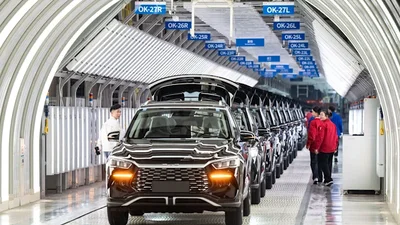
China has made 45 per cent more electric vehicles this year.Getty Images
The future of another Stellantis brand, Peugeot, has also been thrown into uncertainty after it parted ways with its Australian distributor earlier this month amid a steep fall in sales.
But even larger brands, such as Honda, Nissan and Mitsubishi, are at risk of facing “serious challenges” in Australia over the coming years, according to Riz Akhtar, the founder of electric vehicle consultancy Carloop.
“We have already seen the departure of Citroen, and now others are starting to see the pressure – brands that have been in the country for decades,” he said.
Chinese manufacturers have shaken up the Australian car market’s economics, bringing models priced close to – and in some cases below – those of comparable petrol-powered cars, making it difficult for smaller-volume European and Japanese brands to compete.
Akhtar said many Chinese car brands were also arriving with the latest technology and safety features, while offering significantly shorter delivery times than some rivals, whose customers often still had waitlists of 12 to 18 months.
“Manufacturers that can provide vehicles that are cheaper to run, cheaper to own, and cost a lot less than traditional car market offerings are all starting to hit the market at the same time,” he said. “Unfortunately, most of the legacy brands don’t have the products that the market demands right now.”
Electric vehicles are surging in popularity across Australia, accounting for about one in four new car sales last month, as more motorists sought to insulate themselves from petrol and diesel prices that have risen sharply due to the war in Iran. When plug-in hybrid electric models are included in the count, electric vehicles make up nearly half of Australia’s new vehicle sales.
Chinese giant BYD, which makes electric vehicles and plug-in hybrid electric vehicles, has almost toppled Toyota as Australia’s most popular brand.
A Stellantis spokesperson on Tuesday said the availability of models in specific markets, including Australia, could change over time as the company assessed demand and future opportunities.
“We remain focused on ensuring the vehicles we bring to Australia meet customers’ expectations,” the spokesperson said. “We continue to support our Fiat and Abarth customers and dealer network and look forward to sharing more information about Fiat’s and Abarth’s future plans in Australia at the appropriate time.”
Australia’s lack of tariffs and other trade barriers since the closure of large-scale domestic car manufacturing has helped make it one of the most open car markets in the world. “The United States’ market is 15 times bigger than ours, yet Australia has more brands to choose from than they do,” Costello said. “There is a general expectation that there are probably too many brands in Australia already.”
Costello said there was a sense of inevitability in the Australian car market that more car brands would exit over time. “These things do take time; brands will do everything in their power to stick it out,” he said. “But most people who study the market will say there will be more brands over time that do disappear – some of those will be familiar brands that people know, and some might be Chinese brands.”
The Business Briefing newsletter delivers major stories, exclusive coverage and expert opinion. Sign up to get it every weekday morning.
Save
You have reached your maximum number of saved items.
Remove items from your saved list to add more.
Nick Toscano is a business reporter for The Age and Sydney Morning Herald.Connect via X or email.