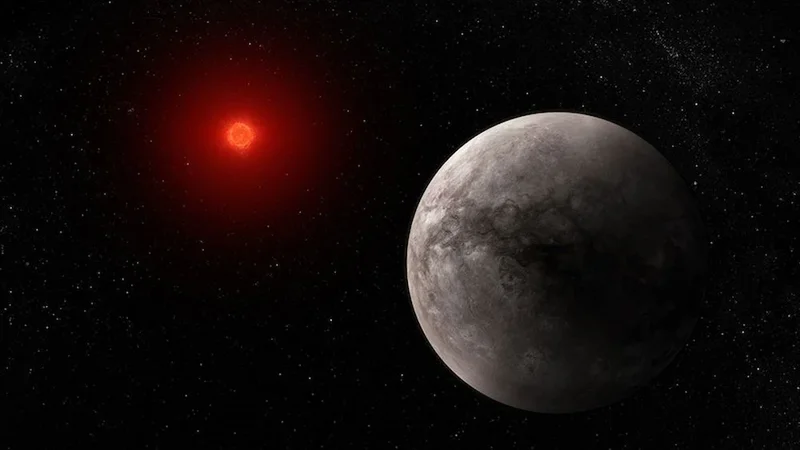
The Habitable Zone concept is useful for understanding which worlds might, possibly, maybe, be habitable. It highlights exoplanets in the right distances from their stars for liquid water to potentially exist on its surface. But that alone can't determine habitability.
Habitability, and the eventual evolution of complex life, requires sustained conditions, and that means a sustained atmosphere.
Plenty of research in recent years has touched on how exoplanets can lose their atmospheres due to extreme stellar UV radiation. Red dwarfs take center stage in this ongoing issue. Because they're so dim, red dwarf habitable zones are close their stars, so any potentially habitable exoplanets are so close to the stars that they're exposed to red dwarfs' extreme radiation and flaring. But the danger extends beyond just red dwarfs (M-dwarfs) EUV photoevaporation can strip away tens or hundreds of Earth-size atmospheres from an exoplanet in only a few million years, rendering them inhabitable.
However, there's much we don't understand about EUV and coronal mass ejections (CME) and how they alter, shape, or destroy planetary habitability. A new proposed NASA mission is aimed at these gaps in our knowledge. The conceptual mission is called the Extreme-ultraviolet Stellar Characterization for Atmospheric Physics and Evolution (ESCAPE) mission.
The details of the mission proposal are in new research titled "ESCAPE: a small explorer mission to study the stellar drivers of exoplanet evolution." The lead author is Allison Youngblood, a research astrophysicist at the Exoplanets and Stellar Astrophysics Laboratory at NASA's Goddard Space Flight Center. The research is currently available at arxiv.org.
"The long-term stability of exoplanetary atmospheres depends critically on the extreme-ultraviolet (EUV) photon and high-energy particle fluxes from the host star, which are poorly constrained," the paper states. "To address this key gap in our understanding of atmospheric retention, we present the Extreme-ultraviolet Stellar Characterization for Atmospheric Physics and Evolution (ESCAPE) mission, a NASA Small Explorer concept proposed in 2026."
To understand atmospheric loss, astronomers work with the idea of the Cosmic Shoreline. It's a line that divides planets that can retain their atmospheres from those that can't. On one side of the line are planets with thick atmospheres like Earth and Venus. On the other are airless worlds like Mercury.
This graph shows the Cosmic Shoreline. It plots planets by XUV radiation and escape velocity. Those below the line can retain their atmospheres while those above the line lose theirs. Image Credit: By ESA/Hubble, CC BY 4.0, https://commons.wikimedia.org/w/index.php?curid=167925665
ESCAPE will use extreme- and far-ultraviolet spectroscopy to examine EUV and CMEs. The goal is a deeper understanding of how EUV and CMEs drive atmospheric mass loss and how they can determine the habitability of rocky exoplanets. ESCAPE will work in the 80â1650 angstrom range. EUV is ~80â825 angstroms, and FUV is ~1280â1650 angstroms.
ESCAPE won't focus intensely on a small number of single targets. Instead, it's a broader general observer program aimed at understanding long-term habitability and how exoplanets can sustain their atmospheres. ESCAPE's data will create more well-constrained models that exoplanet scientists can use in the future. The authors write that "a critical knowledge gap to fill over the coming decade is determining what fraction of temperate, rocky planets around stars of different stellar types can develop and retain atmospheres capable of supporting long-term habitability."
To fill this gap in knowledge, ESCAPE will ask three questions:
- What is the EUV irradiance in the habitable zone?
- How does stellar EUV irradiance evolve in time?
- What are the properties of stellar coronal mass ejections?
Currently, exoplanet scientists use three separate models to try to understand how stars drive atmospheric mass loss. But when using them, they can arrive at mass loss rates that are different from one another by a factor of ten. Our closest neighbour, the M-dwarf Proxima Centauri, illustrates the problem.
This figure shows how the three models for estimating mass loss due to stellar EUV can arrive at very different estimates. "Different reconstructions show orders-of-magnitude flux discrepancies: two differential emission measure models in gray and orange, X-rays in yellow, and a semi-empirical model in blue," the authors write. Image Credit: Youngblood et al. 2026.
"ESCAPE addresses the factor of >10 differences in predicted atmospheric mass loss rates by directly measuring both the present-day EUV irradiance from specific FGKM stars and the stellar EUV evolution as a function of mass," the authors write.
Over its 2-year mission, ESCAPE will use its single instrument to perform two separate surveys. One is Stellar Euv ENvironments (SEEN) and the other is the Dedicated Euv Eruption Program (DEEP).
SEEN is like a snapshot survey that will observe 276 F, G, K, and M-dwarf stars for 12 kiloseconds (3 hours and 20 mintes) per star. It'll gather data for their ages and their EUV and FUV luminosities as a function of their ages and masses. SEEN will address science questions 1 and 2.
DEEP is a monitoring survey that will observe 24 F, G, K, and M-dwarfs for 1 Megasecond (278 hours) each. It'll measure the CME rate for each star and EUV flaring frequencies. DEEP will address science questions 2 and 3.
The ESCAPE mission has a predecessor, the Extreme Ultraviolet Explorer (EUVE), which ended 25 years ago. ESCAPE will more than 50x as sensitive as EUVE, and that will also let the spacecraft do science beyond its 2-year core mission. "An extended mission consisting of a General Observer (GO) program could address many additional science objectives within and beyond astrophysics," the authors write.
ESCAPE will let astronomers study comets and how the Sun's EUV affects them and their volatiles when they're in the inner Solar System. "Key cometary species to be observed include He, H, O, Fe, C, N, Mg, Si, S, and Ne," the authors write. ESCAPE can also study interstellar comets, allowing comparisions between their off-gassing and that of Solar System comets. "These measurements can be further compared with protoplanetary disks observed around distant stars, potentially connecting interloping comets with the types of systems from which they derive," the researchers explain.
This side-view schematic shows the ESCAPE instrument and its major components. The diffraction gratings split the light into its component wavelengths. The MicroChannel Plate (MCP) Detector measures individual photons. Image Credit: Youngblood et al. 2026.
ESCAPE can also gather data on known non-habitable exoplanets. Even though they're not habitable, many of them are in unusual situations and have been shaped by exposure the EUV and FUV. "The mission of ESCAPE to measure the spectroscopic EUV and FUV output of about 300 FGKM stars will have far-reaching impact on our understanding of all planets and their atmospheres, not just the habitable rocky ones we are pushing towards with HWO," the authors write.
An ESCAPE extended mission could also allow the study of hot white dwarfs, interacting binaries, the local interstellar medium, and more.
The ESCAPE mission is more evidence that exoplanet science is advancing. Though discovering more exoplanets will always be important, much of the scientific focus is shifting from detection to understanding habitibility on a deeper and more detailed level.
"Heliophysics, Earth science, and planetary science have long recognized solar EUV and CME observations as essential for understanding orbiting planets, and ESCAPE closes this major observational gap for exoplanetary science," the authors write. "By combining stellar observations with planetary atmosphere models, ESCAPE will enables us to understand other worlds in context; interpreting current observations of all types of exoplanets and providing a roadmap for NASAâs habitable exoplanet characterization missions of the future."