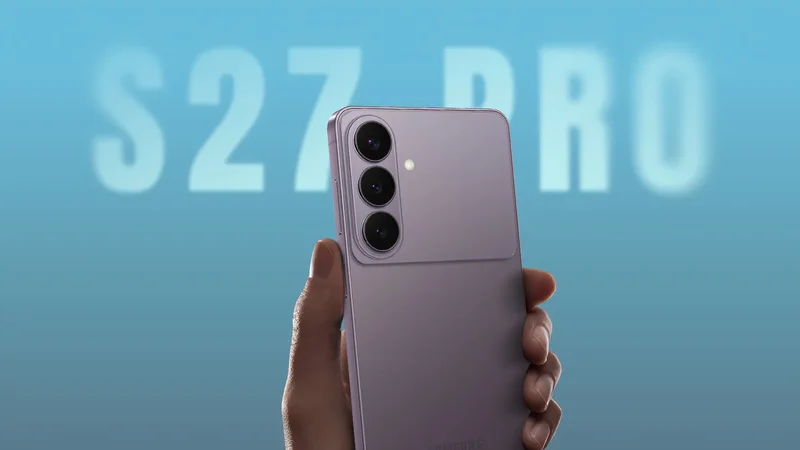
The recent supply chain data regarding the Samsung Galaxy S27 Pro's camera setup was "disappointing" to many, who were hoping for a compact yet capable flagship.
The ongoing chip shortage and Samsung's recent BOM (Bill of Materials) optimization strategy can easily explain this decision.
However, a more promising explanation emerges when you compare the leaks surrounding next year's Pro and Ultra models side by side.
Samsung seems to have engineered away the "Which one is better?" debate between the S27 Pro and S27 Ultra, and it's more important for the series than most people would probably think.
Samsung's strategy becomes clear when you compare the two
The Galaxy S27 Pro wasn't supposed to outshine the Ultra
Supply chain information reveals the Galaxy S27 Pro is getting a 12MP 3x telephoto, a 200MP main camera, and a 50MP ultrawide.
The Galaxy S27 Ultra, on the other hand, has been in the news for a long time. It's removing the 3x telephoto instead of upgrading it.
The rest of the cameras are familiar: a 200MP main, a 50MP ultrawide, and a 50MP 5x periscope telephoto.
The main camera is getting a new sensor, but it's expected to be the same on both the Pro and Ultra.
You probably understand why Samsung has kept the "Plus" model in the lineup. It makes it much easier to justify the Ultra's price tag, even if you have to stretch your budget.
But what if the Pro model appears more appealing than the Ultra? Supply chain information from earlier this year indicated that Samsung was testing a Galaxy S27 Pro prototype with a 3.5x ALoP telephoto camera having a 50MP sensor.
The purpose of Samsung's ALoP (All Lenses on Prism) technology is to reduce the protrusion of the camera module for a given sensor size and focal length.
The Galaxy S27 Pro looked like a compact yet capable flagship, one with a more practical zoom setup than the Ultra.
But the pricing ladder was never meant to encourage you to climb downward.
The earlier prototype with a 3.5x ALoP camera seems to have been shelved, and the latest supply chain details do not create the same excitement as the previous one.
This is bad news for the Pro, but it allows the Ultra to stand out.
Samsung's smartest move with the Galaxy S27 series
The Pro and Ultra are designed to avoid direct comparisons
Differentiating the Pro and Ultra is not something we're seeing for the first time in the industry. What's genius is the way Samsung appears to have implemented it.
You can't compare apples with oranges, or the S27 Pro's zoom setup with the S27 Ultra's.
A side-by-side comparison between a 12MP 3x telephoto and a 50MP 5x periscope telephoto would be unfair and somewhat pointless.
When you can't compare the numbers or the results, you're more likely to judge each phone on its own merits.
That gives Samsung the opportunity to tell you how the Galaxy S27 Pro can close the distance between you and your subject thanks to a new telephoto and a more intelligent image-processing pipeline.
The Ultra, meanwhile, will have a different story to tell: unmatched zoom capabilities and the best camera Samsung has to offer.
The Pro only needs to look "sweet," neither weak nor like a competitor to the Ultra. And in my opinion, Samsung has already nailed it.
The situation would have been different if the Galaxy S27 Ultra had included the same 3x telephoto camera as the S27 Pro or the S26 Ultra.
Removing the 3x camera creates a new problem
Digital zoom still has to cover the gap
The change doesn't eliminate the need for intermediate zoom. It shifts that burden to the main camera and Samsung's AI.
Let's look at the widely rumored camera setup of the Galaxy S27 Ultra again.
It has a 50MP ultrawide, a 200MP main sensor, then jumps straight to a 5x periscope telephoto. What happens when you zoom to 3.5x or 4.1x?
The argument I see online is that the 200MP resolution is enough to replace the 3x telephoto. While it sounds convincing at first, it isn't that simple.
All existing Galaxy flagships with a 200MP main camera shoot at 12MP resolution by default, and there's a good reason behind it: signal-to-noise ratio.
Therefore, relying on the main camera for intermediate zoom has limitations.
There's still some uncertainty surrounding the main sensor choice for the Galaxy S27 Ultra (and the Pro).
But it's unlikely that even the rumored 1/1.12-inch ISOCELL HPA would deliver consistent image quality across the entire 1x to 5x zoom range using digital zoom alone.
The S27 Ultra can handle digital zoom in two ways: crop the 200MP output (more noise), or bin to 12MP before cropping (less detail). Physics still applies.
Samsung is likely to double down on AI-powered image enhancement for the 1x to 5x zoom range to make images look sharper, more detailed, and less noisy.
We'll also likely hear some new branding for this intermediate digital zoom range.
Rather than calling it plain digital zoom, Samsung could rebrand its intermediate digital zoom with a dedicated marketing name to distinguish it from conventional digital zoom.
It would improve an imperfect source. But it should not match the output of proper telephoto hardware at this point.
Still, Samsung removed the telephoto instead of upgrading it. There must be a convincing reason behind this decision.
The real reason Samsung removed the 3x telephoto
Product differentiation mattered more than camera upgrades
To me, it looks like a compromise to the camera prowess of the Galaxy S27 Ultra.
Sure, removing the Ultra's 3x telephoto would allow Samsung to redesign the camera layout. It was also projected to make room for magnets and enable proper Qi2 Magnetic Power Profile support.
The collective benefits of these refinements sound like a tough bargain to justify the hardware downgrade, especially when other Ultra phones from competing brands have moved to external telephoto attachments after reaching the space limit for large optics.
The intent behind the camera changes (I can't say upgrades) seems to be to differentiate next year's Pro and Ultra models more than anything else.
And Samsung did it in the most cost-effective way possible. Both the Galaxy S27 Pro and Galaxy S27 Ultra will likely stand out as two of the best all-rounder flagships available in many markets worldwide.
But whether the phones could pack better cameras is an entirely different question, and it's still worth asking.