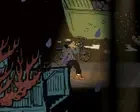
Bubdoes not look like a traditional video game. Artist and stop-motion animator Case Jernigan spends hours, days, months in his studio drawing, painting and delicately cutting out pieces of collected paper, while coder and gameplay designer Todd Anderson builds scripts and physics simulations to make them into a game.
In Bub, you play through the life of an artist in New York City, making art but also diving into his early memories and imaginative dreams. “You go from present day New York City into his childhood, or different sort of visions, which are all rendered in stop motion,” says Anderson. “His story is told in the present day, but also how he’s making sense of his past.”
Jernigan says Bub is based almost entirely on his own life, both as a child and an artist, and one of the biggest themes is health: “I realised that a lot of my anxiety I was experiencing, and other unusual symptoms like problems with my eyes and other senses weren’t just run of the mill panic attacks. When I got diagnosed with MS I had what’s called a relapse, a really bad one, and I got very sick and had a lot of problems with my hands and my ability to make art.”
Thus the tagline: the anxiety of “turning your memories into art while you still can”.
Wistful memories … Bub. Photograph: Paperfrog
A decade ago, Jernigan had been working on a graphic novel of childhood anxiety and how it’s manifested into adulthood. But the format didn’t feel right; he wanted a way to have a bit more control over how a person was involved with the work, the pacing, the feeling of space. “What if you could choose exactly how long you want to be here, and whatever sensation you’re taking from it, whether it’s invigorating or calming or just beautiful,” he says. “You could sit there as long as you wanted.”
A core piece of the appeal of autobiography in games is in how the creator uses the mechanics to influence how the player feels. Anderson says he wanted to make sure that Bub’s controls and mechanics are intuitive but don’t always do exactly what you might expect: “That’s always the relationship between the player and the controls. It’s constantly changing throughout.”
So too with the visual style. The “New York City overworld” feels grounded with its consistent pen-and-ink style, coloured in with the different colours and textures of different papers Jernigan has collected over the years. “But then, as you get pulled into memories or through the process of art making for the character, you get into some of these more papercraft puppets, or the smudgy marker animation, or liquid and paint.”
The music works similarly, created by Adam Schatz of Landlady and Japanese Breakfast, and Old Feels’ Asher Kurtz. “These artists have contributed a great deal to the sensation that you feel when you play the game,” says Jernigan. “It’s wistful music, lots of drones, lots of layers and texture. We think the musical identity very much mimics the visual identity of the game.”
Everything is handmade. Currently the team is working on scenes in which the player will be able to take space to make art themselves, the sort of art that was created to make the game. “We want the player to really feel like an artist a little bit,” says Anderson, “And have some kind of undirected creative output.”