Sign in. It’s quick, free and it’s up to you.
An account is an optional way to support the work we do. Find out more.
IT FEELS LIKE there is some notable skies-based phenomenon (the aurora borealis, various moons) happening every other week, but Wednesday’s eclipse actually is exceptionally rare.
The eclipse is to cover up to 98% of the sun in parts of Ireland, something that hasn’t occurred since 1999, and it is only a small percentage away from a total eclipse, which Ireland is not expected to see until 2090.
Those into astronomy have been gearing up for the event, but it’s piqued others’ interest as well. So, what to expect? How can you get involved? Do you really need the special glasses?
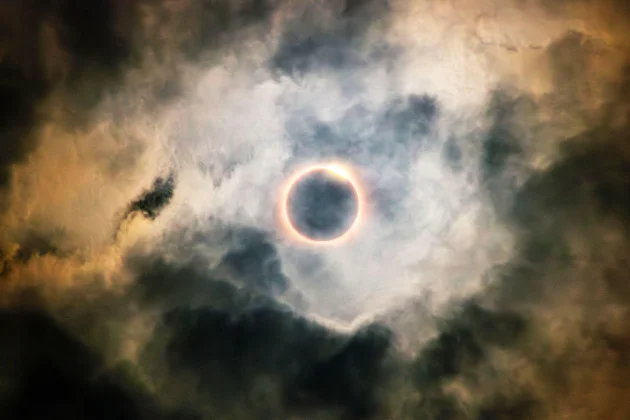
A solar eclipse happens when the moon moves directly between the earth and the sun, blocking its light. From the ground, people can see the sky turn dark and a bright ring of the sun’s atmosphere appear in the sky.
The eclipse is to begin at around 6.10pm and will last for two hours.
It will reach its maximum peak about an hour after it starts.
Peter Gallagher, astrophysicist and director of the Dunsink observatory, told The Journal that when the eclipse happens we can expect to see “a little bite taken out of the sun, and that little bite will progressively get bigger and bigger”.
“It will be like dusk or dawn and go noticeably dark just after 7pm”, he said.
You can witness this phenomenon anywhere in Ireland, although the coverage of the sun by the moon will vary by a few percentage points in different counties. Cork and Kerry have been flagged as the areas in which the eclipse will be at its most potent.
It won’t make a massive difference in the viewing experience, experts assured.
As for the actual viewing experience, you can easily just observe from your home (with protective eyewear – but more on that later). That said, viewing events have been arranged to take place all over the country.
In Cork, free public viewing events will take place at MTU Blackrock Castle Observatory, Tramore Valley Park and Bell’s Field from 6pm to 8.30pm on the day.
In Kerry, the Dingle peninsula is expected to offer the best view in the country, although there is no official event organised for the area.
Out east, the Irish Astronomical Society is hosting a free public viewing event at the visitor centre in Phoenix Park in Dublin.
In Galway, the Galway Astronomy Club is also having a free public viewing event. It will take place between 6pm and 8pm on Mutton Island Causeway, which is just out of the city centre, by Salthill.
Queen’s University Belfast is welcoming people to the lawn at the Lanyon Building from 6pm to view the eclipse.
Other free events require booking ahead of time, as spaces are limited. You can find out more about these events here.
Last but not least, you do actually need to wear the special glasses if you plan on looking at the eclipse.
Anyone looking directly at the sun should wear certified ISO 12312-2 eclipse glasses, as ordinary sunglasses do not offer adequate protection.
Thousands of free pairs have been handed out across the country, but if you haven’t picked some up yet, it might be best to order online with next-day delivery.
Astronomy Ireland and others offered glasses for sale in Ireland, but these have totally sold out.
Using these glasses is a non-negotiable: looking at the sun during a solar eclipse without adequate eye protection can burn the light-sensitive cells in your retina within seconds. This is called solar retinopathy. It is painless but leads to blurry vision, headaches and a central blind spot.
It can cause permanent damage.
You also cannot view the eclipse safely through your phone screen or camera without protection, as you could damage your eyes trying to capture the scene on camera. The eclipse can also ruin your phone’s digital camera sensor. If you want to take a picture of the eclipse, you’ll need a certified solar filter to protect your camera lens.
Liz Grennan, president of Optometry Ireland, said people should never look directly or point a camera, phone or telescope at the sun.
“Do not attempt a selfie with the eclipse,” she warned.
Watching via a livestream is a safe option. The European Space Agency will have one.
If you want to (almost) view the eclipse yourself without glasses, you can use an indirect viewing method to project the sunlight onto another surface.
You can create a DIY projector with items such as a colander, a pinhole card – or even your hands – and look at the projection. Perhaps the most simple way to do this is to face away from the sun at a blank surface, hold up a piece of cardboard with a small hole in the centre, and view the projection.
It sounds more complex than it actually is.
A plus of many of the organised events is that there will be experts on hand, and many will have telescopes with adequate filters to view the phenomenon.
The eclipse will be most visible in the southeast of the country, Linda Hughes, a meteorologist with Met Éireann, says.
“That’s where we’re expecting the skies to be clearest and for the longest length of time.”
Skies won’t be so clear in coastal areas of the west and southwest.
For most of the country, “it’ll really depend on the timing of when cloud is passing over the area the viewer’s in”, Hughes said, but generally there’s a “good chance” of catching it.
Viewers should be aware that the sun will be low in the sky, meaning the eclipse could be obstructed by trees, hills or buildings, depending on where you’re standing.
You can use the Eclipse Horizon Checker website to see whether your view could be blocked based on your location, but it only covers ground that is in the eclipse’s path.
To embed this post, copy the code below on your site