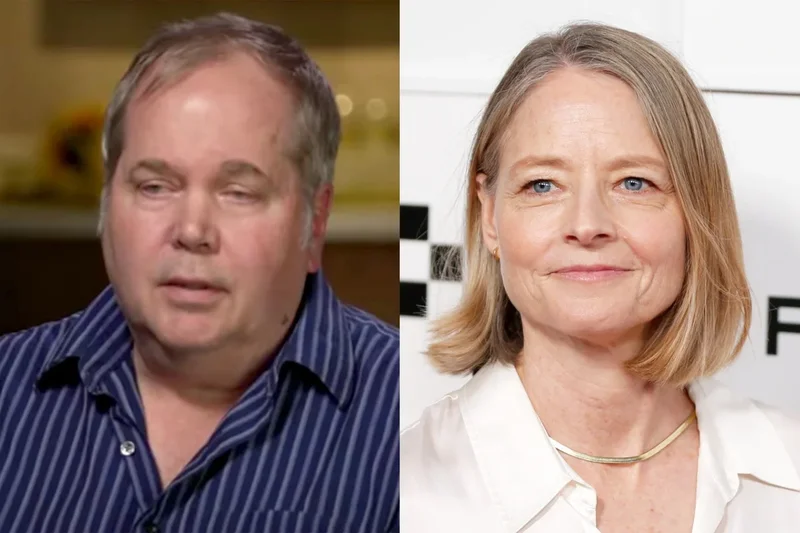
The man who tried to assassinate Ronald Reagan in an attempt to impress Jodie Foster has wished the movie star well in a new interview.
John Hinckley Jr., 71, spoke about the two-time Oscar winner with the Mark Joseph Show, according to Entertainment Weekly’s preview of the interview before its release Wednesday.
“I just wish Jodie Foster well, you know,” Hinckley said, per the publication. “I don’t really see her movies, but I wish her well, and I know she’s doing quite well. And that’s all I can say is just, I wish Jodie well, and I hope she has a good life.”
Hinckley infamously shot President Ronald Reagan outside of the Hilton Hotel in Washington, D.C., on March 30, 1981. Reagan was wounded in the attack, along with three other people: Press Secretary James Brady, police officer Thomas Delahanty and Secret Service agent Timothy McCarthy.
Shortly after the shooting, it came to light that Hinckley — who was 25 at the time — had carried out the assassination attempt to get Foster’s attention after spending months calling her and sending her love letters.
He had become obsessed with the actor, who was 18 at the time, after seeing her 1976 movie Taxi Driver, in which she plays a child prostitute alongside Robert De Niro’s character Travis Bickle, who attempts to kill a politician.
Hinckley told the Mark Joseph Show: “I wanted to have a union with Jodie Foster and live the rest of my life with her and all these things that, of course, were delusional. But I was believing those things at the time, so the best outcome would have been a union with Jodie Foster.”
The Independent has contacted Foster’s representatives for further comment.
After a seven-week long trial in 1982, Hinckley was found not guilty by reason of insanity for the attempted assassination. He went on to spend 35 years in a psychiatric facility before being released in 2022.
Since his release, Hinckley has openly spoken about his remorse for his actions and is pursuing a career as a singer-songwriter.
Foster has not spoken about the experience except for what she said was the first and last time in a 1982 article for Esquire titled “Why Me?” and published months after the verdict.
“John Hinckley's greatest crime was the confusion of love and obsession,” she wrote. “The trivialization of love is something I will never forgive him. Love is blissful. Obsession is pitiful, self indulgent.”