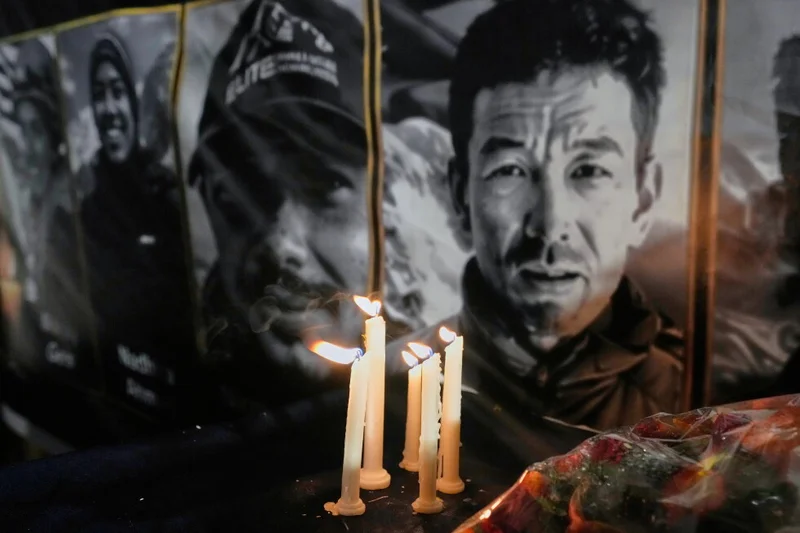
Candlelight vigil in Islamabad honors 10 climbers killed on Broad Peak
Candlelight vigil in Islamabad honors 10 climbers killed on Broad Peak
ISLAMABAD (AP) — Mountaineers, diplomats and members of civil society gathered in Pakistan’s capital Tuesday evening for a candlelight vigil honoring 10 climbers killed in an avalanche on Broad Peak, as rescuers described an arduous mission to bring their fellow climbers down from one of the world’s highest mountains.
Rain fell as mourners lit candles and prayed for the dead, shielding the flickering flames from the downpour as they gathered on the open lawns of a sports complex in Islamabad to remember the climbers who never returned from the mountain.
The vigil came days after search teams ended an operation that recovered the remains of eight climbers. Two bodies have not yet been recovered.
Among the dead was renowned British-Nepali mountaineer Nirmal Purja. Nepal lost six climbers in the July 30 disaster, when a massive avalanche struck an international expedition.
Nepal’s ambassador to Pakistan, Rita Dhital, joined the vigil and paid tribute to the climbers as candles were lit in their memory. She recalled meeting Purja at her Islamabad home before the expedition and said he would often tell her, “Giving up is not in my blood.”
She thanked Pakistani climbers and rescuers who went onto the mountain in dangerous weather to search for the missing climbers and recover their bodies. Dhital particularly praised renowned Pakistani mountaineer Sirbaz Khan, who led the recovery team, as well as the Alpine Club of Pakistan, the military and government officials involved in the operation.
The bodies of all six Nepalese climbers have been returned to their families, she said.
Khan told The Associated Press that he and his team had set out hoping they would find the missing climbers alive. “I had hoped that I would hug them after finding them alive,” he said. Instead, the rescuers found climbers buried beneath the avalanche. Khan said the team used shovels to dig through the snow and pull out the bodies one by one.
Seeing fellow mountaineers dead on the mountain was difficult, he said, but the rescuers composed themselves and began the equally difficult task of bringing the bodies down, using ropes and makeshift stretchers. Khan said he remained deeply saddened by the deaths but took some solace in knowing that families who had waited desperately for news were able to receive the remains of their loved ones.
Irfan Arshad Khan, president of the Alpine Club of Pakistan and no relation to the rescuer, said the remains of seven climbers, including all six from Nepal, had been repatriated. He said bad weather repeatedly prevented helicopters from reaching the accident site, forcing rescuers to continue much of the search and recovery operation on foot. Eight bodies were eventually brought to a location from where they could be airlifted, he said.
“We have gathered here today to commemorate the passing of our great comrades,” Khan told those attending the vigil. He said the days following the avalanche tested not only the endurance of those searching the mountain but also the courage of rescuers who continued on foot when helicopters could not reach them.
The international expedition included climbers from Nepal, Oman, Pakistan, China, Britain and the United States.
Broad Peak, which rises 8,051 meters (26,414 feet) above sea level in the Karakoram range, is the world’s 12th-highest mountain and lies near K2, the world’s second-highest peak.
Mountaineering accidents are common in northern Pakistan, home to some of the world’s highest mountains.