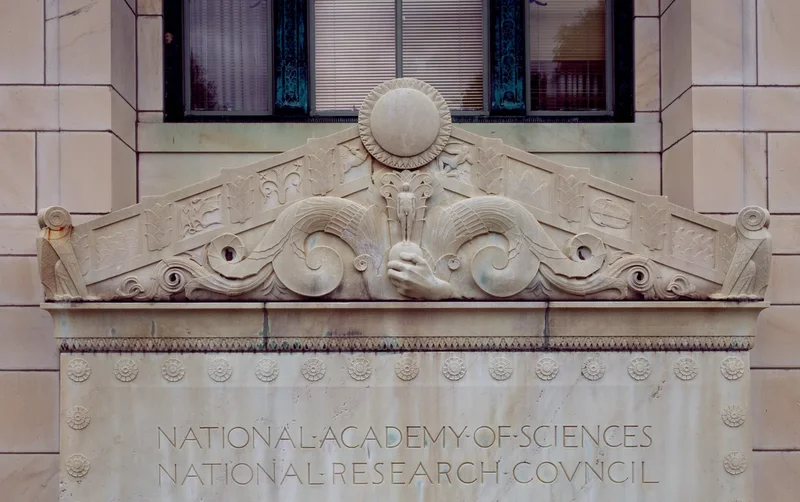
The National Academy of Sciences (NAS) pulled a chapter on climate from its scientific reference manual for judges, the organization said in a statement released on Friday.
The Reference Manual on Scientific Evidence is produced in concert with the Federal Judicial Center (FJC); its latest edition was released in 2025 and, for the first time, included a chapter on climate change. The manual is designed to help judges reason through legal cases that touch on complex scientific topics.
The decision to nix the chapter follows criticism from President Donald Trump and other Republican officials. Trump claimed on social media that the organization’s climate guidance was “biased,” “fraudulent” and “misleading.” The Federal Judicial Center pulled the chapter in February 2026.
On supporting science journalism
If you're enjoying this article, consider supporting our award-winning journalism by subscribing. By purchasing a subscription you are helping to ensure the future of impactful stories about the discoveries and ideas shaping our world today.
“The NAS has determined that questions about the processes used to develop the chapter warrant an independent review, and the chapter will not appear on our website while that review is underway,” NAS said in its statement.
The chapter, “Reference Guide on Climate Science,” included information about the greenhouse effect, atmospheric cycling, peer-reviewed research, attribution science, and more, according to a copy stored on the Internet Archive.
This past January dozens of state attorneys general protested the chapter in a letter to the director of the Federal Judicial Center.
In response to the criticism, the chapter’s authors—Jessica Wentz, a nonresident senior fellow at the Sabin Center for Climate Change Law at Columbia University, and Radley Horton, a climate professor at Columbia—argued that their work was based in science.
“The chapter underwent extensive peer review from external reviewers, including both scientists and judges, as well as staff from the National Academies [of Sciences, Engineering, and Medicine] and the FJC,” they wrote in a February statement. “It was held to the same rigorous standards as every other chapter in the manual.”
Wentz and Horton and the NAS did not immediately respond to a request for comment from Scientific American.
Disclosure: Jackie Flynn Mogensen was the recipient of a 2024 award that was given in part by the National Academies of Sciences, Engineering, and Medicine and included a cash prize.