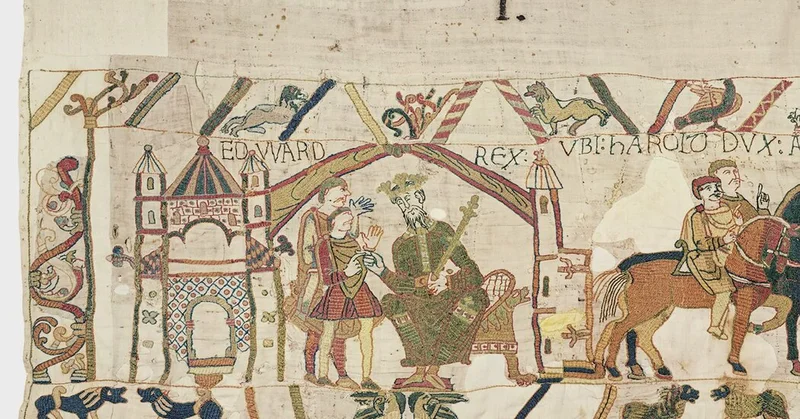
When Elizabeth II was about to be crowned in 1953, British officials decided on the perfect gift for the monarch-to-be: They would bring home the Bayeux Tapestry.
For over 900 years, the 220-foot-long embroidery depicting the 1066 invasion of England by William the Conqueror had resided in Bayeux, France. A celebratory loan of one of Britain’s most important cultural artifacts would have made an ideal coronation present, but there was a problem: French art experts wouldn’t let the tapestry travel. It was too fragile to move, they said.
French experts scuppered another British plan to borrow the tapestry in 1966 for the 900th anniversary of the invasion. Then again in 1980. Last year, too, the tapestry’s handlers insisted a loan was impossible.
And yet, against the odds, the tapestry is now in London. On July 9, at 6:15 p.m., a bright yellow truck carrying the masterpiece, sealed in a climate- and vibration-controlled case, left Bayeux in a secretive overnight operation. Accompanied by members of the French security services, the truck drove onto a Eurostar train that took it under the sea through the Channel Tunnel.
Once in England, the truck crawled through the night to the British Museum in London, where its cargo will be the star of a blockbuster exhibition that opens Sept. 10 and runs through July 11. Tickets are already sold out through Dec. 31, and the British Museum hopes attendance will rival the 1.6 million who flocked to its “Treasures of Tutankhamen” show in 1972.