HUNTSVILLE, Ala. — Uncertainty over Golden Dome’s long-term funding is hanging over the Pentagon’s missile defense plans, even as defense executives say money is beginning to reach contracts for satellite sensors, interceptor weapons and other programs now grouped under the initiative.
The Defense Department describes Golden Dome as a layered homeland defense architecture linking sensors, interceptors and command systems across land, sea, air and space. Most details remain classified, limiting what contractors can say about their specific roles. Executives nevertheless have highlighted the program as a source of future growth.
Their comments suggest the most immediate business is concentrated in relatively mature capabilities: missile-warning and tracking satellites, ground-based interceptors, infrared sensors, directed-energy demonstrations, systems engineering and test support. The more speculative elements — particularly a large operational constellation of space-based interceptors — remain in development.
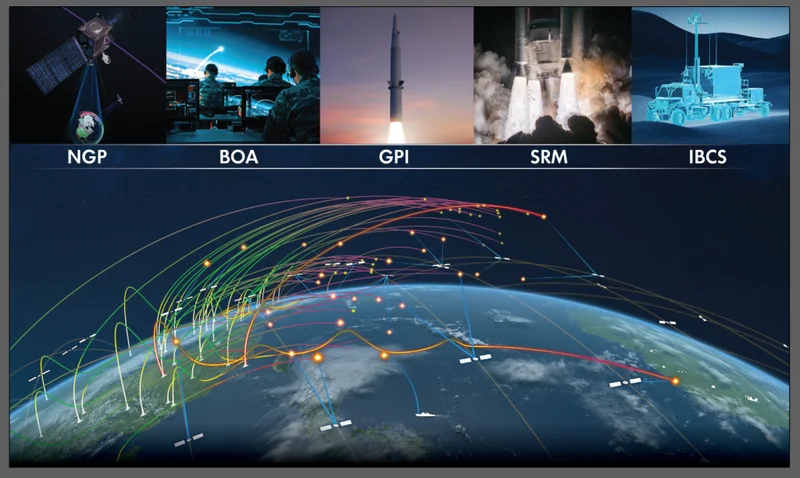
Northrop Grumman’s missile defense portfolio illustrates where much of the early Golden Dome spending is flowing. Rather than funding an entirely new generation of systems, the initiative is building on existing programs already in development, including next-generation missile-warning satellites, infrared tracking networks, hypersonic interceptors, command-and-control systems and expanded rocket motor production. At the same time, Northrop is among the companies competing for Golden Dome’s new space-based interceptor program, where it is teamed with satellite manufacturer Apex to develop an orbital interceptor concept.
“Money is flowing for Golden Dome,” said Raymond Sharp, vice president of Northrop Grumman’s missile defense integration business.
“From a long-term funding perspective, we continue to watch what’s going on on the Hill,” Sharp told reporters Aug. 11 at the Space & Missile Defense Symposium. “We’re focused on developing the capability and bringing forward capabilities that we believe are affordable within the funding that’s been published out there,” he added. “We’ll continue to watch and monitor the process, we’ll adapt as necessary.”
Golden Dome’s fiscal year 2027 funding remains uncertain because nearly all of the administration’s roughly $17.5 billion request depends on separate reconciliation legislation, while the regular defense appropriations bills provide about $400 million for the program.
Northrop Grumman’s chief executive Kathy Warden said during the company’s recent earnings call that the release of funding provided last year through budget reconciliation had moved slowly at the start of the year but “opened up” during the second quarter.
“We are seeing those funds be put onto contract,” Warden said.
Warden described the opportunity as a combination of new competitions and sole-source additions to work already under contract.
Congress provided substantial initial financing, but not yet a stable multiyear acquisition plan. A 2025 reconciliation law supplied about $24 billion for integrated air and missile defense capabilities associated with the initiative. The outlook becomes less certain in fiscal 2027.
Contracts down the supply chain
For suppliers farther down the chain, Golden Dome can provide broad exposure without a direct award from the program office. Teledyne Executive Chairman Robert Mehrabian said on the company’s July 22 earnings call that it is “the primary supplier to just about everybody in the Golden Dome.”
Mehrabian highlighted Teledyne’s mercury-cadmium-telluride infrared detectors, which are used in space-based sensing systems, and said the company is seeking to provide more of the electronics that accompany them. The company’s position illustrates how Golden Dome spending can flow through several competing satellite and sensor manufacturers to a common component supplier.
Lockheed Martin is presenting the initiative as a portfolio opportunity spanning several parts of the architecture. Chief Executive Jim Taiclet said July 23 that a Lockheed directed-energy system had completed what he described as Golden Dome’s first milestone test, cueing, tracking and engaging incoming threats.
Taiclet connected that demonstration to a later contract to develop a transportable 500-kilowatt laser intended for cruise-missile and drone defense. Lockheed’s role also includes space-based interceptors, ground-based missile defense, radar and command systems. The breadth of that portfolio makes it difficult to separate Golden Dome revenue from the company’s existing missile defense and space businesses.
Parsons said July 29 that it received a two-year, $514 million option under the Missile Defense Agency’s Technical, Engineering, Advisory and Management Support contract. The work includes advanced engineering for integrated missile defense, including Golden Dome.
Chief executive Carey Smith called the MDA contract a “critical driver” for Golden Dome, covering systems engineering, test support and management of facilities over their operating lives. She also said program funding had begun moving through MDA, although staffing shortages and backlogs in contracting offices were slowing the pace.
L3Harris Technologies has more explicitly connected its financial outlook to Golden Dome-related satellite work. Chief Executive Chris Kubasik identified a roughly $9 billion pipeline over the next several years across missile warning, missile defense and classified space missions.
KBR, meanwhile, is among the contractors openly positioning for future work without yet identifying a material award. Chief Executive Stuart Bradie said on the company’s July 30 earnings call that it sees opportunities in software, artificial intelligence and digital systems, but he did not quantify them.
The remarks suggest KBR expects to compete through its existing relationships in missile defense, intelligence, space and systems engineering. The company is making Golden Dome part of a broader push as it prepares to separate its defense- and space-focused Mission Technology Solutions operation from its energy and sustainable technology businesses.
Commercial space companies are also receiving Golden Dome-related work indirectly through prime contractors that control larger platforms and weapons programs.
Voyager Technologies supplies propulsion, guidance, electronics and other subsystems that can be incorporated into programs led by larger contractors. It works under Lockheed Martin on the Missile Defense Agency’s Next Generation Interceptor and is part of Anduril Industries’ team for the Space Force’s space-based interceptor competition.
Voyager Chief Executive Dylan Taylor has described Golden Dome as a multiyear modernization effort and said the company expects to participate across several layers of the architecture. That structure shows how spending can move from the government through prime-led platforms and into a wider commercial supply chain, even when smaller companies cannot disclose the underlying contract details.
Classification challenges
Golden Dome’s high level of classification is testing the defense industry’s ability to understand and respond to requirements, including among companies that hold security clearances.
Daniel Dant, KBR’s vice president of strategic initiatives, leads a team focused on engaging with the Golden Dome program office and identifying parts of the architecture where KBR might compete. The work reflects the investment decisions facing contractors: The Pentagon wants industry to commit resources, while withholding most architectural and technical details to prevent adversaries from learning how the system would operate.
Connecting with program officials still requires traditional relationship building through calls, emails and meetings, Dant told SpaceNews.
“Fortunately, most of us have the clearances to get in the door because those discussions are almost invariably at the top secret SCI level,” he said. “It’s hard to engage at an unclassified level.”
The funding uncertainty has not diminished KBR’s interest.
“We’re watching it very carefully,” Dant said. “But I’ll say that KBR is still committed. We’ve got the resources and the team, even if there are funding uncertainties.”
“Our approach is to stay the course, and try to make a contribution as best we can,” he added.