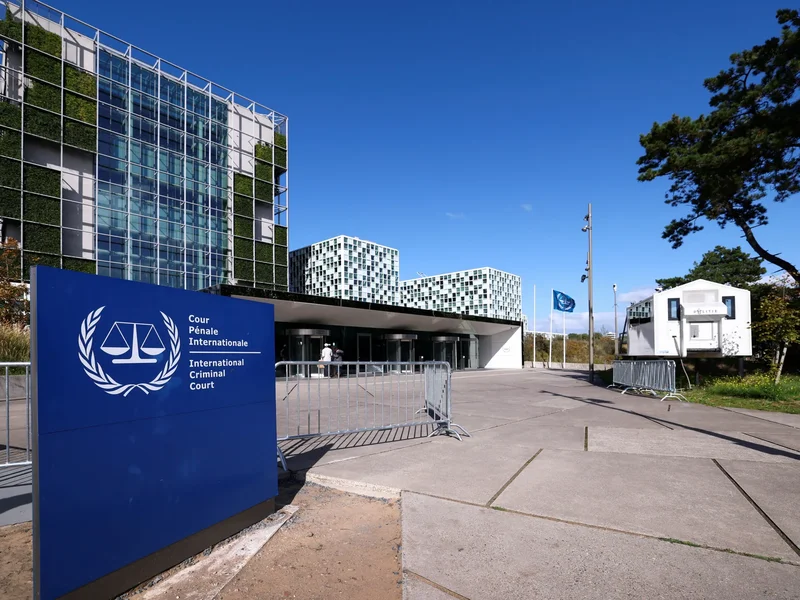
Four leading human rights groups have launched a new lawsuit against the Trump administration’s campaign against the International Criminal Court.
The new lawsuit filed on Tuesday charges that the administration’s wide-ranging sanctions against the international tribunal and organisations that cooperate with it risk treading on the constitutional rights of US citizens and groups. It adds to several previous legal challenges making similar claims.
Recommended Stories
list of 3 items- list 1 of 3Netanyahu vows to go to New York City despite ICC arrest warrant, Mamdani
- list 2 of 3Chad to join raft of withdrawals from International Criminal Court
- list 3 of 3What drove Venezuela’s decision to leave the ICC?
The four US-based groups – The American Friends Service Committee, the Centre for Constitutional Rights, Human Rights Watch, and the Open Society Institute – charge the sanctions “force them to curtail a wide range of human rights and legal work”. That, in turn, violates their constitutional rights, including their freedom of speech and their right to due process.
The lawsuit further charges that Trump has exceeded his presidential authority “based on a pseudo ‘national emergency’ that has no basis in fact”, according to a Human Rights Watch statement.
“The US government’s efforts to dismantle the ICC and punish people seeking justice for grave human rights violations harm far more than the individuals and groups facing sanctions. It is an affront to all victims and survivors of war crimes and genocide,” said Joyce Ajlouny, general-secretary of the American Friends Service Committee.
“This executive order seeks to intimidate human rights defenders and deter people of conscience from advocating for the rights and dignity of others. We are joining this lawsuit because we refuse to stay silent when the pursuit of justice is criminalised.”
Trump escalated his approach towards the ICC upon taking office last year, issuing a sweeping executive order in February 2025 that authorised sanctions against the court’s prosecutors, judges and other officials, as well as individuals or groups that support the court’s investigations.
The executive order specifically cited the court’s issuance of arrest warrants for Israeli Prime Minister Benjamin Netanyahu for war crimes committed in Gaza, as well as an ongoing investigation into possible abuses committed by foreign forces in Afghanistan, including US military and intelligence personnel.
Since then, several ICC judges and prosecutors have been sanctioned by the US, along with an array of Palestinian rights groups that provided evidence to the court. It also sanctioned UN Special Rapporteur Francesca Albanese.
Beyond the earlier lawsuit filed by the Washington, DC-based DAWN rights organisation and the Taxpayers Alliance Against Genocide (TAAG), ICC judges and Albanese’s family had previously sued the Trump administration in response to the sanctions, which included travel bans and restrictions on assets in the US.
Last month, US Secretary of State Marco Rubio promised to increase the US pressure campaign to “disable” the ICC, accusing the court of “waging a war against our country, not with bullets or missiles, but with statutes, compacts, and the force of so-called international law”.
He pledged to increase “scrutiny” of how countries that receive US assistance approach the court and increase penalties on officials. At least one member state, Chad, cited pressure from Washington in recently announcing its withdrawal from the court.
International law experts have called the timing of the announcement perplexing, noting that, beyond the long-stalled Afghanistan investigation, no US citizens are known to currently be the subject of any investigations by the court. No US citizen has ever been prosecuted by the ICC.
The US is not a signatory to the ICC’s founding charter, the Rome Statute, and is therefore not subject to the court’s jurisdiction, although abuses committed on the territory of member states can be probed and potentially prosecuted.
Federal judges in Maine and New York ruled last year that Trump’s ICC executive order violated the constitutional rights of individual advocates and academics who provide expertise to the court.
In the latest lawsuit, the four human rights groups said the sanctions had stopped them “from continuing or undertaking activities like representing victims of war crimes as legal counsel, making legal and policy submissions to the ICC, and collaborating with the sanctioned Palestinian human rights groups to undertake litigation, coordinate advocacy campaigns, research human rights violations, or provide humanitarian aid”.
It noted that, due to the dominance of US financial and technological companies, sanctions are also chilling organisations that do not operate in the US.
“These sanctions are an assault on the rule of law, independent judges and prosecutors, and civil society in the United States and around the world,” James Goldston, executive director of the Open Society Justice Initiative, said in a statement.
“They betray historic US leadership in the cause of international justice and are a slap in the face to victims and survivors of grave crimes everywhere who depend on the ICC as a court of last resort.”