The National Treasuryâs recent Come to Jesus moment for the nationâs defaulting municipalities read like an honour roll of delinquency, with Nelson Mandela Bay (NMB) as a clear class valedictorian.
It was like watching a car careening into an immovable object, but in slow motion, since the original draft budget didnât pass funding muster in May. The June redux does pass legislative requirements but doesnât solve any of the underlying problems.
To understand the full extent of the problem, you first need to reckon with the fact that the NMB Metro is budgeting with the assumption that a vast portion of its billed service revenue is entirely uncollectible.
For 2026/27, the budgeted collection rate for water is only 30.9% (meaning the metro writes off 69.1% of water billed). Waste management is budgeted at 50.9%, and wastewater at 59.3%.
Now for the kicker: In 2024/25, the metro lost 52.74% of its bulk water (worth R392.56-million) and 26.81% of its bulk electricity (worth R1.48-billion) to physical leaks, meter tampering and illegal connections.
But even through all this balance sheet distress, it does not yet breach the legal definition of defunct.
The phantom financial cushion
Confused? Donât worry, it gets crazier. The only reason the cityâs physical water pipes, electrical networks and sewer lines havenât suffered a total cardiac arrest is a massive, multibillion-rand bailout from the national government. Known as the Urban Development Financing Grant (UDFG), this lifeline pumps R2.38-billion into the city over three years.
Usually, national infrastructure grants come with strict red tape that only allows municipalities to build new things. But under the UDFG, the Treasury has thrown Nelson Mandela Bay a lifeline: the city is allowed to use this money to cover daily operating costs, repairs, maintenance and hiring expert consultants â an emergency cash injection specifically designed to prevent the physical collapse of the aforementioned critical, constitutionally mandated services.
And, on paper, the city has plenty of room to take out huge new commercial loans to build revenue-generating infrastructure. While the city is being choked by unpaid bills from its own residents, the municipality itself actually owes very little money to the banks.
Because the metro has kept its formal long-term bank loans very low (borrowing makes up only 5.89% of its operating revenue), its debt coverage ratio is 56.35 times.
But while the theoretical capacity to borrow is there, the question is whether any commercial bank would be brave enough to approve a loan to an administration in such deep governance distress.
Where NMB residentsâ money goes to die
The five delinquent departments transforming dry balance sheets into daily resident misery:1. Electricity:A R1.48-billion black hole. Legally, selling power should generate a profit to fund civic services. Instead, the bulk Eskom bill exceeds the revenue billed to consumers, forcing the National Treasury to siphon property rates just to keep the lights on. Rampant theft and unpoliced illegal connections bleed R1.48-billion annually.2. Water Services:A sieve in a water-scarce region. The metro sells water below cost. Worse, the revenue isnât ringfenced to fix decaying infrastructure, but dumped into a general kitty. The result? Clean, treated water leaks straight into the dirt or is stolen through unmetered connections.3. Waste Management:Refuse removal operates at a crippling -21% deficit. Meanwhile, critical landfill rehabilitation is entirely gridlocked because the city is paralysed by the sensitive crisis of squatters living directly on active, toxic waste dumps.4. Human Settlements:Tasked with delivering dignity, this department built exactly zero state-subsidised houses in the 2020/21 financial year. Instead of shrinking the massive waiting list, it froze R195-million in precious capital to bridge-fund provincial projects the province hasnât bothered to repay.5. Budget and Treasury:The clogged heart of the metro. Supply chain bottlenecks mean routine contracts take 18 months, forcing illegal emergency deviations that have pushed irregular expenditure to a cumulative R26.8-billion. Most alarmingly, instead of legally compliant software, this multibillion-rand city runs its finances on unstable, manual Excel spreadsheets.
Silver linings playbook
Believe it or not, it is not all doom and gloom.
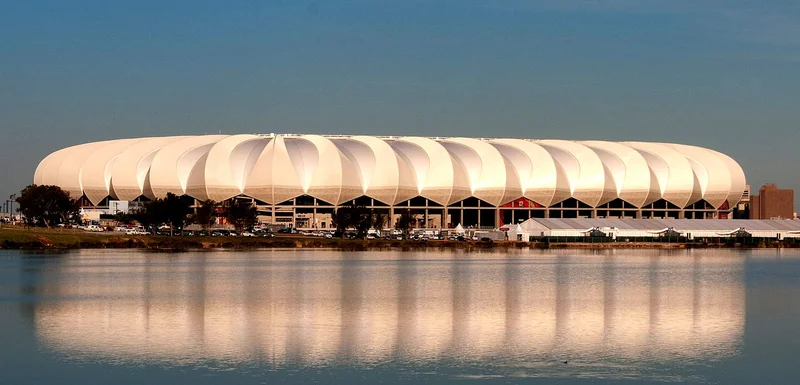
The Nelson Mandela Bay Stadium and economic nodes, managed under the Mandela Bay Development Agency (MBDA), have been a major success.
The MBDA achieved a turnaround 81% annual institutional target performance in 2024/25, significantly boosting local tourism and event revenues.
There are also certain administrative units operating at a high standard. For instance, the municipality takes an average of only four working days to finalise business licence applications (against a target of 21 days) and successfully issues 99% of rates clearance certificates within 10 working days â very close to and sometimes better than Cape Town.
And that UDFG cash injection comes with a performance improvement action plan that is a legally binding mechanism to force the political and administrative wings to implement recovery strategies under threat of losing national funding.
The R2.3-billion grant will be split like this: R650.7-million in 2026/27, R758.1-million in 2027/28, and R971.1-million in 2028/29.
To stop the operating budget leak caused by excessively generous local subsidies, NMB had to commit to equate its Free Basic Services in terms of free water and electricity directly to the National Policy. This will scale back the local subsidy to match National Treasury guidelines.
The metro will also target water and electricity losses at their source by identifying indigent households with massive active leaks.
In many cases, decaying household-level plumbing has caused vulnerable residents to accumulate arrear accounts exceeding R5-million.
The municipality will repair active water leaks and electricity faults at these households at no cost to the account holder to stop physical water and electricity losses. Following successful technical repair, the historical debt will be written off.
Daily Maverick sifted through as many pages of audited data as we could find, and the resulting reading does not make for a good bedtime story. But the foundations for recovery have finally been laid after years of maladministration and leadership merry-go-rounds.
Now all that is needed is an executive that can execute. DM