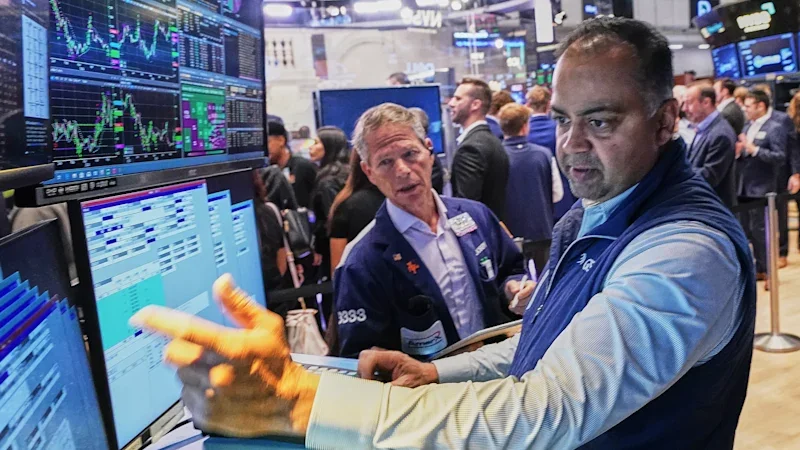
US stocks are slipping below their records, while oil prices keep swinging on uncertainty about when the war with Iran will allow crude to flow freely again.
The S&P 500 fell 0.4 per cent, sliding further away from its all-time high set on Friday. The Dow Jones Industrial Average was down 145 points, or 0.3 per cent, in mid-afternoon trade, and the Nasdaq composite fell 0.8 per cent.
The Australian sharemarket is set to decline, with futures at 5am pointing to a loss of 43 points, or 0.5 per cent, at the open. The ASX added 0.2 per cent on Tuesday. Commonwealth Banks results are the highlight of reporting season today. The Australian dollar is trading at US70.60¢.
The action was more unsettled in the oil market, where the price for a barrel of Brent crude briefly jumped above $US90 in the morning before falling back below $US87. It was most recently at $US88.71, up 1.1 per cent from Monday’s settlement price.
Such swings have become typical since the United States and Israel attacked Iran in late February, which led to the closure of the Strait of Hormuz and kept much of the world’s oil pent up in the Middle East. Last month alone, Brent’s price veered between $US72 and $US102 per barrel.
Higher oil prices make inflation worse, and they’ve sent the average cost for a gallon of regular gasoline to $US4.01, according to AAA. That’s up from less than $US3.14 a year ago, though it’s down from last week’s nearly $US4.09.
That has Wall Street’s attention focused on Wednesday, when the US government will release the latest monthly reading on inflation. Economists expect it to show inflation remains high but that it decelerated to 3.4 per cent in July from 3.5 per cent in June.
That could help the Federal Reserve, whose members are notably split on whether they should be raising the country’s interest rates to keep a lid on inflation. While higher rates could help slow the increases of prices on store shelves, they would also slow the overall US economy by making it more expensive for US households and businesses to borrow money. They would also undercut prices for stocks and other investments.
Traders are betting on a coin flip’s chance that the Fed will raise its main interest rate at its next meeting in September, according to data from CME Group. If it does, that would be the first increase in more than three years. It also could anger President Donald Trump, who has been lobbying for lower interest rates.
Treasury yields have jumped since the war with Iran because of higher oil prices and worries about inflation, sending long-term mortgage rates to their highest levels in a year.
The 10-year Treasury yield eased back on Tuesday, falling to 4.69 per cent from 4.72 per cent late Monday. But it remains well above its 3.97 per cent level from before the war with Iran.
On Wall Street, Cardinal Health rose 1.1 per cent after becoming the latest big US company to report a stronger profit for the spring than analysts expected.
Businesses have blown past analysts’ forecasts, which Wall Street loves because stock prices tend to follow the path of corporate profits over the long term.
Aramark, the food company and facilities manager, rallied 8.9 per cent after reporting stronger profit and revenue for the latest quarter than analysts expected.
They helped offset a drop of 20.9 per cent for On Holding. The Swiss sneaker company also topped analysts’ forecasts for profit in the latest quarter. But it gave a forecast for upcoming revenue that fell short of analysts’ expectations, while saying it does not want to slash prices to drum up more sales.
Intel slipped 0.3 per cent after it said it would sell $US20 billion of its stock at $US95 per share. That’s up from the $US15 billion that it said it would sell the day before, and such moves dilute the ownership stakes of people who already own Intel stock.
Intel plans to use the cash it’s raising for investments to take advantage of the boom in demand for artificial-intelligence technology.
In stock markets abroad, indexes were mixed in Europe following a mixed finish in Asia. Hong Kong’s Hang Seng fell 1.1 per cent for one of the world’s bigger moves.
AP
The Market Recap newsletter is a wrap of the day’s trading. Get it each weekday afternoon.