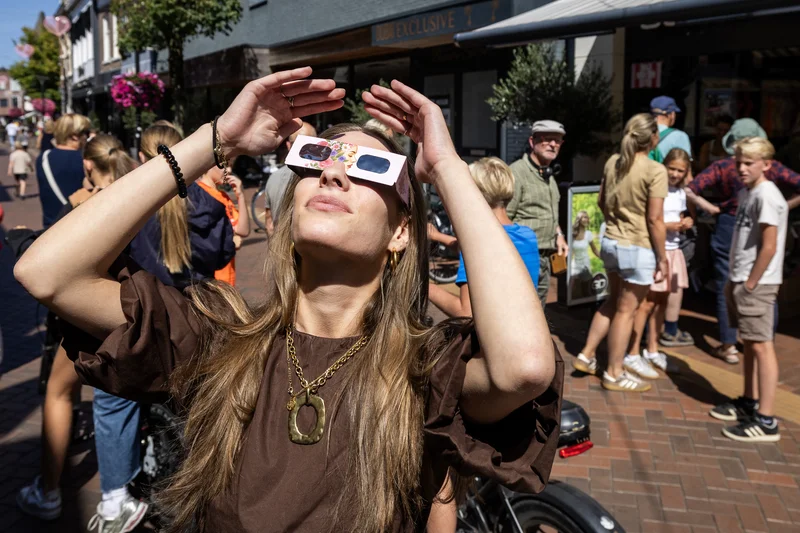
Two celestial events are set to appear in the skies around much of the world on Wednesday.
The annual Perseid meteor shower and a solar eclipse coincide this week, though Canadians may not get the best view of the latter.
While it’s pure coincidence that the eclipse and meteor shower are occurring simultaneously, it’s worth taking advantage of the favourable timing to enjoy a rare astronomical double bill.
Here’s what you need to know about both events.
What is a solar eclipse?
During a solar eclipse, the moon passes in front of the sun.
It will be a total eclipse in some parts of Western Europe, meaning the moon will fully block the sun’s light for a minute or two.
What time is the solar eclipse?
The eclipse happens on Wednesday, at different times depending on what part of the world you’re in.
While the total eclipse will only be visible in Europe, a partial version will be visible more widely, including in much of Canada.
The path of the total eclipse begins in the High Arctic, but will touch the coast of Siberia, brush past the North Pole, and race down the northeast side of Greenland.
The path then crosses to Iceland, where the capital, Reykjavik, will be the first large city immersed in the moon’s shadow.
From there, the eclipse’s path heads southward over the Atlantic until it finally intersects the north coast of Spain. It then bends east and hits water again at Spain’s Mediterranean coast south of Barcelona, before finishing off as a sunset spectacle for viewers on Majorca and neighbouring islands.
Spain is rolling out a massive police operation and public safety campaign ahead of the rare eclipse that will coincide with one of the country’s highest-risk periods for wildfires.
Where in Canada will the solar eclipse be viewable?
The best views will be in the far North, including Iqaluit, which will see about 70 per cent of the sun covered at maximum eclipse, around 1:24 p.m. local time.
For people in the south, the eclipse will be much less obvious. Here are the particulars for selected cities across the country where the eclipse will be visible. (All times local).
How to safely watch the eclipse?
It is never safe to stare at the sun directly. The best way to watch an eclipse is with ISO-approved viewing glasses, which are typically made with reflective Mylar or with black, light-absorbing polymer. Many such glasses were handed out in Canada during the eclipse of 2024. If using such a pair, be sure to check for damage, including scratches or holes, to avoid direct sunlight in the eyes.
A partial eclipse can also be viewed indirectly by projecting the sun’s light through a small hole onto a screen, such as a piece of white cardboard.
What is a meteor shower?
Meteors are glowing embers of interplanetary dust particles that streak across the sky as they burn up in the atmosphere. Meteor showers tend to put on dazzling celestial shows and happen at predictable times every year, but random meteors are visible in dark skies on any given night.
When the Earth plows through trails of debris left behind by comets and, sometimes, asteroids, those remnants collide with Earth’s atmosphere at extremely high speeds, producing streaks of light known as shooting stars and the result is a shower.
“Shower” can be somewhat misleading, however.
Although the Perseid shower is among the most active and reliable of the year, even under ideal conditions it yields an average of about one to two meteors a minute under ideal conditions, often with long gaps between bursts of action.
If your goal is to see more than a handful of meteors, you’ll likely spend hours doing so.
What is the Perseid meteor shower?
The Perseids are debris from comet 109P/Swift-Tuttle, an icy ball that orbits the sun every 133 years and isn’t scheduled for a return visit until 2125. Observations of this meteor shower date back over 2,000 years.
The Perseids are a perennial favorite because they tend to produce brilliant fireballs. Summer temperatures also make this shower popular.
What time is the Perseid meteor shower?
The shower peaks on Wednesday night but is active all week.
It will be at its most intense in the evening when the rate at which meteors appear is likely to reach its apex.
Where to watch the meteor shower in Canada?
It will be visible around the world, but it’s best seen in a dark, open area with a view of the entire sky.
Just lie back on a sleeping bag or chaise longue and look up. If skies are clear, the meteors will start showing up, particularly after midnight when Earth turns you toward the oncoming meteor stream.
The best views will be between midnight and dawn when the constellation Perseus is high in the northern sky. The meteors will appear to radiate from that constellation.
As many as 50 to 100 meteors per hour may be visible under ideal conditions, according to NASA. The American Meteor Society estimates 30 to 50 meteors per hour could be seen from rural regions.
The moon will be in its new moon phase during the Perseids’ peak, making viewing conditions even better.
Without the interference of moonlight, the night sky will be at its absolute darkest. If your observing site is free of artificial light then you’ll have excellent contrast that allows fainter meteors to show up more readily.
With reports from Ivan Semeniuk and The Associated Press