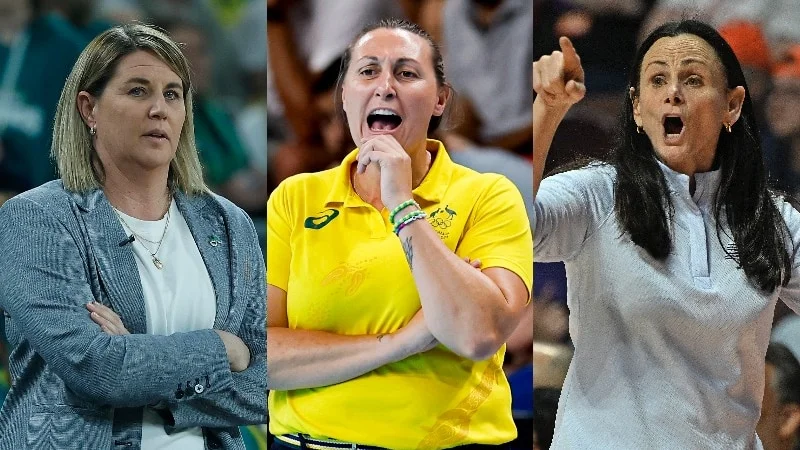
If you asked generative AI to create an image of a sports coach, it would likely serve up a middle-aged white man.
And while rooted in stereotypes, it would not necessarily be inaccurate.
The picture is slowly changing in some sports, although not substantial enough yet to disturb the algorithm.
The Australian Institute of Sport found the number of female head coaches in funded sports has nearly tripled since starting its Women in High Performance Coaching project in 2021.
The number now sits at more than 25 per cent, but AIS Director Matti Clements told ABC Sport that is still not good enough.
"Maybe we've had a history where we've just had male coaches coaching our best athletes," she said.
"We want to make sure the right people are coaching our athletes at the right time, female or male coaches."
The AIS report found many women coaches have experienced bad behaviour, which was "in some cases appalling, misogynistic and abusive," as well as challenges managing careers alongside having a family, and difficulties even getting a foot in the door, let alone climbing the ladder.
It highlighted the need for leaders within the sporting sector to drive cultural change to address the barriers.
"As a system, we've had a real focus in the last couple of years of wellbeing being fundamental to high performance sport in this country," Clements said.
"If you look at wellbeing as a sustainable high-performance lever, that will encourage all different types of people to stay in our system, female coaches included.
"Perhaps historically, high-performance sport in this country has not been as welcoming for female coaches as it has been for male coaches."
Clements pointed out some of the strategies which have helped deliver positive results over the past four years include visibility of high profile coaches, having conversations at the highest levels, re-evaluating recruitment practices, and targeted development.
Sauvage leading the way
Louise Sauvage is one of Australia's most decorated Paralympians, and since retiring in 2004, has established herself as a leading coach in para wheelchair track and road racing.
She has noticed an evolution over the past 20 years.
"It's been really good to see that infrastructure and also the investment into women's coaching," she told ABC Sport.
"Our athletes are almost 50-50 male, female, so to have that balance is perfect.
"And I think women bring something a little different to the male coaches as well. So I think it's important that we encourage them to continue on in those roles and to show the identity and what we can bring as female coaches."
Sauvage is also one of very few elite coaches with disability across the Australian sporting landscape, and acknowledged it has not always been an easy path for her.
"I think some of the barriers were definitely identifying what you could or couldn't do or how the workarounds would work," she said.
"And also talking with your national sporting organisation and how you can get past them or what help you might need and then you can just be as effective as any other coach.
"I think it's about communication more than anything and not just looking at something [and saying] 'oh, I can't do that.'
"[You should ask] how can you do it? How can we make it work for you so that you can progress as a coach?"
She added having coaches with shared lived experiences was a valuable asset for athletes.
"They already know that I know how they're feeling or what they need because I've been there and I've done that," she said.
"But things evolve all the time, so I need to keep learning as well. But I really do think a lot of the athletes do appreciate that the understanding is already there."
The professional picture
The AIS report focused on sports it funds, largely rooted in the Olympic and Paralympic arena, but many of the issues raised prevail in the professional codes too.
Four of the 18 of AFLW head coaches are women, one of 12 in the NRLW, one of 11 in the A-League Women and two of eight in the WBBL (last season).
The WNBL is close to parity with four of the nine coaches women, and as the country's number one female participation sport, five of Super Netball's eight coaches were female last season.
Like the dearth of disabled coaches, there are also very few First Nations, or culturally diverse head coaches, across men's and women's sports.
Clements said diversity in coaching simply makes sense.
"The sports are seeing the value of it in terms of performance outcomes. So this is not just a nice to have, we're doing it because it feels good," she said.
"It absolutely is a competitive advantage and that's what's going to engage our sports to continue to focus on this because we want to have the best games ever in Brisbane and in order to do that we have to make sure we've got the best people coaching."