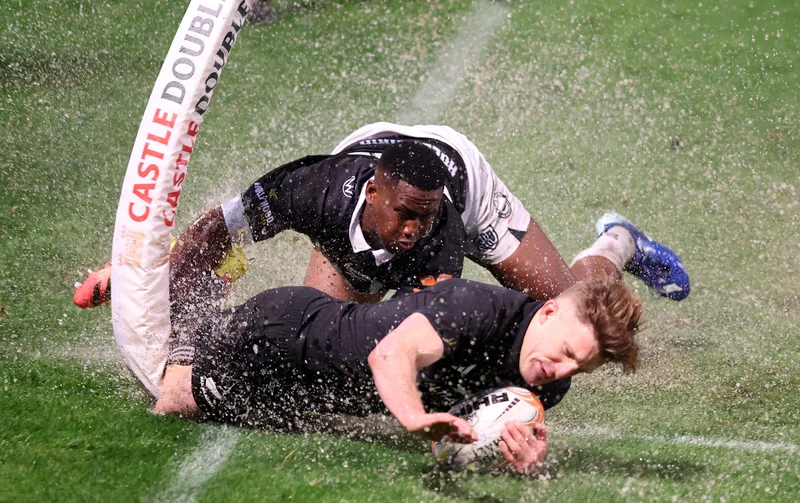
If the opening game of the Greatest Rivalry tour in Cape Town on Saturday set the tone for a sensational trek through South Africa, Game Two against the Sharks on Tuesday, 11 August, set it back.
Played in sopping conditions after heavy pre-match downpours, supposedly in front of 14,759 people according to the official count, it was an ugly mismatch.
The only highlight was when the Sharksâ 44-year-old centre Maâa Nonu, a 103-Test All Black, responded to the touristsâ Ka Mate haka by doing a solo version of their other haka, Kapa o Pango.
It should have been a gesture roared on by a full stadium. Still, it was wonderful theatre â the only memorable moment in an otherwise shambolic encounter.
Rebrand
The All Blacks scored eight unanswered tries and, outside of the opening 10 minutes, were never under any duress.
The Sharks were already on shaky ground with their rebrand last week, which features a logo, to the consternation of some more traditional fans.
Logos aside, the more worrying aspect was that the Sharks put out a callow team containing five junior Boks and a string of journeymen against the All Blacks.
Obviously, the Sharks were in a pre-season phase and were, to an extent, hamstrung by circumstances. But the contrast to the team and the effort the Stormers put into the fixture a few days earlier was stark.
While it must have been a great moment and thrill for the U20 youngsters to face the All Blacks, the sight of the hugely talented 18-year-old Zekhethelo Siyaya completely out of his depth was uninspiring. He might go on to be a great Springbok in years to come, but he was not ready for this.
The same could be said for many others. At least Sharks coach JP Pietersen knows the scale of the challenge he faces in the new season.
Overall, it seemed the Sharks players were confused by the game plan. Late in the contest, at 47-0 down with barely any scraps of possession, scrumhalf Ivan van Zyl launched a contestable kick from one of the rare moments when they had the ball.
Why kick away possession at that stage? And to make it worse, not a single player chased the kick. Shambolic. It summed up the confusion of the entire night for the home team.
The stats reflected the dominance on the scoreboard. The All Blacks made 15 line breaks to the Sharksâ one, and made 371 post-contact metres with 60% possession.
Class and experience
The conditions were obviously atrocious and unhelpful, but the way the All Blacks adapted, especially after halftime, underlined their class and experience.
Centre Jordie Barrett was outstanding, unleashing a tactical kicking game that will have the Bok analysts working overtime before the first Test.
Wing Fehi Fineanganofo has pace, power and good feet. He scored two tries and was a constant source of good moments for the tourists.
Flyhalf Ruben Love also looks a fine player and an excellent goal-kicker. Missing only one of eight kicks at goal in those conditions, and many from wide out, was a formidable feat.
Giant loosehead Ethan de Groot dominated Vincent Koch in the scrums while flank and captain Luke Jacobson showed why coach Dave Rennie rates him so highly.
The pack in general was excellent, while the backline grew into the game and, once it found its rhythm, produced some fine tries.
Fullback Damian McKenzie, wing Caleb Clarke, Jordie Barrett, scrumhalf Kyle Preston, wing Timoci Tavatavanawai and lock Sam Darry scored the other tries.
They were almost all scored through fine passages of ball-handling and accurate running lines that cut the Sharks to pieces.
Slow start
Despite just about setting up a small village in the All Blacksâ 22-metre area for the opening 10 minutes of the game, the Sharks never looked like scoring.
The touristsâ defence was as unyielding as Shakaâs Rock, and once they had weathered the early onslaught, the All Blacks gradually squeezed the life out of the home team.
The All Blacks nearly scored with their first 22 entry, but did score with their second when Fineanganofo smashed over from close range.
The try had its genesis from a towering up-and-under from Barrett from a free kick, which the All Blacks regathered and took through the phases.
It was a lesson in clinical play in extremely difficult conditions. The All Blacks underlined that it was essential to make the most of chances on a field that was almost as saturated as it was for the 1995 World Cup semifinal.
Fullback Damian McKenzie scored the teamâs second try with a nicely angled run. He received the final, clever pass from Fineanganofo, who in turn had received a clever cross-field kick from Barrett.
That score came moments after McKenzie appeared to have scored by knocking the ball on in the process of sliding in to dot down. Chalk that one down to the treacherous conditions.
McKenzie, who is one of coach Rennieâs key players, didnât make it to halftime, though. Early in the game he twisted his ankle when fielding a high kick. Despite a heavy strapping being applied, he never looked fully comfortable and was withdrawn early. The All Blacks will be sweating on the further scans.
After halftime it was one-way traffic to the Sharksâ line, with the All Blacks scoring six tries. Nonu made a late appearance to some listless cheers, and the match descended into little more than a contact training session for the tourists. DM
Scorers
New Zealand â Tries: Fehi Fineanganofo (2), Damian McKenzie, Caleb Clarke, Jordie Barrett, Kyle Preston, Timoci Tavatavanawai, Sam Darry. Conversions: Ruben Love (6).