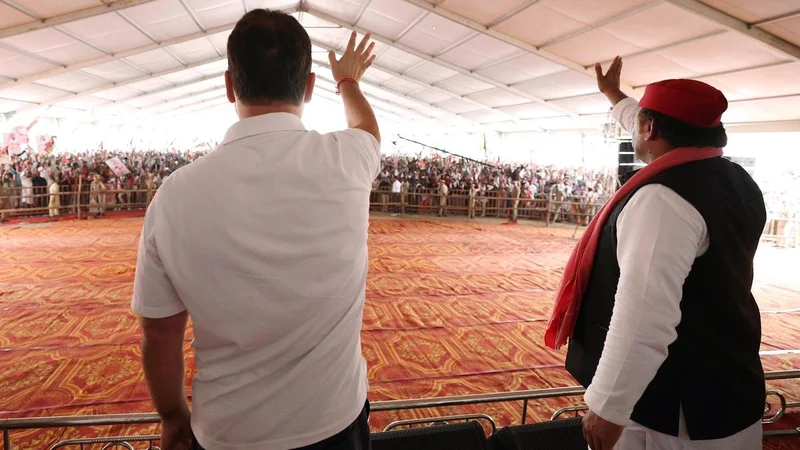
The Congress party, under its leader Rahul Gandhi, is attempting perhaps its most significant ideological and social repositioning. It seeks to recast itself as the principal political vehicle of the Bahujans: the broad social coalition of Other Backward Classes (OBCs), Scheduled Castes, Scheduled Tribes, and economically disadvantaged groups among the upper castes and minorities. In doing so, it is consciously trying to move beyond its long-standing image as a party whose leadership and institutional culture were dominated by upper castes, even while it enjoyed substantial support from the rest. Mr. Gandhi’s repeated emphasis on a nationwide caste census, his slogan ‘Jitni Abadi, Utna Haq (rights proportional to population’), and his persistent advocacy of greater representation in state institutions all reflect a larger political project: to redefine the Congress as the natural home of social justice and equitable representation.
Samajwadi Party (SP) chief Akhilesh Yadav too is engaged in an equally ambitious exercise for his party. The SP has long carried the perception of being primarily a Yadav-Muslim formation: a coalition that delivered electoral success but also imposed clear political limits. Mr. Yadav now seeks to broaden that social base. His formulation of Pichhda, Dalit, Alpsankhyak (PDA, i.e., Backward Classes, Dalits and Minorities) signals an effort to transform the SP from a caste-centred regional party into a wider coalition across caste and religious lines. He has now said P stood also for Pandits, i.e., Brahmins.
Published - August 12, 2026 12:16 am IST