IDAHO FALLS, Idaho — NASA officials say they are confident in plans to launch a nuclear electric propulsion demonstration mission by the end of 2028 after visiting the national lab building the mission’s reactor.
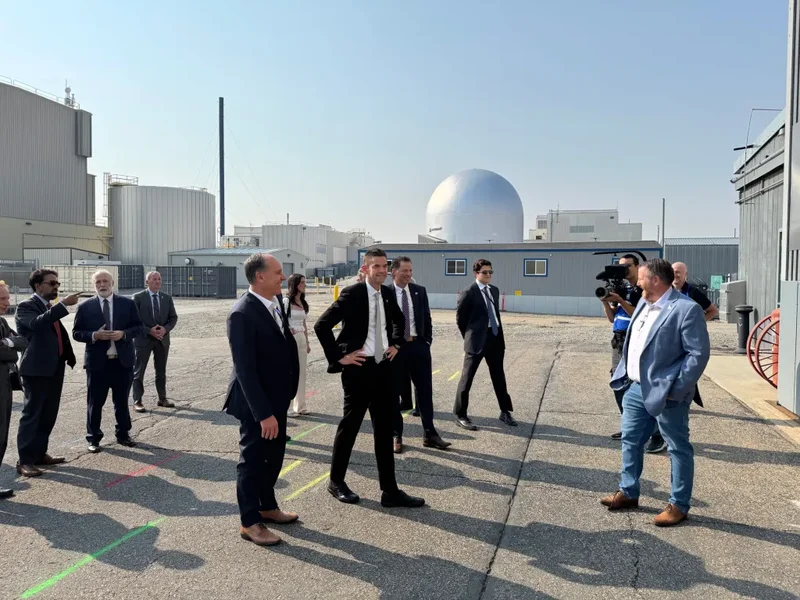
NASA leadership, including Administrator Jared Isaacman and Associate Administrator Amit Kshatriya, visited the Idaho National Laboratory, or INL, on Aug. 7 to review work being done on nuclear reactors there. That includes designs developed by the lab itself as well as several companies that are using INL to test small nuclear reactors, some with potential space applications.
INL is responsible for the reactor that will be used on Space Reactor 1 Freedom, a mission NASA announced at its Ignition event in March. SR-1 Freedom, slated for launch in late 2028, will use a 20-kilowatt-electric nuclear reactor to power an electric propulsion system originally developed for the lunar Gateway. That will propel the spacecraft to Mars, where it will deploy SkyFall, a set of helicopters modeled on the Ingenuity rotorcraft that accompanied the Perseverance Mars rover.
SR-1 Freedom is intended to be a precursor for future space nuclear power and propulsion systems, Isaacman said in remarks after the tour, drawing comparisons to the USS Nautilus, a U.S. Navy submarine that was the first nuclear-powered vessel.
“This is our Nautilus, and where we go from here must lead to the nuclear NASA of the future,” he said. “What should follow is an agencywide Apollo-like endeavor, a series of SR missions, progressively incorporating new technology.”
That would, in turn, lead to a vehicle capable of crewed Mars missions, he said. “Then we bring those technologies together into a vehicle capable of carrying astronauts to Mars and bring them home safely, and not just once.” That would, he argued, be the culmination of a “third space race” after the original space race of the 1960s and an ongoing second space race to return humans to the moon.
Isaacman told reporters after his remarks that the tour “absolutely” increased his confidence in launching SR-1 Freedom by the end of 2028. “Everybody’s moving very quickly,” he said, including both government and commercial teams.
SR-1 progress and challenges
NASA announced SR-1 Freedom at the same event where it also revealed its intent to establish a lunar base over the next decade. However, while NASA has provided regular updates about work related to the base, the agency has said little about SR-1 since the Ignition event.
At a meeting of two National Academies committees in early June, NASA officials said they were working to streamline management of SR-1 Freedom to ensure it could be ready to launch at the end of 2028, but provided few technical details on the mission and declined to offer a cost estimate. The agency later said it has a preliminary cost estimate of $2.1 billion for the mission.
In an interview after the INL event, Steve Sinacore, NASA’s SR-1 Freedom program director, said the agency had recently finished a “design sync review” for the mission analogous to a mission concept or systems requirements review that examined the status of the major elements of the mission.
Those elements include the Power and Propulsion Element, or PPE, a spacecraft originally built for the lunar Gateway with a high-power electric propulsion system. NASA plans to repurpose the PPE as the electric propulsion system for SR-1 Freedom. He said the agency was preparing a contract modification to Intuitive Machines to perform the needed modifications to the PPE.
He added the agency has a concept for the spacecraft structure that will link the PPE with the SkyFall payload and the nuclear reactor. “Procurements are hitting the street for the major components, and so we’re making really good progress,” he said.
The heart of SR-1 Freedom, though, is the reactor itself. The mission will use a design based on the Versatile Autonomous Lightweight Kilowatt-class Reactor Experiment, or VALKRE, a reactor concept developed at INL. That reactor will use high-assay low-enriched uranium, or HALEU, also provided by the Department of Energy.
Neither NASA nor DOE have provided many details about the reactor design. Media accompanying the NASA tour of INL were not allowed to take photos or videos in a room that contained information about and hardware related to VALKRE and its application for SR-1 Freedom, and some lab officials were reticent to talk about VALKRE.
NASA officials, though, said they were pleased with what they saw of reactor development at INL. “I was super impressed to see the engineering design unit for VALKRE, the condition that was in, the testing they’ve done,” said Kshatriya.
That heritage is essential to meet SR-1 Freedom’s schedule. “We need to launch by December of 2028, and to do that, we just have to use the things that we have today,” said Justin Coleman, division director for nuclear reactor technology at INL.
That December 2028 launch date requires the reactor itself to be completed by the spring of 2028. “It’s a very aggressive schedule,” he said, but one he felt was achievable based on what companies have demonstrated with small nuclear reactors in the past year. “I think that shows it’s possible, and there is a supply chain that we can pull from to make that happen.”
That supply chain, though, poses perhaps the biggest issue to meeting that schedule. “The biggest challenge is the procurement of components,” said Sebastian Corbisiero, national technical director for the DOE Space Reactor Program, as those nuclear reactor startups also need some of the same components.
“There’s some overlap with some of the components that are needed by these small commercial reactors as well, so the biggest challenge is making sure that we can get all the pieces and parts made in time to meet NASA’s target,” he said.
Coleman, in addition to his work at INL, also serves as a senior adviser to the NASA administrator on space nuclear issues. “In my role at NASA, I’m there to help enable that to happen,” he said of SR-1 Freedom. “So, if NASA’s running into barriers, if they’re running into issues, I’m there to help them remove those.”
Both NASA and INL say they have been cooperating well on SR-1 Freedom. Corbisiero described the collaboration as “badgeless” between the agencies. “You wouldn’t necessarily know whether it’s a NASA engineer or a DOE INL engineer. We are all part of one team.”
“It’s been phenomenal to watch the nuclear reactor design engineers at INL and the NASA spaceflight engineers get together and meld their craft,” said Sinacore. “It gives me great hope that this is going to happen, and it’s going to be sustainable for the future.”
Thinking beyond SR-1
As NASA and INL race to develop a reactor for SR-1 Freedom in time for a late 2028 launch, they say they also want to avoid developing a point design that is suitable for that mission but can’t be extended to later applications, such as a proposed Lunar Reactor 1 that could be used by NASA’s future lunar base.
“All of the technology that we are using will absolutely be extensible to both Lunar Reactor 1 and then the next version of SR-1,” said Sinacore. “That is always in our design decision space: Is it extensible or not?”
Examples of this, he said, are the reactor’s use of a Brayton power conversion system to generate power from the reactor’s heat, which can be scaled up for larger reactors, as well as heat-pipe technology he said could be used on future reactors up to the megawatt level.
“I don’t see any constraints in terms of scaling this up,” said Corbisiero. “Within the reason of the mission cases that we’ve thought about, this technology that we’re pursuing is good.”
Coleman said one goal of the SR-1 Freedom program is to develop a reactor design that can then be handed over to industry to build and revise for future space missions.
“Hopefully, with Space Reactor 1 Freedom, when we are done, we’ll have a design that we’ll say, ‘Yeah, that’s good enough. It works. It meets the objectives,’” he said. “At that point, we have a technology that works, and we hope that there’s a private industry out there that is interested in helping take that technology and then grow it.”