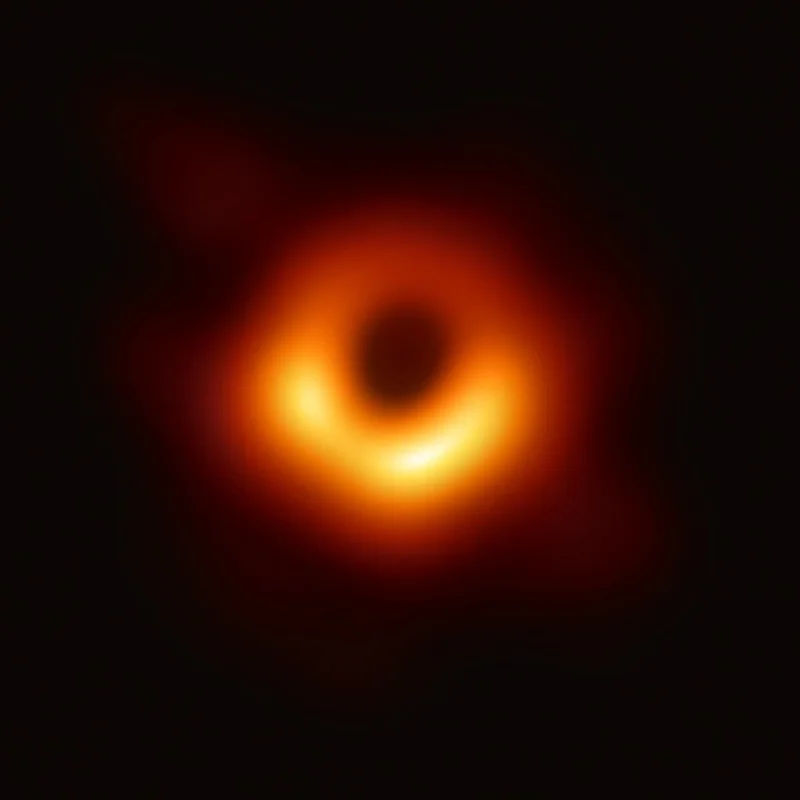
There is a question that often comes up at every public talk I do, and I have never had a good answer to it, well not an entirely confident one. What's inside a black hole? The textbook reply is a singularity. Cross the event horizon, and everything falls inward to a point of infinite density where our equations return nonsense. It isn't so much an answer as an admission that we've run out of physics.
Enter Chen Tan and Yong-Qiang Wang from the Lanzhou University who have now published something rather more interesting. Their paper describes a configuration they call, with a wonderful directness, a neutron star in a black hole!
A neutron star crushes around half a million Earth masses into a sphere roughly the width of Manhattan. In Tan and Wang's solution, one of these sits intact inside an event horizon; surface at 8.5 kilometres, horizon beginning at 10 (Credit : NASA's Goddard Space Flight Center)
The setup starts with an idea from last year. Certain exotic forms of dark matter, arranged in a halo with a particular relationship between pressure and density, can produce black holes with no singularity at the centre! These are so called âregular black holes,â where the equations stay sensible all the way to the centre. Tan and Wang asked what happens if you drop an ordinary neutron star into the middle of one of these halos.
The answer, worked through the standard equations of stellar structure, is peculiar. Below a certain halo density, nothing dramatic occurs and you get a neutron star with a dark matter cloud around it, slightly squashed. Above a certain density, the whole thing collapses and no stable solution exists.
But between those two, something strange happens in the space just outside the star. A shell forms In one of their models, a shell forms running from about 10 to 12 kilometres out, with the star's own surface sitting at 8.5. Here the geometry flips and becomes that of a black hole interior. An event horizon, in other words, but one that closes over a star rather than being created by it. And inside, the neutron star simply carries on, regular, structured, entirely non-singular.
The Bullet Cluster, where two galaxy clusters have collided and the mass has separated from the visible matter. The blue regions are dark matter, the substance this entire solution depends on, and which nobody has yet identified (Credit : X-ray NASA/CXC/CfA/M. Markevitch et al.; Optical NASA/STScI; Magellan/U.Arizona/D. Clowe et al.; Lensing map NASA/STScI; ESO WFI; Magellan/U.Arizona/D. Clowe et al.)
The crucial point in this model is that nothing collapsed. The gravity making the horizon comes from the star and the halo combined, with the dark matter contributing roughly as much mass as the star itself. The team find the same result using two different descriptions of neutron star matter, which suggests it isn't an artefact of one particular assumption.
Now the caveat, which the authors state plainly and which deserves stating plainly here too. The dark matter densities this requires are far greater than anything astronomers actually expect dark matter to reach. This is not a claim about objects out there in the sky but more of a thought experiment with the mathematics filled in. It says the inside of a black hole need not be the end of physics. There is at least one solution in which itâs a place, with something in it! The challenge remains the same as with any black hole, they need to be detected and maybe one day one of these peculiar objects will be found.