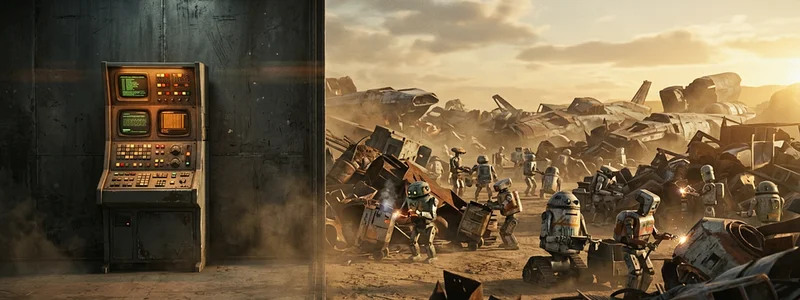
Two science-fiction futures for machine intelligence: the lonely oracle and the crowded junkyard. Only one of them came true. AI assisted.Droids are cheap, specialized, everywhere, and slightly annoying. That commodity vision maps to how artificial intelligence is reaching your desk right now.Science fiction gave us two competing pictures of artificial intelligence, and for decades we bet on the wrong one.Star Trek imagined a single, calm, all-knowing computer; one brain per starship, summoned by voice, answering anything. That felt like the sophisticated future managed by Microsoft Windows with Clippy (Duck!).Star Wars imagined something messier: droids. Cheap, mass-produced, task-specific machines, underfoot in every scene, bought and sold like appliances, ordered around, occasionally argued with, mostly ignored and not really connected to anything for upgrades.The junkyard, not the bridge, and read that way, the two franchises were placing different bets on how machine intelligence would arrive.One imagined concentration.The other imagined diffusion.The diffusion camp is winning.The AI reaching your desk does not look like the Enterprise computer, it looks like a swarm of small, bounded, unglamorous tools you have already stopped noticing, a spread that mirrors how earlier general-purpose technologies moved into the world.Unintegrated through Model Context Protocol, but they can still talk to each other. How quaint.The prediction was never in the plots, but in the furniture. This piece walks through five things Star Wars got right, and what each one tells you about designing for the machines already here.A working machine is one nobody stops to admire anymore.Appliances, Not MarvelsThe central bet in Star Wars is that machine intelligence becomes ordinary. Droids are not marvels anyone gathers to admire. They are equipment — welded, dented, resold at swap meets, wiped and repurposed, left to power down in a corner until they are needed again.Nobody on Tatooine is amazed that a droid can translate or navigate, any more than you are amazed by a thermostat. That casualness was the real prediction, and it has aged well.Compare the Star Trek model: one central computer per ship, addressed out loud, treated as an oracle. It is a cleaner fantasy, and a worse forecast. Intelligence in that world stays concentrated and rare, while in the Star Wars world it is distributed and cheap, which is the direction the technology took.The measure of a technology’s arrival is not wonder, it is how fast it becomes part of your life.The numbers back the junkyard.McKinsey’s The state of AI in 2025: Agents, innovation, and transformation reports that 88 percent of organizations now use AI in at least one business function, up from 78 percent a year earlier. This is in a mess that has to be wired up manually still.That is a utility spreading the way electricity did, when factories stopped sharing one giant steam engine and gave every machine its own small motor.Droids passed that test on screen decades ago, and AI is passing it now, quietly, in the tools you already forget you are using.A galaxy of bounded specialists beats one mind that claims to do everything.Narrow Machines Beat General GeniusLook closer at the droids and the second prediction appears: specialization beats general genius. An astromech patches ships. A protocol droid handles language. A medical droid runs surgery. None of them is a do-everything supermind; each is a bounded tool that does one job well and knows its edges. The galaxy runs on a division of machine labor.That is close to how AI is being deployed, whatever the headlines about a single coming superintelligence suggest. The working reality is plural. The paper Anatomy of a Machine Learning Ecosystem: 2 Million Models on Hugging Face analyzed roughly 1.86 million models on one open-source hub, a sprawling population of narrow, task-tuned systems, most of them fine-tuned descendants of a few parents, each pointed at a specific job.Real deployment looks like a division of labor, not a single mind that knows everything. This should be read as Small Language Models are the future.The productive shift was not one enormous engine getting smarter; it was small motors multiplying until every task had its own. General-purpose models matter, but the value shows up when they are cut down, specialized, and embedded where the work is.The protocol droid does not need to fly the X-wing. It needs to be fluent, reliable, and cheap enough to keep around, kind of like MCP. Design for the bounded competence you can trust, not the general genius you keep waiting for.The highest compliment a smart feature earns is that no one calls it smart.Translation as a Boring UtilityC-3PO is a walking translation service, fluent, the films claim, in over six million forms of communication. What is telling is how boring everyone finds this. Nobody treats the protocol droid’s fluency as sorcery.It is a service you switch on, like a dial tone. Star Wars guessed that translation would become infrastructure long before it stopped feeling like magic.That guess landed, because machine translation is now plumbing. Google’s own account, 110 new languages coming to Google Translate, describes adding that many languages in a single expansion to help over half a billion people, part of a stated goal to build models for the thousand most-spoken languages on earth.Translation stopped being science fiction and became plumbing, which is exactly what winning looks like.A capability that would have read as fantasy in 1977 is a free feature inside a browser tab, used a billion times a day without ceremony. That is the C-3PO arc in miniature: not a genius who astonishes you, but a utility so reliable you stop thanking it.Aim for the dial tone: the highest compliment your intelligent feature can earn is that no one calls it intelligent anymore.Give a machine a manner and people start treating it like a colleague.Machines People Argue WithThe droids have personalities, and everyone treats them as social beings. Han argues with them. Luke gets attached to one. The astromech and the protocol droid bicker like an old married couple. Star Wars understood something many engineers resisted for years. Give a machine a voice and a manner, and people will relate to it socially, whether or not it deserves the treatment.That instinct is now a product strategy. The moment a chatbot got a warm tone and a name, people started confiding in it.Common Sense Media’s Talk, Trust, and Trade-Offs found that 72 percent of United States teens have used an AI companion, and that this is mainstream behavior rather than a fringe hobby.Give a machine a voice and a manner, and people will relate to it socially, whether or not it deserves the treatment.The bond is not free. A joint study from OpenAI and the MIT Media Lab, Early methods for studying affective use and emotional well-being on ChatGPT, paired an analysis of nearly 40 million conversations with a controlled trial of about 1,000 people, and found that the heaviest, most emotionally engaged users reported more loneliness and more dependence, not less.The manner works, and that is the problem as much as the point. A machine that feels like a companion is one you correct less, doubt less, and lean on more than its reliability may warrant.Star Wars played the bond for warmth and comedy and rarely asked what it cost. You do not have that luxury.If you design manner into a system, you are shaping trust, and trust that outruns competence is where people get hurt. Design the personality on purpose, and design the brakes alongside it.The more a system acts on your behalf, the harder it is to call it just a tool.The Ethics Star Wars Stumbled IntoThe last thing Star Wars got right, it got right by accident. Droids are property. They are bought, sold, rented, and wiped.The films almost never pause on any of this, and the treatment is background furniture. Yet, played back now, it looks like a preview of a question we are walking into.The question arrives with agency. A tool that answers is easy to treat as a tool; a system that acts invites a murkier relationship. When a system books, buys, sends, and decides on your behalf, the clean line between operator and instrument blurs.KPMG’s AI Quarterly Pulse Survey found that agent deployment nearly quadrupled in a single stretch of 2025, reaching 42 percent of organizations, up from 11 percent two quarters earlier.A tool that answers is easy to treat as a tool; a system that acts invites a murkier relationship.I do not think your code editor has feelings, and I am not arguing that it does. The point is narrower and more practical.As systems take actions, the framing of “just a tool” starts to strain, not because the machine has a claim on you, but because the way you treat an agent shapes how you reason about responsibility, oversight, and blame when it acts wrongly.Star Wars let itself off the hook and enjoyed the droids as loyal sidekicks.You are building the real ones.The stakes are not hypothetical. Gartner Predicts Over 40% of Agentic AI Projects Will Be Canceled by End of 2027, blaming escalating costs and inadequate risk controls rather than weak models.Concretely, that means deciding in advance what an agent may do on its own, where a human sign-off is mandatory, and how you halt it when it goes wrong. The restraining bolt, in your world, is called governance, and it is worth designing before you need it.Stop Designing the Enterprise ComputerPut the five together and a coherent forecast emerges from a space opera about laser swords. AI would arrive cheap, not rare. It would specialize rather than generalize. It would turn hard problems like translation into boring utilities. It would wear a personality and earn a strange kind of trust. And it would raise questions about agency that its creators would rather not answer.Star Trek imagined a cleaner, grander machine and got the shape of the future wrong. Star Wars imagined a junkyard and got it right.None of this means the films were doing engineering, they were telling stories and the accuracy is partly luck.But the reason the junkyard reads as prophetic is that it took machine intelligence seriously as something ordinary, embedded in daily life, owned and used and argued with, rather than enshrined on a bridge.That ordinariness is the whole forecast, the part every grand vision of intelligence keeps quietly missing.That is the useful correction for anyone building now. Stop designing the Enterprise computer. You are building droids: small, specialized, social, and increasingly able to act.Design them as what they are, and design the restraining bolt before you hand them the keys.ResourcesChris Noessel and Nathan Shedroff, Make It So: Interaction Design Lessons from Science Fiction — the companion site to the book that treats science-fiction interfaces as a design source.72% of US teens have used AI companions, study finds — reporting on the Common Sense Media companion research.Google Translate adds support for 110 languages, representing 614M speakers — the scale of machine translation as everyday infrastructure.Model statistics of the 50 most downloaded entities on Hugging Face — how concentrated and specialized the open-model population is.What Star Wars got right about AI was originally published in UX Collective on Medium, where people are continuing the conversation by highlighting and responding to this story.
What Star Wars got right about AI