It turns out, the world's biggest dark matter detector may well be the planet you're standing (or sitting) on. Dark matter makes up around a quarter of the energy content of the universe, and we still have no idea what it is. Two of the leading suspects are the axion and the dark photon, both hypothetical, both extraordinarily light. In this case, the range studied here puts them some nineteen to twenty-one orders of magnitude lighter than an electron.
Numbers like that stop meaning anything, so put it this way, you would need a billion billion of them to get close to the mass of a single electron.
The ionosphere, the electrically charged upper atmosphere. The gap between it and the ground forms a natural cavity that rings at around eight cycles per second, the frequency an ultralight axion would announce itself at (Credit : NASA's Scientific Visualisation Studio)
The usual way to hunt an axion is for it to turn into a photon, which it will do in a sufficiently strong magnetic field. Hence the enormous laboratory magnets that have been created across the World. But a laboratory can only be so big, and the volume you can fill with a strong field is the fundamental limit on the experiment.
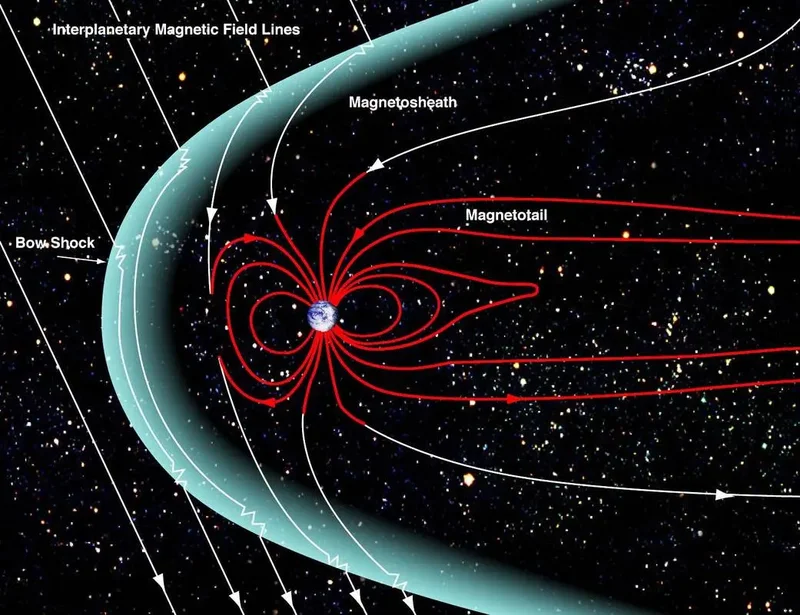
Atsushi Taruya at Kyoto University, working with colleagues at Hiroshima and Nihon universities, asked the obvious question that nobody had quite followed through. The Earth has a magnetic field, and it is vastly larger than anything we can build.
Better still, the space between the ground and the ionosphere forms a natural cavity, and like any cavity it has a resonant frequency. Lightning strikes ring it constantly at around eight hertz, the Schumann resonance, discovered in the 1950s. That resonance happens to fall right in the frequency band where an ultralight axion would announce itself, so the planet doesn't merely act as a detector, it acts as an amplifier.
The theory to describe this only worked below one hertz, so the team built a new framework accounting for the electrical conductivity of the atmosphere, extending reliable predictions up to about thirty hertz. Then came the part I like mostâ¦.they didn't build anything. They went to the British Geological Survey's observatory at Eskdalemuir in the Scottish Borders and took a decade of magnetic field measurements, from 2012 to 2022, recorded for entirely unrelated reasons. They stripped out the artificial noise and looked for a steady, narrow signal of the kind dark matter should produce over long timescales.
Two galaxy clusters after a collision, with the mass (blue) separated from the visible matter (pink). It is among the clearest evidence that dark matter exists, and among the least informative about what it actually is (Credit : X-ray NASA/CXC/CfA/M. Markevitch et al.; Optical NASA/STScI; Lensing map NASA/STScI, ESO WFI, Magellan/U.Arizona/D. Clowe et al.)
No axion. But the limits they set on how strongly axions can couple to light are roughly a hundred times tighter than the best previous ground-based result, and they rival constraints from X-ray observatories like Chandra and NuSTAR which come with theoretical assumptions of their own.
The dark photon search however looks more promising as there are some unexplained signals, it turned up several in fact. Nobody yet knows what they are, and the honest expectation is that they'll probably evaporate under scrutiny. But someone now has to check and maybe, just maybe, the Earth has become the dark matter detector we have all been looking for.
Source : Searching for dark matter with the world's biggest detector