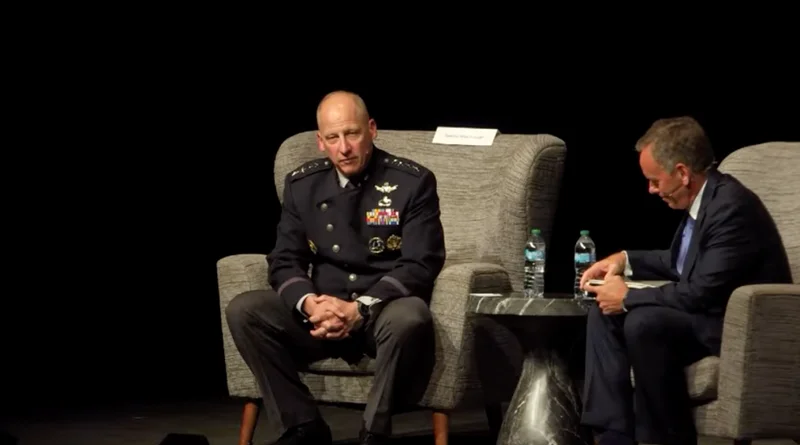
HUNTSVILLE, Ala. — Gen. Michael Guetlein, the Pentagon official overseeing Golden Dome for America, warned that the missile defense initiative faces a fiscal year 2027 funding gap unless Congress finds a new way to finance the program.
Speaking Aug. 11 at the Space & Missile Defense Symposium, Guetlein said Golden Dome is in an unusual budget position because its initial funding was routed through reconciliation rather than the Pentagon’s regular annual budget.
“It’s a tough, tough budget environment to try to figure out how to fund all of the nation’s priorities, both domestic and military overseas,” Guetlein said during a fireside chat with retired Army Lt. Gen. Dan Karbler.
When the administration submitted its fiscal 2027 defense budget, Guetlein said, “the plan was another reconciliation package.” With that route now uncertain, the Pentagon and Congress need another solution.
“We’ve got to figure out a different way of funding Golden Dome, at least in 2027,” Guetlein said. “Both sides of the aisle, the House and Senate, are working with OMB on how to do this in 2027.”
His warning was unusually direct: “I will tell you that if they don’t figure out a result, there is no funding.”
Guetlein later tempered that assessment, saying he is “concerned about the timing of the money, but not really concerned about the funding,” because he expects lawmakers ultimately to reach an agreement.
Golden Dome is the Trump administration’s planned layered homeland missile defense architecture, intended to combine existing and new sensors, interceptors and command systems against ballistic, hypersonic and cruise missiles and other aerial threats approaching the U.S. from multiple directions.
The administration continues to put the broader cost at roughly $185 billion. Guetlein again defended that figure against outside estimates that have run far higher, arguing that analysts have largely extrapolated the cost of existing systems across the geography of the U.S. rather than pricing the architecture his office is building.
Golden Dome, he said, is intended to make greater use of lower launch costs, improved computing, commercial space manufacturing and military systems that already exist.
For now, the more immediate question is whether Congress can keep the money flowing fast enough to sustain the schedule.
“I do believe, as a nation, we’re going to figure this out,” Guetlein said, urging executives in the audience to weigh in with lawmakers. “Talk to your representatives. Please let them know your thoughts.”
He added that Congress is also confronting competing demands for supplemental spending tied to overseas conflicts. “We’ve got to figure out how to fund that as well.”
Some construction underway
Even with the uncertainty over next year, Guetlein said Golden Dome has moved quickly through the initial funding Congress has already provided.
He said the program currently has $22.5 billion, with 95% of it committed. That money has put radars, launchers, space-based interceptors and the Space Data Network under contract, he said.
Golden Dome also has its “first operational site,” Guetlein said, and construction is underway elsewhere.
“We are digging dirt around the homeland,” he said.
He did not identify the locations, but said he expects construction at the sites to be almost complete by the end of 2027.
The program has also conducted two tests, Guetlein said, describing both as highly successful while declining to discuss specifics because the results remain classified. He said the 2027 test campaign will be more complex and will build toward the operational demonstration planned for 2028.
Guetlein also offered one of the clearest explanations yet of how Golden Dome is being executed across the Pentagon.
His own office is directly running only command and control, he said. Most other capabilities are being funded and developed through the military services and defense agencies, then brought back together through a common command-and-control architecture.
That structure helps explain why Golden Dome spending is appearing inside existing Space Force, Missile Defense Agency and Army programs rather than primarily through contracts issued directly by Guetlein’s office.
It also puts integration at the center of the effort.
Many of the Pentagon’s missile-defense systems were designed to operate independently, with their own radars, communications networks, command systems and interceptors. Golden Dome is supposed to connect them into a broader network capable of sharing data and coordinating engagements across the homeland.
Guetlein said President Trump signed a national security presidential directive roughly three weeks ago giving Golden Dome broader access to government data the program determines it needs. Previously, he said, obtaining information from organizations such as the Federal Aviation Administration, NASA or the Department of Homeland Security could require separate negotiations with each agency.
The program plans an interagency exercise this fall aimed in part at identifying legal and operational authorities that could complicate homeland defense. Guetlein cited counter-drone operations as one example, where responsibility can shift among military, federal and local authorities depending on where an aircraft is flying and the nature of the threat.
Those integration issues will become more relevant as Golden Dome moves from separate weapons and sensor programs toward the larger network the administration wants to demonstrate in 2028.