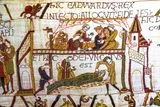
In 1066 C.E., a battle raged between King Harold Godwinson and William, Duke of Normandy (William the Conqueror) for the English crown. The Battle of Hastings is one of the most notable historic moments in English history. A defining moment when the invading Normans struck down King Harold and his forces, and the Norman Conquest began.
Many of the events leading up to the battle and the battle itself are depicted on the Bayeux Tapestry, an embroidery that stretches nearly 230 feet long and 20 inches tall. The tapestry, which is normally housed in France, is set to go on display at the British Museum in London. Along with this event, new findings about this period are coming to light.
A recently uncovered letter, however, tells a story that the tapestry does not depict. These findings suggest that the battle for England’s crown may have been decided in Rome, not Hastings, thanks to the conflict between two rival popes.
The Battle Between Two Kings and Two Popes
As a power struggle raged in England, two popes were also competing against one another, according to research from the University of East Anglia (UEA).
“In 1061, rival factions elected two competing popes, Alexander II and Bishop Cadalus of Parma, who became known as Honorius II.” Tom Licence, a professor of Medieval History and Literature at UEA, said in a press release. “For several years the two popes and their supporters fought for control of Rome, with Honorius retaining powerful backing from the Holy Roman Empire and attracting support elsewhere in northern Europe.”
Before uncovering the letter, traditionally, historians viewed the Battle of Hastings and the Norman Conquest as a domestic struggle. The letter, however, suggests that the conflict stretched all the way to Rome. Research suggests that King Harold may have backed Honorius over Alexander II, leading the disgruntled pope to throw his support behind William, Duke of Normandy.
"1066 was not simply decided on the battlefield at Hastings. The outcome may also have been shaped by decisions taken almost a thousand miles away in Rome," Licence said.
What Pope Alexander II’s Lost Letter Said
The findings come from one of Pope Alexander II’s lost letters, which is preserved in a medieval canon law collection at the Vatican.
“The Pope's whole register of letters is lost,” said Licence. “But some survive as copies or excerpts. Two excerpts from this particular letter survive in collections of papal rescripts.”
In the letter, Pope Alexander II discusses the relationship between the papacy and England before the conquest. He goes on to claim that England had once been protected by St. Peter, until the people “fired with the pride of their father Satan” led the nation away from “the path of truth,” according to the press release.
“While historians have occasionally noted these remarks, they have generally treated them as unexplained references,” said Licence. “But they can only be fully understood in the context of a fierce dispute that divided Western Christendom during the early 1060s.”
According to Licence, this rhetoric was often used against Honorius and those who followed him at that time. The letter suggests that instead of calling out King Harold as an oath-breaker, Pope Alexander II called out all of England for abandoning him and perhaps siding with “evil.”
“In the eyes of Pope Alexander's supporters, it was no longer simply a battle for a crown, but a struggle against those they regarded as followers of Satan," Licence said.
Pope Alexander II’s Political Gain
According to Licence, the letter helps answer an important historical question: Why would the pope advocate violently overthrowing an already anointed king?
"Historians have traditionally explained papal support for William through Harold's disputed claim to the throne and allegations of oath-breaking," Licence said. “What this evidence suggests is that Pope Alexander II may have had political reasons of his own for backing the Norman invasion."
"If Harold had aligned England with Alexander's rivals, it would help explain why the pope was willing to support the overthrow of a crowned king. Viewed from Rome, the conquest was not simply a succession dispute but part of a wider struggle over the future of the Church in Europe," Licence added.
Read More: A Toilet Helps Identify the Lost Residence of Last Anglo-Saxon King of England
Article Sources
Our writers at Discovermagazine.com use peer-reviewed studies and high-quality sources for our articles, and our editors review for scientific accuracy and editorial standards. Review the sources used below for this article:
- This article references information from the University of East Anglia: Lost letter from the Pope casts 1066 as a holy war against ‘followers of Satan’