Photo courtesy of AITX
Every agentic AI demo ends in the same place. The system notices something, produces a clean summary of what it noticed, and hands the decision back to a person waiting on the other side of the screen.
That handoff is where most of what gets called agentic quietly stops being agentic.
It is also the most expensive thirty seconds in enterprise software, because it is the moment the machine finishes its work and the organization goes back to waiting on a human.
The Alert Was Always the Easy Part
Detection got solved. Across security, observability, logistics, fraud, and industrial monitoring, the sensing layer has improved dramatically. Models got better at classifying what they were looking at. Recall went up. False positives came down. Every one of those systems got measurably smarter at noticing.
What happens immediately after noticing has barely moved.
A person reads the alert, decides whether it matters, and works out what to do next. The sensor did its job. The bottleneck sat one step downstream the entire time, and almost nobody was building there.
An alert is a request for a human's attention. Attention scales far more slowly than detection does. An organization can add sensors faster than it can add people qualified to interpret what those sensors produce, at the moment the decision has to be made, with the same judgment every time.
That mismatch is why alert fatigue shows up identically in a security operations center, a network operations center, and a hospital telemetry unit. Different domains, same structural failure. The queue grows faster than the people reading it.
Deployed Is Not the Same as Trusted
The gap between shipping an agent and trusting one is wider than the category admits.
Forrester Consulting, in
The split underneath that number is the useful part. Forrester sorted respondents by operational readiness, measured on governance, integration, and API and MCP management. In the top quartile, 55 percent reported high confidence in what their agents decide and do. In the bottom quartile, 22 percent did. Trust tracked the plumbing, not the model.
Steve Reinharz, CEO and Founder of Artificial Intelligence Technology Solutions, Inc. (“Organizations should approach AI claims carefully because the market is currently flooded with messaging that does not always reflect real operational capability,” he says.
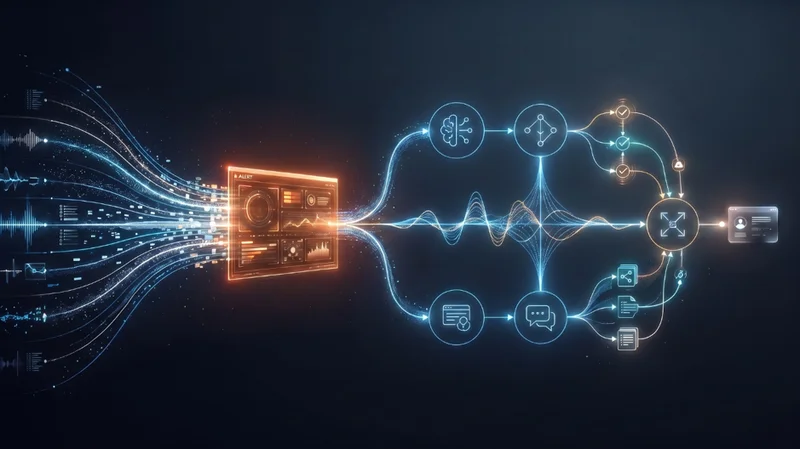
His working definition of operational autonomy is narrower than most marketing copy will admit to. A system observes an environment. It interprets what it is seeing. It makes a decision inside defined parameters. It initiates an action. It communicates with a person. It documents what happened. It escalates the moment a human needs to step in.
Seven steps. Most deployed systems perform two of them and stop.
A platform that runs flawlessly through a curated pilot and inconsistently three months into production has not solved anything. It has postponed the problem to a quarter when more is riding on it. The Forrester spread suggests a large share of the industry is currently living inside that delay.
The Real Cost of Building AI Native
AITX built its platform on the far side of that handoff.
The architectural decision underneath it is the part worth arguing about.
Most AI in operational software is an assistant bolted onto a workflow that predates it. It detects, classifies, and recommends, and a person converts the recommendation into action. That system inherits everything about the original workflow: its data formats, its handoff points, its assumptions about who is responsible for what. The model is new. The shape around it is not.
A system designed to act from the first architectural decision carries less of that. Unexpected inputs were part of the original design surface rather than an exception handler added later, which is why the two behave completely differently the first time production sends something nobody planned for.
That path is slower and more expensive, and it shows up in the roadmap. Every new capability has to be designed against the full loop rather than the convenient half of it. There is no shipping detection this quarter and figuring out escalation next quarter. The constraint is the point.
It also has to run where the work already happens. SARA operates inside the platforms operations teams already have open during a live event, including Immix, rather than asking anyone to rebuild around it. That sounds like integration trivia. It is the difference between technology an organization can adopt and technology it admires from a distance.
Security Is the Lab, Not the Destination
Physical security turned out to be an unusually honest place to test all of this, for reasons that have nothing to do with security being interesting.
The feedback is immediate and the failure modes are public. A false escalation wastes a dispatcher's night. A missed one is a different conversation entirely. Latency is not an abstraction when milliseconds separate a warning from an incident, which forces decisions to the edge rather than through a round trip to a data center. And nothing survives a demo environment for long, because the environment is a parking lot and the test subject did not agree to participate.
None of this is a story about operators failing at their jobs. A person watching dozens of feeds through a night shift is being asked to do something attention was never built to do. The failure is structural, and adding headcount has never once fixed it.
The security industry has started conceding the point in public. SARA won the Security Industry Association's New Product Showcase Award in Commercial Monitoring Solutions at ISC West 2026, a year after taking both Judges' Choice and Best in Threat Detection and Response from the same body. RAD, the AITX subsidiary that builds the hardware, has also completed a SOC 2 Type 2 audit, an important independent standard for enterprise technology providers.
But the interesting part was never the parking lot.
Where the Alert Screen Goes Next
Observe, interpret, decide, act, document, escalate. That loop is not a security pattern. It is the operating model of an IT operations desk at 3 a.m., a logistics dispatcher rebalancing docks, a facilities team triaging building faults, a fraud queue, and a clinical monitoring station at shift change.
Every one of those environments has spent a decade buying better detection. None of them has a good answer for the step after it.
For anyone building in this category, the question that matters is not whether a model can reach the right conclusion. It is whether the system can be trusted to act on its own conclusion, unsupervised, across thousands of unscripted instances, consistently enough that the trust survives the one time it is wrong. That is an operations problem disguised as a machine learning costume, and the 34 percent figure is what it looks like unsolved.
The clearest measure of progress in agentic AI is not benchmark performance. It is the shrinking distance between what a system decides and what it is permitted to do about it.
The next generation of agentic AI will not be defined by how well systems detect, summarize, or recommend. It will be defined by how reliably they close the distance between decision and action.
This story was distributed as a release by Sanya Kapoor under
Disclaimer: This article is paid content. HackerNoon’s editorial team has reviewed it for clarity and quality standards, but the views, claims, benchmarks, and comparisons expressed are solely those of the sponsor, and HackerNoon assumes no responsibility for third-party assertions contained in sponsored content.