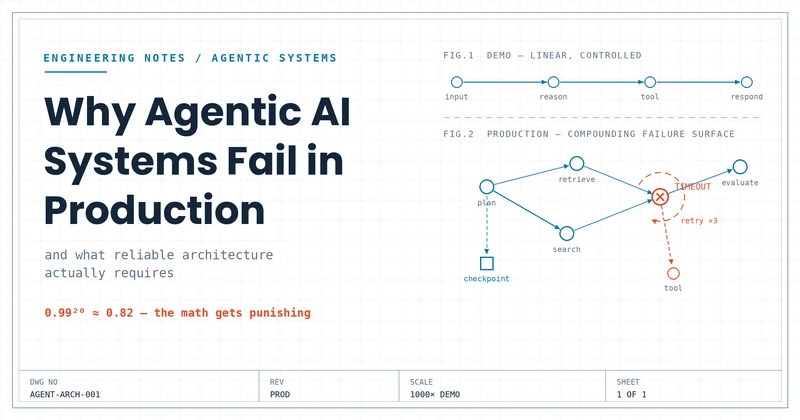
The moment the agent performs a sequence of tasks for the first time, feels like a breakthrough. The moment the agent repeats it for the second time, it seems repeatable. But once it performs the task hundred times and even more, people think it’s ready for production.
Until it breaks down in production and begins to make inconsistent decisions. The tool call times out. The quality of retrieval degrades. The context windows get polluted with stale context. The latency spikes unpredictably. Multi-agents workflows deadlock under loads. The flawless demo turns out to be unreliable in production.
This pattern has been observed many times throughout the industry. The teams invest months in tweaking prompts, selecting the right model and building increasingly sophisticated agents’ workflows, only to find out the real problems with reliability emerge much later.
And the thing is, those problems are not caused by the selected model. Those are architecture issues.
Having spent years working on distributed AI infrastructure, large-scale ML platform and production AI systems, I’ve seen quite a few of those architecture problems resurfacing in agentic architecture space under different names.
The leap from the successful agent demo to a production agent is not really about intelligence.
It is all about architecture.
Demo-to-Production Fallacy
The majority of agent demos work in ideal conditions.
The environment is controlled. The APIs respond as expected. The context is small. The tools are always available. The session is short. The interactions are predictable. But the production environment rarely offers such luxury.
For example, a customer support agent might have to serve a thousand users simultaneously. The research agent might have to use dozen of external API calls in a single workflow. The enterprise assistant might maintain the context during weeks of interactions. The retrieval systems are constantly changing with evolution of the knowledge base.
Each new dependency introduces a new failure mode.
Yet there are many approaches that continue considering reliability as something you can just add later through retries, monitoring dashboards or prompt refinements.
And that mindset produces fragile systems, since reliability is not an extra layer. It is a fundamental property of the architecture.
Distributed machine learning provides a good point of comparison. It is relatively easy to train a model using a single GPU. But to scale that training across several hundreds or thousands of GPUs introduces a whole different set of problems with synchronization, fault-tolerance, communication overhead and state management.
The same happens with agentic architecture.
Even a perfectly fine agent in isolation can fail catastrophically once you run it at scale due to the non-linearity of complexity. What looks like AI problem is actually infrastructure problem in disguise.
The teams that are capable to deploy production agents early on have already realized that. They consider orchestration, state management and observability to be the first-class citizens of the architecture.
What “Agentic” Really Means at Scale
The concept of “agentic AI” is used so broadly that it might lose the meaning very soon.
At the least, the agent can be called the system that is able to reason, plan and take actions towards the goal.But what really means being agentic at scale?
Let’s imagine a single-agent workflow. It can be something like this:
- User input
- LLM reasoning
- One or two tool calls
- Response generation
The architecture is relatively straightforward. But once the multi-agent systems come into play, the architecture gets a whole different flavor:
- Agents communicate with each other
- Tasks are delegated
- There are shared memory layers
- The dependencies are interconnected
- There is coordination logic
- The latency gets compounded across several execution paths
And the failure surface gets substantially bigger as a result. Imagine the following enterprise workflow:
- Planning agent is splitting a task
- Retrieval agent is gathering context
- Research agent performs external searches
- Execution agent invokes APIs
- Evaluation agent validates the output
Each of these steps introduces a new failure mode:
- Tool execution error
- Retrieval inconsistency
- Context corruption
- API rate limit
- Network interruption
- Latency variance
- Model non-determinism
The system will continue working fine most of the time.
But “most of the time” is not production-level reliability. Traditional web architectures are based on the statelessness principle. The requests are coming, calculations are performed and the responses are served.
With agentic workflows, the things get different. The agents need to maintain persistent memories and long-running execution path with complex state.
And architectural patterns taken directly from traditional web services become unsustainable as a result.
The system is no longer performing calculations on separate requests. It is maintaining an evolving computational state.
Four Structured Failure Modes
1. Non-Deterministic Tool Chaining
The most misleading feature of any agent architecture is the ability to look perfectly reliable while being essentially unpredictable.
An agent may succeed at performing 95% of tasks. But the remaining 5% make the operations extremely troublesome.
The issue usually occurs in multi-step tool orchestration. The minor variations in the model reasoning can lead to different execution path, thus resulting in the different outcome for the same input.
And the unpredictability grows as the workflow gets longer.
Five steps workflow with 99% reliability per step gives approximately 95% of reliability overall. Twenty steps workflow will end up with about 82% success.
The math gets punishing. The teams in the field of distributed systems have already understood decades ago that reliability has to be considered in terms of the whole system rather than its components. Agentic systems require the same rigor.
2. Context Window Mismanagement
The majority of retrieval strategies works pretty fine in initial testing phase.
But the problems start occurring once the sessions get longer. The context windows get filled with redundant context. The historic interactions are accumulated. The retrieval pipeline starts returning increasingly irrelevant content. And the degradation usually comes gradually and therefore is hard to detect.
At some point, the agent starts looking less intelligent while the model is exactly the same underneath.
The issue is the context pollution.
It is a similar memory management problem for the distributed computing. The systems that fail to manage the state effectively will eventually see performance degradation regardless of their computational capabilities.
3. Lack of Observability
The vast majority of teams can tell when an agent fails.
But only few can tell why. Surprisingly, a lot of deployments can only provide the visibility into the final output but lack the information about the intermediate reasoning steps, the results of retrieval, the interactions with tools and state transitions.
And the engineers are left with the situation of post mortem analysis without the access to the crucial execution data.
Fortunately, modern distributed systems have solved this problem years ago through observability frameworks.
4. Retrying as a Reliability Mechanism
The most widespread anti-pattern is treating retries as the substitute of reliable architecture.
Tool call failed? Retry.
Retrieval returned poor results? Retry.
The agent took a wrong action? Retry.
There is nothing wrong with the retries. Every decent distributed system uses them. The problems emerge once the retries are used as the only mechanism of reliability. In many cases, retrying hides the design flaws behind and introduces the latency increase, costs and lack of the failure understanding.
Designing Reliability from the Beginning
The reliability of the system cannot be retrofitted efficiently.It has to be designed from the very beginning.
And one helpful mindset shift here is to stop treating the orchestration as application logic and start treating it as infrastructure. This matters.
Because infrastructure is supposed to be highly fault tolerant, observable and recoverable. But the glue-code usually is not.
And many agent implementations fall in the latter category. One helpful approach is to borrow the lessons of distributed machine learning systems.
Checkpointing the State Frequently
The distributed training frameworks, such as ZeRO and FSDP, work great mainly due to the fact that they are based on the assumption that the failures happen.
The state of the training is checkpointed continuously. The recovery is a part of the architecture. The same applies to the agents.
Instead of restarting the entire workflow once the failure happened, the system has to persist the intermediate state and continue executing from known checkpoint. This reduces the cost and the impact of failures substantially.
Separating Planning, Execution and Evaluation
Quite often, the architectures mix together reasoning, the action execution and validation in a single workflow component.
It introduces the scaling issues and makes the troubleshooting harder. A more resilient design separates these parts. The planning generates the strategy. The execution executes the actions.
The evaluation validates the outcomes. Each layer can scale independently and be monitored and recovered independently.
Choosing the Right Computational Model
Not every agent requires maintaining the state.
Not every workflow needs stateful execution. The actor-based architectures are more suitable in case of the agents maintaining the state and continuously interacting or communicating with each other.
On the other hand, the task-based architectures work best for short-lived and isolated workloads. But choosing the right computation model is far from the trivial task. The architecture should follow the workload nature rather than the hype about some framework.
Observability Is Not an Operational Concern
Observability is usually perceived as an operational aspect.
But it is more of a design constraint. Reliable agent system exposes the telemetry data during each step of the execution. Among others, the team has to monitor:
- Step-wise execution latency
- Success rate of tool invocations
- Quality metrics of retrieval
- Context usage patterns
- Decision pathways of agent
- Performance of the external dependencies
- Categorization of failure trends
Just as important is how the data is collected. Unstructured traces get quickly hard to analyze on scale. The structured logging makes the aggregation and correlations possible. This is especially relevant in case of the non-deterministic systems, when identical inputs can lead to different execution paths.
It is something the distributed ML teams figured out by building the GPU monitoring infrastructures. The job, which is running on thousands of GPUs, cannot be optimized without the visibility into the utilization, communication overhead and memory behavior. The agent systems face the same reality.You cannot improve the reliability of something that you cannot observe.
The RAG Layer Is the Reliability Constraint
The RAG is usually perceived as an additional quality improvement.
But in reality, it is a reliability dependency. The most insidious retrieval failures are the silent ones. The agent continues working. The responses are generated. Nothing crashes. But the context quality has degraded under the hood. The system is functioning normally while making wrong decisions. There are several reasons for that.
Chunking Strategy
The chunk size affects how the context is represented and retrieved.The bad choice of the chunking strategy can fragment the context or increase the noise.
Embedding Drift
The embedding models are evolving. The knowledge base is changing. And the retrieval quality, which was good enough before, becomes worse over time without alerting anyone.The organizations underestimate this danger.
Index Staleness
The retrieval systems are as current as their indexes.
The outdated indexes introduce informational gaps, which are invisible to the agents.It is somewhat similar to the cache consistency in distributed systems.The infrastructure is operational but serves the outdated information.Therefore, the production-grade RAG architectures have to introduce the degradation mechanisms. Once the retrieval quality decreased, the system has to react to it.
It has to expose uncertainty, gather additional evidence or lower the automation levels instead of operating blindly.
What Does Being Production-Ready Mean
The AI industry evaluates the readiness through the benchmark performance. But the production environment requires the other criteria.
The agent is not production-ready because it performs well in the benchmarks. It is production-ready because the failures of the agent are predictable.More precisely, the production-ready agent satisfies three criteria:
- The system can fail in limited number of ways
- Failures are observable and understood
- The failures are recoverable
It is a close match to the principles that define the reliability of the distributed infrastructure. Interestingly enough, it has very little to do with the model intelligence.
So the practitioners interested in the production readiness should be asking themselves questions, rarely addressed in vendor benchmarks:
- Can the workflows resume from checkpoints?
- How do the retrieval failures manifest?
- What are the telemetry options for the agent’s reasoning?
- How are the external dependencies isolated?
- What happens in case of the memory corruption?
- How is the state persisted?
- How are the cascading failures contained?
These questions matter much more for the operational viability than the incremental benchmark improvements.The future agentic systems will distinguish themselves through the architectural discipline.
The reliability in agentic AI is not the feature flag.It is not something that can be switched on once the deployment happens.It is a design philosophy influencing the architecture decisions from the very beginning.