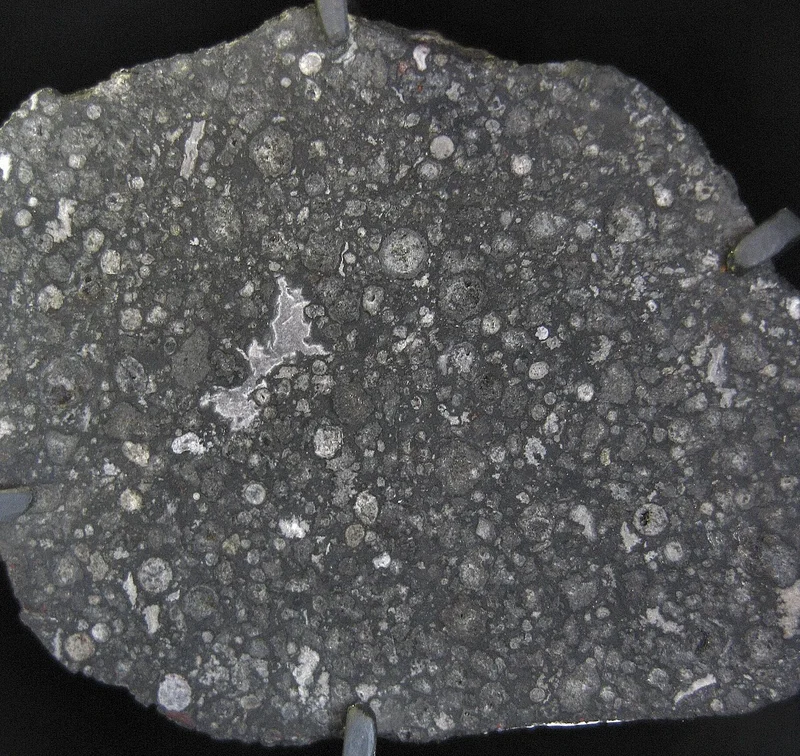
In February 1969, months before Apollo 11 lifted off, a fireball crossed the sky over Chihuahua and dropped more than two tons of rock across northern Mexico. The Allende meteorite is the largest primitive meteorite ever recovered on Earth, primitive in this sense meaning unaltered, a rock that has sat unchanged since the Solar System was assembling itself 4.5 billion years ago. It is about as close to a fossil of the solar nebula as we are likely to get without going there, and more than half a century later people are still learning things from it.
The oldest things inside Allende are called calcium-aluminium-rich inclusions, or CAIs. These are the first solids known to have condensed out of the hot gas of the early Solar System, the very first material to stop being vapour and start being rock. Everything that followed, the asteroids, moons and even the ground beneath you came afterwards.
The white patches in this image are CAIs, the first material in the Solar System to stop being vapour and start being rock. Buried inside them, the new work finds grains from a star that died before the Sun existed (Credit : Dmadeo)
Now, the interesting part is that since the 1980s, researchers have known that primitive meteorites contain grains that are older still. Nano-diamonds and similar minerals with compositions so unlike anything in our Solar System that the only explanation is that they formed around some other star, one that died before the Sun ignited. Genuine stardust, predating everything.
But those grains had only ever been found in the cool, carbon-rich matrix of meteorites. Never in the CAIs, which formed in the hot regions where you would expect delicate ancient grains to be destroyed.
Ren Marquez and Francois Tissot at Caltech, with Bruce Charlier at Victoria University of Wellington, have now found them there and argue the grains did more than merely survive. They think the stardust acted as nucleation seeds, the surfaces around which the first Solar System solids crystallised.
Tissot puts the problem neatly ânucleation is very difficult without a surface to grow on. Without something to disrupt an otherwise uniform mix of gases, minerals should have taken a long time to condense as the Solar System cooled. The stardust solves a problem cosmochemists hadn't properly addressed.â
The image, then, is this. A star lived and died somewhere, scattering dust. Some of that dust drifted into the cloud that became our Sun, endured the furnace, and became the grit around which the first solid matter here condensed.
A specimen of the Allende meteorite at the Center for Meteorite Studies, Arizona State University. More than two tons fell across Chihuahua in 1969, and fragments are still yielding new results more than half a century later.
There is a footnote to this story that I rather think needs calling out. The techniques Marquez developed to analyse vanishingly small samples are now being turned on blood and tissue, with a project underway to aid osteoporosis detection. Itâs rather wonderful that sometimes, studying the night sky informs and progresses science down here on Earth that has a very real impact on our lives. As Tissot's grandfather apparently used to say âwe didn't discover electricity by studying the candle.â
Source : Ancient Stardust Were Seeds for the Earliest Solids in the Solar System