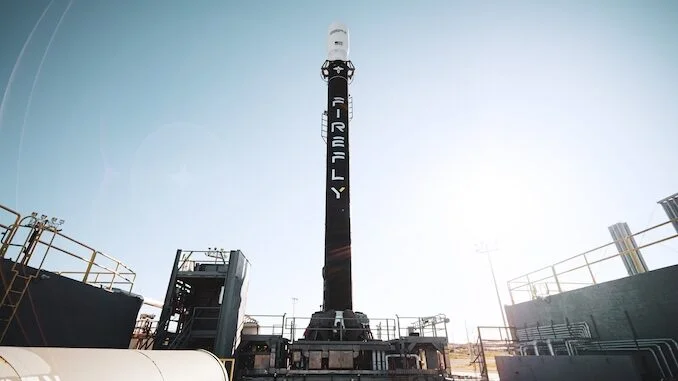
Firefly Aerospace said it will be at least another two months before it’s ready to launch its next Alpha rocket. Alpha Flight 8 (FLTA008) will debut the Block 2 configuration of the rocket.
During its second quarter earnings call on Tuesday, Firefly CEO Jason Kim said the next two Alpha launches are now expected to take place in the fourth quarter of 2026.
“We are preparing for acceptance testing of Alpha in the next few weeks, followed by delivery to Vandenberg, static fire, payload integration and then launch,” Kim told investors. “As with any flight, we’ll disclose more specific timing as we get closer to launch.”
Following a successful launch of Flight 7 on March 11, Kim said the goal is to close out the year with three Alpha missions. He said that the rockets for Flight 10 and Flight 11 are “flowing through our production line” and stated that they sold the majority of the company’s 2027 launch manifest.
Kim didn’t name a specific number of launches planned for next year.
“We have visibility into out years as well, thank to the extension of our Lockheed Martin multi-launch agreement,” Kim said. “Additionally, we added a second hypersonic task order for Alpha from a confidential customer.”
In addition to its launch pad at Vandenberg Space Force Base, Firefly is also moving forward with SSC Space’s Esrange Space Center to bring Launch Complex 3C online with the first launch from that site planned in 2028.
Firefly increased its research and development costs by $25.8 million for the second quarter of 2026 as compared to the same time period of 2025, according to a financial disclosure to the U.S. Securities and Exchange Commission. The company said that it stemmed mainly from “costs related to the Alpha program associated with ramping production on our Alpha Block 2 configuration upgrade, stock-based compensation expense, depreciation and amortization from newly acquired assets being placed into service, and other R&D initiatives.”
The next evolution of Alpha.
Block II is the next-generation configuration of our Alpha rocket and the only operational U.S. 1-ton rocket. The striking white exterior isn’t just for looks—it enhances thermal protection and is one of several engineering upgrades across the… pic.twitter.com/FdYCQPj3gL
— Firefly Aerospace (@Firefly_Space) August 11, 2026
The shift to the Alpha Block 2 rocket was necessitated by the in-flight anomaly seen during the Alpha Flight 6 mission on April 29, 2025. Teams determined that increased thermal protection system thickness on the booster was needed after a rupture occurred following stage separation.
The company also experienced an explosion of one of its Alpha boosters during an acceptance test at its facilities in Briggs, Texas, in late September.
The Alpha Block 2 rocket is designed to overcome the issues that led to that explosion. That includes increasing the length of the vehicle by seven feet to account for larger liquid oxygen tanks; shifting to in-house manufactured batteries and avionics; and building stronger carbon composite structures.
Road to Eclipse
While progress continues towards the next version of its Alpha rocket, Firefly continues working towards bringing its medium-lift rocket, Eclipse, to life alongside Northrop Grumman. That rocket is now expected to debut sometime in 2027.
“We are maturing Eclipse towards first flight. Our thunderous Miranda engine, designed for reusability, crossed 150 hot fire tests to date as the campaign crosses key milestones at pace,” Kim said. “A big, recent unlock was the flight-like mission duty cycle test that the team completed, with the engine firing for 226 seconds, all while completing both power ratio and mixture ratio sweeps.
“Our Miranda engine qualification test campaign is imminent, as our recent tests demonstrated the performance needed to meet the range of stress requirements during a launch.”
Kim said the engine base structure for Eclipse, which mounts the seven Miranda engines that power the first stage, is currently “in assembly and bonding as we prepare for integration.” He noted that the hold-down/release clamps that will be built into the pad infrastructure in Virginia is also being built.
Eclipse shares a first stage with another joint venture between Firefly and Northrop Grumman: the Antares 330 rocket. That vehicle will use a solid rocket upper stage and is designed to fly up to three time to deliver Cygnus spacecraft to the International Space Station.
Kim said that Firefly is “focused on delivering the vehicle’s first stage” to Northrop Grumman. Spaceflight Now reached out to Northrop Grumman to see whether it expects the Antares 330 to fly first or Eclipse.