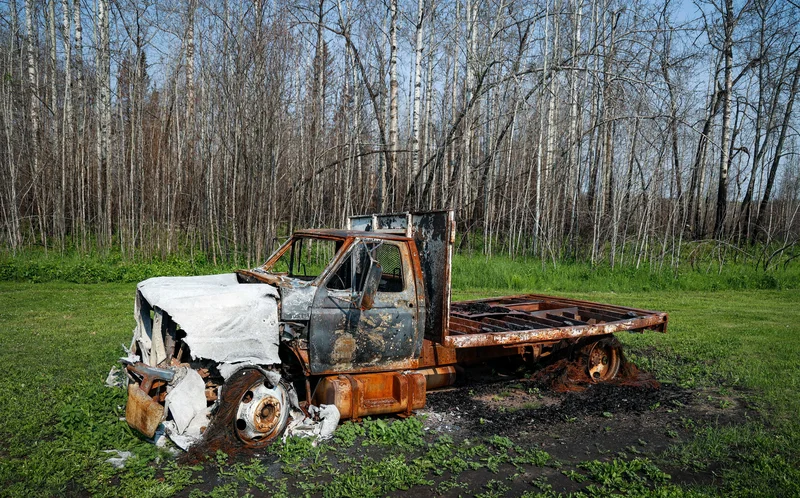
An Indigenous community in Alberta is suing the provincial government for damage caused by a 2023 forest fire, alleging officials prioritized neighbouring areas while Métis land burned, resulting in dozens of destroyed homes and buildings, scorched timber assets and the loss of carbon offset credits.
East Prairie Metis Settlement, which sits about 400 kilometres northwest of Edmonton, in a lawsuit amended in April alleges Alberta was ill-prepared at the start of the 2023 wildfire season despite the extreme fire hazard, which hampered the province’s ability to respond to blazes.
The province did not have enough wildland firefighters and resources to attack the blaze, which was dubbed the Grizzly wildfire, when it ignited in early May, 2023, the community alleges. Further, Alberta advised East Prairie Metis Settlement that it was not in danger when the province knew or should have known otherwise, the lawsuit alleges.
That an Alberta community has turned to the courts to apportion blame – and seek compensation – for a natural disaster’s wreckage underscores the mounting financial and political risks for Canadian jurisdictions wrestling with more frequent and intense wildfires as climate change reshapes the planet. U.S. President Donald Trump last month threatened to hit Canadian goods with additional tariffs as punishment for the wind blowing smoke from northern forest fires south of the border.
Alberta Premier Danielle Smith has argued that Ottawa mismanages forests in Canada’s national parks, negligence she said contributed to the fire that devastated Jasper in 2024 and threatens to ruin other communities.
The 2023 fire season was the most damaging in recorded Canadian history, with flames consuming about 17.2 million hectares that year, according to the Canadian Interagency Forest Fire Centre. This included the 180,458 hectares the Grizzly blaze chewed through in and around East Prairie Metis Settlement, the lawsuit alleges.
The settlement covers 33,444 hectares between Slave Lake and Grande Prairie. East Prairie Metis Settlement alleges the Grizzly fire torched 54 of its homes and outbuildings and about 30,100 hectares of its coniferous and deciduous timber, worth about $19.3-million. The lawsuit also alleges the fire destroyed carbon offsets valued at about $12-million, traditional areas and culture, and wildlife that serves as a source of both food and income.
“There were instances where firefighters and resources were shifted from one fire to another without any apparent reason, causing questions to arise as to the priorities assigned to the different fires, and leading to potential resentment and hurt morale,” the Métis community alleges. “Valuable energy and time was lost as crews spent time moving to change fires rather than fighting them.
“In particular, crews and equipment from EPMS were told to redeploy to the community of Banana Belt to the west of EPMS, despite the fire not being under control within the Settlement.”
The Grizzly fire overlapped with the province’s 2023 election campaign, and East Prairie Metis Settlement alleges this meant the Indigenous community “had difficulty in communicating with the appropriate representatives.”
Alberta has not filed a statement of defence, according to court records.
Responding to an inquiry from The Globe and Mail, the government did not address specific questions about the allegations.
“Alberta’s government is committed to protecting communities and supporting Albertans impacted by wildfires through prevention, preparedness, response and recovery efforts across the province,” spokesperson Karah Folk said in a statement provided to The Globe.
The province declined further comment because the matter is before the courts.
East Prairie Metis Settlement filed a statement of claim in the Court of King’s Bench of Alberta in May, 2025, and amended its allegations in April. The document provides a glimpse of a string of alleged missteps, ranging from Alberta providing cumbersome radios to officials ordering crews to focus on other fires, that East Prairie Metis Settlement claims were ultimately detrimental in the spring of 2023.
A similar case by a tribal nation in Washington State has sought a potentially enormous payout from the United States government. In 2021, the Confederated Tribes of the Colville Reservation filed a suit claiming the federal government failed to properly manage forest fuels, fight wildfires or replant trees after flames scorched valuable stands of commercial timber. In 2015 alone, fires burned through 165,000 acres of Colville forest lands. From 2015 to 2021, flames destroyed an estimated one billion board feet of lumber – worth, at current prices, more than a half-billion U.S. dollars.
And wildfires continue to attack Colville forests. The reservation encompasses roughly 1.4 million acres. In the past decade – including new fires in the past month – more than 1.1 million acres have burned, said Brian Gunn, a lawyer for the Colville in the case. He is himself a Colville tribal member.
In 2024, a federal judge ruled that the case can proceed, citing laws that obligate the U.S. government to manage areas categorized as “Indian forests.” That management includes work to thin forests and “protection against losses from wildfire.”
“There is a trust responsibility to Indian tribes in the United States,” Mr. Gunn said in an interview. “And under certain circumstances, if the government fails to live up to those responsibilities, the beneficiary – in this case, the tribe – can sue and get money as damages.”
Lawyers have spent years amassing paperwork for the case.
“If it doesn’t settle, we’ll have a trial,” Mr. Gunn said.
In Canada, forest fires disproportionately affect Indigenous communities, which are often sparsely populated and located in remote areas. Between 1980 and 2021, roughly 42 per cent of wildfire evacuations in Canada occurred in communities where more than half the population was Indigenous, despite those groups making up just 5 per cent of the country’s population, according to a paper published in the International Journal of Wildland Fire by wildfire expert Amy Cardinal Christianson and her colleagues in 2024.
British Columbia’s Wildfire Act shields the government, ministers, officials, employees and others involved in battling blazes, while exercising power or performing duties under the legislation, from legal proceedings for damages.
The 2021 census counted 310 people in East Prairie Metis Settlement. Alberta announced in July, 2023, that $9-million from the Indigenous Housing Capital Program would be provided to help rebuild the community.
With reports from Jesse Winter in Vancouver