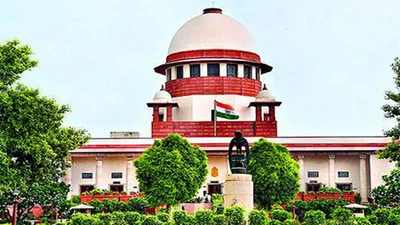
A view of the Supreme Court of India. File
\| Photo Credit: The Hindu
The Supreme Court on Tuesday (July 21, 2026) liberated the Kerala Waqf Board from the supervision of a State official, indicating it can judicially intervene in case of “egregious” interference in a statutory body’s day-to-day management.
A three-judge Bench headed by Chief Justice of India Surya Kant passed the order while hearing the Board’s appeal against an interim order of the Kerala High Court on July 15. The High Court had directed that the State Waqf Board must function under the “supervision” of the Joint/Additional Secretary of the government.
*Kerala HC halts major functions of Waqf Board*
Arguing in the Supreme Court, the Board said it cannot be compelled to function under the “command or control” of a government official.
“If the High Court direction has led to an egregious interference in the day-to-day management [of the Board], we would like to modify the last line of the order on the issue of supervision,” Justice Joymalya Bagchi said.
The Court, however, allowed the Joint/Additional Secretary to continue in the role of an ex-officio member of the Board.
*Kerala Waqf Board chairperson sees conspiracy in petitions*
The Bench was hearing the challenge raised by the State Waqf Board, represented by senior advocates Huzeifa Ahmadi and V. Chitambaresh, against a Kerala High Court interim order directing it to not exercise any major functions, incur capital expenditure or make policy decisions without express permission from the court. The judicial functions of the Board were also stopped.
The High Court gave the power of supervision of the Board’s functioning to a Joint or Additional secretary of the government.
The interim order was passed on the basis of writ petitions, one of them filed by BJP leader Shone George, submitting that the Board was not constituted according to the mandate of the Unified Waqf Management, Empowerment, Efficiency, and Development (UMEED) Act, 2025. The Act requires the inclusion of two non-Muslim members and a Shia member on the board. Petitioners contended that the Board had at present nine members, without the representation of non-Muslim communities and the Shia community.
*SDPI alleges Kerala government is complicit in Waqf Board restrictions*
Mr. Chitambaresh submitted that the interim order was passed without hearing the Board or its members. Mr. Ahmadi said the interim order had “virtually substituted a statutory authority [Board] with an administrator [Joint Secretary] under the government”. He alleged the petitions intended to substitute the already nominated members “with their own people”. The High Court travelled beyond the reliefs sought by the petitioners by handing over the supervision of the Board to a State official.
The petitioners argued that Section 14 of the UMEED Act does not mention that a lack of two members would make a Waqf Board defunct.
The Supreme Court requested the High Court to decide the petitions expeditiously, after giving parties a fair opportunity to place their claims and counter-claims. The court emphasised that it had not made any comment on the merits of the pending case in the High Court.
Published - July 21, 2026 03:22 pm IST