- See more Daily Mail on Google - save us as a Preferred Source
As Britain prepares to bake yet again this week, Britain's famous faces have faced just the same battle as everybody else to keep their gardens just about alive.
But one celeb is faring better than most – due to a quirk in hosepipe ban regulations, which some 27 million Britons are currently subject to.
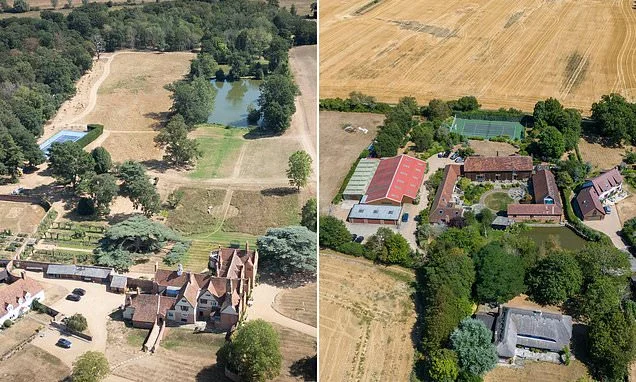
Chef Jamie Oliver's plush lawns are rather lusher than most, and the secret is easy to spot – a large personal lake just a stone's throw from the back of his Essex mansion.
He has lived at the Grade I listed 12-bedroom property since purchasing it for £6million in 2019, and the pond sits within its 70-acre site.
Mr Oliver, 51, is able to run hosepipes from the water feature to the rest of his garden, keeping it markedly greener than the surrounding parched countryside.
While this summer is set to be the UK's hottest ever and 45 million people are now living in areas declared in drought, the chef has kept selective areas of his land a refreshing shade of green, encircled in brown fields.
Under hosepipe bans, certain exemptions apply including to designate they can be used if the water is taken from a privately owned source.
These might include lakes or ponds, as well as springs or wells on the property.
Chef Jamie Oliver's plush lawns are rather lusher than most, and the secret it easy to spot - a large personal lake just a stone's throw from the back of his Essex mansion
He has lived at the Grade I listed 12-bedroom property since purchasing it for £6million in 2019, and the pond sits within its 70-acre site
Mr Oliver, 51, is able to run hosepipes from the water feature to the rest of his garden, keeping it markedly greener than the surrounding parched countryside
A long yellow pipe could be seen extending from Mr Oliver's garden to the pond behind in images taken this week.
The TV chef is faring better than many, including Rolling Stones member Keith Richards, 82.
The songwriter and guitarist's pad in West Sussex has a small garden encircled in buildings which is clearly being well cared for.
But other grass on his estate is just as brown and dry as the surrounding fields.
With no visible private water source, Mr Richards cannot rely on a handy nearby lake to get around restrictions, which came into place in the county on July 25.
The legendary musician has owned the property for decades after initially persuading the retired naval officer owner to sell.
Known as the Redlands Estate, the property would make headlines in 1967 after he and Mick Jagger were arrested there by police while high on drugs.
These days it's a much quieter corner of the English countryside, surrounded by large trees offering some protection from the relentless summer heat.
Keith Richards' pad in West Sussex has a small green garden at the centre, but other grass on the property is struggling
With no visible private water source, Mr Richards cannot rely on a hand nearby lake to get around restrictions, which came into place in the county on July 25
Sir Rod Stewart’s Grade II-listed mansion has very green gardens despite the dry weather
The property in Essex has an artificial football pitch with a 20-space car park
Sir Rod's mini golf course features a fairway, two bunkers and a lush putting green
One of the most successful gardening efforts this year has to go to Sir Rod Stewart, whose lawn betrays no hint it is even summer, let alone a record-breakingly hot and dry one.
Aerial photographs show the land around the 81-year-old singer's 18th-century Grade II-listed property, which he bought for £4.65million in 2013, is still extremely green.
His ten-bedroom home opens out on to a range of sprawling gardens and includes a mini golf course with a fairway, two bunkers and a lush putting green.
There is also an artificial football pitch with a 20-space car park which Sir Rod had installed at the property before moving in with wife Penny Lancaster in 2016.
Sir Rod's property is supplied by Affinity Water, which introduced a hosepipe ban across its central region, including Essex, on July 17 due to the weather conditions.
Eight other water companies have brought in bans, which mean customers are legally banned from using hosepipes to water gardens or wash cars, patios or boats.
There is no evidence Sir Rod has breached a ban, given there are many workarounds for watering grass such as using a watering can. He may also have an exemption such as that used by Mr Oliver.
Drought has been declared for all of Wales and almost three-quarters of England – and a sixth heatwave of the year is on the way this week with 38C (100F) highs.
It was confirmed on Tuesday that the UK is on course for its hottest summer ever – with only average conditions needed for the rest of August to beat a record set only last year.
The mean temperature for the summer so far, from June 1 to yesterday, stands at 16.48C – which is 1.88C above the 1991 to 2020 average, provisional data shows.
| Area | Mean temperature (June 1 to August 10, 2026) | Difference from summer average | Current warmest summer on record |
|---|---|---|---|
| UK | 16.48C | +1.88C | 16.12C (2025) |
| England | 18.19C | +2.46C | 17.44C (2025) |
| Wales | 16.80C | +2.17C | 16.09C (2025) |
Dry fields at Jeremy Clarkson's Diddly Squat Farm in Chipping Norton, Oxfordshire, today
The dirt paths and scorched grass of Parliament Hill on Hampstead Heath this afternoon
A person walks over a dried up stream on parched land at Richmond Park in London today
The grass surrounding Sarah Beeny's house also looked incredibly dry as it appears the entrepreneur has been sticking to the hosepipe ban
The £3 million custom-built Somerset estate near Wincanton, featured on her Channel 4 series Sarah Beeny’s New Life in the Country
| 1 | 40.3C | July 19, 2022 | Coningsby, Lincolnshire |
| 2 | 38.7C | July 25, 2019 | Cambridge |
| 3 | 38.5C | August 10, 2003 | Faversham, Kent |
| 4 | 38.2C | July 18, 2022 | Pitsford, Northamptonshire |
| 5 | 38.0C | June 26, 2026 | Lingwood, Norfolk |
| 6 | 37.8C | July 31, 2020 | London Heathrow |
| 7 | 37.1C | August 3, 1990 | Cheltenham, Gloucestershire |
| 8= | 36.7C | August 9, 1911 | Raunds, Northamptonshire |
| 8= | 36.7C | July 1, 2015 | London Heathrow |
| 8= | 36.7C | June 25, 2026 | Merryfield, Somerset |
To equal the 16.12C seen in 2025 – the UK's warmest summer on record – the rest of August would only need to be 0.21C below the long-term average, and any warmer than this would establish a new record for the country, meteorologists confirmed.
It comes as the record-breaking drought revealed the remains of a fascinating lost village which was demolished and flooded half a century ago to create a reservoir.
Stonework and the outlines of buildings in Nether Hambleton can now be seen because of the low water levels at Rutland Water reservoir in the East Midlands.
More than 3,000 acres of land were submerged in the 1970s to create what was then Europe's largest man-made lake, with residents rehoused in the surrounding areas.
Among the lost buildings were 18th century homes and farmland growing barley to be sold to Germany for brewing lager and wheat which Hovis bought for breadmaking.
The remains of Nether Hambleton were left in the bottom of a valley between what is now the Hambleton peninsula in the north and the hamlet of Lyndon to the south.
People across drought-hit England have been told to expect no rain in this week's forecast with some areas now having been completely dry for two months.
Some parts of Hampshire and West Sussex have not had rain for 59 days. The parched landscape will only deteriorate as Britain's sixth heatwave of the year builds from today towards one of the hottest days on record this Thursday with a 38C (100F) peak.
If 38C (100F) is observed, it would see Britain experience its joint fifth hottest day on record – tying with that same temperature recorded at Lingwood in Norfolk on June 26. The hottest-ever UK day was July 19, 2022 when Coningsby in Lincolnshire hit 40.3C.
The Met Office has issued only its second extreme heat warning in four years, in an alert saying the 'wider population is likely to experience some adverse health effects'.
The 15-hour amber warning for central and southern England will run from 9am until midnight on Thursday. Another extreme heat warning was also issued in the June heatwave but that was the first time such an alert had been issued since 2022.
Separately, UK Health Security Agency today activated amber heat health alerts for much of England, which will run until Friday – warning of a 'rise in deaths'.
The Government has urged people to stay safe by drinking plenty of water, checking on vulnerable friends and family, and avoiding the sun at the hottest part of the day.
Met Office chief forecaster Chris Bulmer said: 'While the peak heat will be more short-lived than recent heatwaves, temperatures widely into the mid-30Cs on Thursday bring the potential for impacts for some, which is why a Met Office warning has been issued.
'High pressure is now becoming dominant and temperatures will build day-by-day.
'Southerly and south-easterly winds will also tap into the hot conditions over Europe, which helps develop this further notable heat in what has been a hot and dry summer so far.'
This summer has been one of extreme heat and dry conditions, with two record-breaking heatwaves in May and June that led to the deaths of more than 2,800 people.
This was followed by two further heatwaves in July, and a fifth was confirmed last week.
The UK has been struggling with the impact of extreme weather including drought, heatwaves and wildfires.
Some 45million people are in drought-stricken areas, and 27million customers are under hosepipe bans as rivers and reservoirs run low.
Rainfall in July ranged from 1 per cent of the average in the South East to 26 per cent in the North West.
Meanwhile firefighters continue to battle a series of fires across the UK, including one in the New Forest National Park which began in a van and spread to nearby heathland.
The latest heatwave is set to subside over the weekend and bring fresher air and rain – although this is not expected to make up for the shortfall in recent months.
Sarah Davies, head of environment and energy at the Met Office, said: 'Forecasts for the remainder of August and into September suggest a good deal of dry weather is expected, mixed with some unsettled spells.
'While some areas may see useful rainfall at times, there is currently no strong signal for a sustained period of widespread rainfall, with below-average rainfall more likely than above-average for the period as a whole.'