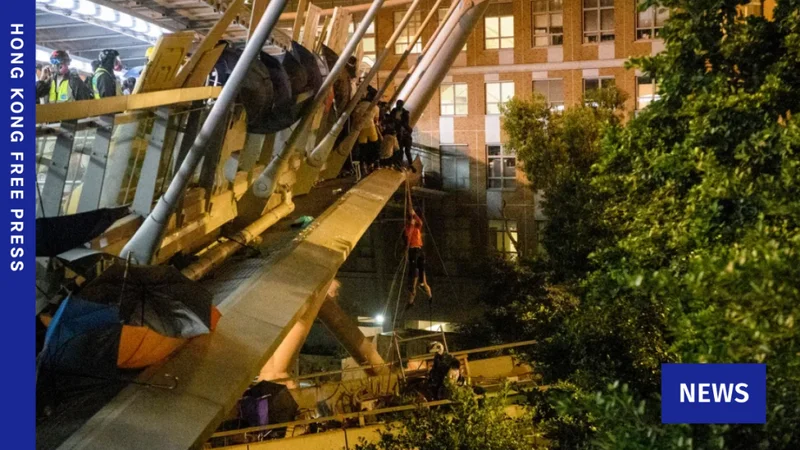
Six people who rappelled off a bridge and fled from a university campus besieged by police at the peak of the pro-democracy protests in 2019 are seeking an appeal against their earlier convictions for perverting the course of justice.
The six defendants, who were earlier found guilty and handed prison sentences after they fled into getaway vehicles, argued that accepting transportation should not constitute perverting the course of justice.
A panel of Court of Appeal judges said their decision will be handed down within six months.
Campus siege
The six appellants, Ng Wai-nam, Leung Wing-yan, Lau Shuk-wa, Tom Wong, Lam Yam-to and Lai Ching-yin, were earlier convicted and sentenced to five years and ten months.
They were accused of rappelling down from a bridge at the Polytechnic University and boarding getaway vehicles when the campus was surrounded by police at the height of pro-democracy protests and unrest in November 2019.
The prosecution had accused the defendants of participating in a “joint enterprise” to flee the scene. Senior Counsel Marco Li, representing Ng and Wong, asked the court to consider whether the defendants had committed a “positive” deliberate act by getting onto the vehicle.
The two defendants are only appealing against their convictions.
Li raised an example of a robbery, whereby robbers cannot face an additional charge of perverting the course of justice if they enter a getaway vehicle. Similarly, he said, fleeing the scene with someone providing transportation cannot be considered perverting the course of justice.
Barrister Yvonne Leung, representing Lam, said that there was no footage of her client rappelling from the bridge or boarding the vehicle on the Hung Hom Bypass. Barrister Steven Kwan similarly argued there was no footage of his client, Lai, boarding a private car.
Leung also said that the medical records the prosecution had earlier relied on to prove Lam injured his palms from descending the rope were insufficient evidence.
Assistant Director of Public Prosecutions Ivan Cheung said that the appellants were already acting in concert with drivers from the moment they rappelled down from the bridge.
In response to Cheung noting that there were vehicles already at the base of the bridge when the protesters came down, Judge Andrew Chan said it was possible the vehicles were there because they could not make a U-turn.
Cheung also cited the trial judge’s verdict, which ruled that the protesters’ boarding of the vehicles had involved a “division of labour” with a common purpose to evade arrest.