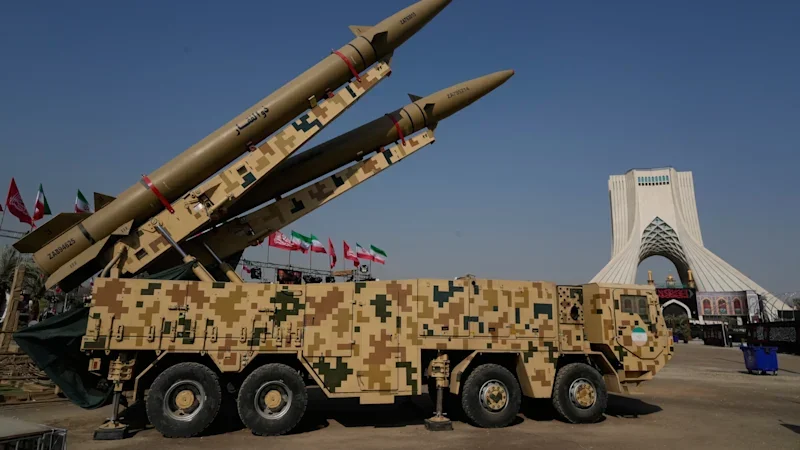
Washington: During five intense days last month, Iran launched waves of drones and missiles at US troops on three bases in Jordan, hoping to break through the formidable American air defences.
Using advanced missiles that can suddenly change course, Iran pummelled the bases’ defensive systems, forcing the Americans to burn through scarce supplies of Patriot interceptors.
On the fifth day, the Iranians broke through.
A missile struck prefabricated housing units at one base on July 17, killing three American soldiers and wounding more than 100. Pentagon officials later acknowledged that scores of other troops were injured, and several aircraft were damaged in attacks in Jordan that week.
”We shot down almost all the missiles,” US Secretary of State Marco Rubio said when asked about the fatal attack. “One leaked through.”
The strikes reveal a deadly confluence of two important trends. First, Iran has become a more skilled adversary as the war has progressed, learning how to evade US air defences as it widened the battlefield to include most of the Middle East and enlisted allies such as the Houthis in Yemen and militias in Iraq.
Second, the Pentagon’s supply of interceptors has quickly dwindled, with the weapons becoming more precious each day of the off-and-on conflict.
The two trends drive home a point that has slowly emerged in the months since the war started: that a global superpower with a mighty military footprint can still be held at bay by a lesser adversary willing to wage asymmetric warfare to find any advantage it can.
The Pentagon has used more than 1500 Patriot interceptor missiles in the war and has fewer than 1700 interceptors left, according to two people briefed on the stockpile levels who spoke on the condition of anonymity to discuss sensitive military details.
The United States produced about 600 interceptors in all of 2025.
The rapid depletion is occurring as Iranian forces study another war. In Ukraine, Russia has used combinations of ballistic and cruise missiles to distract Ukrainian air defences, and then rushed in drones.
“The Iranians are making it more difficult on air defences when you have a range of both missiles and drones coming in,” said Seth Jones, president of the defence and security department at the Centre for Strategic and International Studies.
“They have effectively leveraged the Russian tactic to make it more difficult to protect across locations in the Gulf.”
On a single day during that deadly week last month, according to two US officials, American forces in the Middle East fired about 50 Patriot interceptors, which cost about $US4 million ($5.6 million) each.
The Pentagon has continued to face a powerful threat, which it has tried to minimise, in the months since major combat ended in early April.
Defence Secretary Pete Hegseth told reporters on April 8 that Iran’s missile program was “functionally destroyed” and that its launchers and missiles were “depleted and decimated and almost completely ineffective”.
Most of Iran’s missiles and launchers were stored in vast underground facilities that US and Israeli forces heavily bombed during the first five weeks of the war. But Iran dug out many of those sites and resumed firing, bringing shipping in the Strait of Hormuz to a near standstill and threatening US troops in the region.
President Donald Trump and his national security advisers assumed the fight would be short and would not jeopardise the Pentagon’s Patriot stockpiles, said Vali Nasr, a professor at the Johns Hopkins School of Advanced International Studies.
But Tehran, he and other Iran experts say, had been waiting for this moment since the conflict began more than five months ago. During the 12-day war in June 2025, Iran’s leaders saw how quickly Israeli and American forces burnt through ballistic missile interceptors to knock down barrages of Iranian drones and missiles.
Iran’s deadliest strikes against American forces in Jordan targeted Muwaffaq Salti airbase in Azraq, a Jordanian military installation that the US Air Force has increasingly used as a major hub for dozens of aircraft and several thousand service members.
Many US troops previously stationed in Kuwait, Bahrain, Qatar and the United Arab Emirates were moved before and during the war to bases like Muwaffaq Salti that were farther from Iran and deemed safer from drone and ballistic attacks.
In the days immediately after the strike on July 17, US military commanders strengthened air defences in Jordan and elsewhere in the region, a senior official said, speaking on condition of anonymity to discuss operational matters but declining to provide more details.
A new reality
Military specialists who have also studied drone and missile attacks in Ukraine have been working with US Central Command for months, sharing lessons learnt from that campaign. Two of the three soldiers killed in Jordan were assigned to air defence units based in Germany that became part of that effort.
This new reality is having geopolitical consequences.
In late July, Trump asked Hegseth about the dwindling American weapons supplies, US officials said, confirming reporting by The Washington Post.
The Pentagon has maintained publicly that it does not have a shortfall. “Claims of US munition shortages are false,” chief Pentagon spokesperson Sean Parnell said in a statement. “When the fake news media irresponsibly amplifies these lies, the real-world consequence is clear: Our enemies are emboldened to provoke – or attack – American troops.”
In April, Iran shot down an American F-15E fighter jet over southern Iran with a shoulder-fired surface-to-air missile. Both the pilot and the weapons officer ejected.
The pilot was rescued quickly, but the weapons officer was missing for nearly two days, hiding from Iranian security forces until US special forces rescued him in a daring operation.
In this case, Iran learnt from Ukraine and deployed a swarm of drones in an area American fighter jets had penetrated, a senior US military official said. In interviews with Pentagon officials, the crew said that the F-15E’s defensive countermeasures provided only half a second of warning before Iran hit the $US60 million advanced fighter jet with a shoulder-fired missile.
Trump announced a “pause” in the fighting shortly after that incident. Military officials needed time to adjust to Iran’s new tactics, two military officials said.
Even during breaks in fighting, those tactics have continued to evolve.
When the Houthi militia in Yemen entered the war last month, experts said it signalled Iran’s intention to force the United States and its allies to defend themselves from aerial attacks from all directions. Yemen is hundreds of miles south of Iran.
International inspectors also believe that Iran is storing elements of its nuclear program in a heavily fortified underground complex in central Iran. The site, which the United States refers to as Pickaxe Mountain, is buried more than 90 metres beneath a mountain.
And Iran had sent its troops and leaders to hideouts scattered across the country, experts said.
“Where are they?” asked Nasr of Johns Hopkins. “It’s not like they’re sitting in a place where you can bomb them. You don’t find them.”
This article originally appeared in The New York Times.