Sign in. It’s quick, free and it’s up to you.
An account is an optional way to support the work we do. Find out more.
(Seo alt ónár bhfoireann Gaeltachta. Is féidir an bunleagan as Gaeilge a léamh anseo)
IRISH LANGUAGE ADVOCACY organisation Conradh na Gaeilge faces a challenging time ahead to achieve what it believes is the ‘transformative’ impact that Irish unity could have on Irish and the Gaeltacht, if the small crowd present at an information event in Cork city on Monday night is any guide.
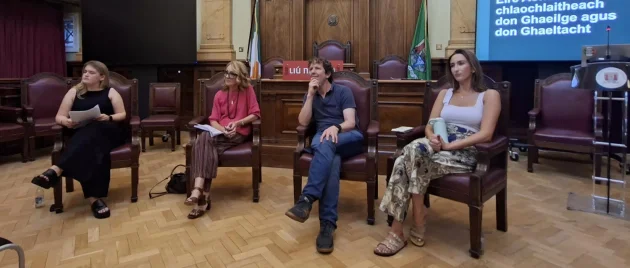
Around 20 people attended the event in the council chamber at Cork City Hall, organised by Liú na Laoi, the local branch of the language advocacy organisation.
It would be hard to fault city folk for not being present, given that Barrack Street – not far from City Hall – was thronged with supporters of the county camogie team for the official homecoming celebration on Leeside following their victory in the All-Ireland final at the same time.
But it is an illustration of the struggle facing Conradh na Gaeilge and other organisations in getting people informed about all the arguments relating to this issue.
The Conradh established the roadshow to inform people across the country after a majority of delegates voted at its ard fheis/annual conference to amend the organisation’s aims so that members would act “towards a united Ireland for the benefit of Irish and the Gaeltacht”.
Concern was expressed at that Ard Fheis that the Irish language movement would be left on the sidelines in Irish unity discussions between political parties and other stakeholders north and south.
That was what was under discussion by Róisín Nic Liam, a doctoral researcher at Queen’s University, who made a presentation on her work ‘A United Ireland – A Transformative Opportunity for Irish and the Gaeltacht’, in her talk in which she referred to the concern that the language would become a bargaining chip and Irish speakers would be left without a voice on the sidelines.
There are many examples in her report pointing to precisely that, but in her talk she referred to what former Taoiseach Leo Varadkar said when he claimed that perhaps less emphasis should be placed on Irish, and when he questioned, for example, whether it would be appropriate to use titles such as ‘Taoiseach’ and ‘Tánaiste’ in a united Ireland.
According to Nic Liam, this was an example among many others of a mindset in which political leaders and commentators were treating Irish as a bargaining chip.
“That comes up continuously in all these debates from some of the most senior politicians in the government in the south – presenting Irish as if it were a matter for debate in all these talks, presenting it as a national symbol rather than as a question of rights and as a community language,” she said.
“The rights of one minority should not be diminished to accommodate the rights of another minority in a united Ireland — rather, an all-encompassing rights-based society would need to be established that would treat every person equally by enshrining their rights — including language rights — in law.”
Another panel speaker, Eibhlín Ní Lionáird, Language Planning Officer with Comharchumann Forbartha Mhúscraí, noted the success of the Fleadh Cheoil in Belfast and suggested that this could be an indication of the way forward as efforts are made to bring people to the cause of Irish and Gaelic culture in the future.
Conradh na Gaeilge general secretary Julian de Spáinn, another panel speaker, referred to the damage he believes partition has done to the growth of Irish across the various jurisdictions since partition was imposed more than 100 years ago.
“According to the Census in 1911, 3% of the population of Leinster said they had Irish; in the six counties in the north at that time, 3% said they had Irish as well – more than 100 years later the questions are somewhat different but that 3% in Leinster has grown to 36%, with people acknowledging that they have some Irish or that they are competent speakers,” said De Spáinn.
“In the north in the six counties, the number of people acknowledging that they have some Irish is at 12%.
“That shows the difference that was brought about by the partition that existed in this country over all that time.”
Questions then came from the floor on various aspects and what impact the unification of the country could have – not only on the position of Irish in the north but on the use of the language in the south as well.
While organisations like Ireland’s Future have been focusing on Irish unity for a few years now, this Conradh na Gaeilge roadshow is the first series of meetings that has been organised on the subject with a particular emphasis on Irish language and Gaeltacht matters.
There were previous meetings in Gaeltacht areas such as Gaoth Dobhair and Connemara, and further information events are being planned – among them a discussion event in Baile Mhúirne in the Muskerry Gaeltacht at the end of September.
The Journal’s Gaeltacht initiative is supported by the Local Democracy Reporting Scheme.
To embed this post, copy the code below on your site