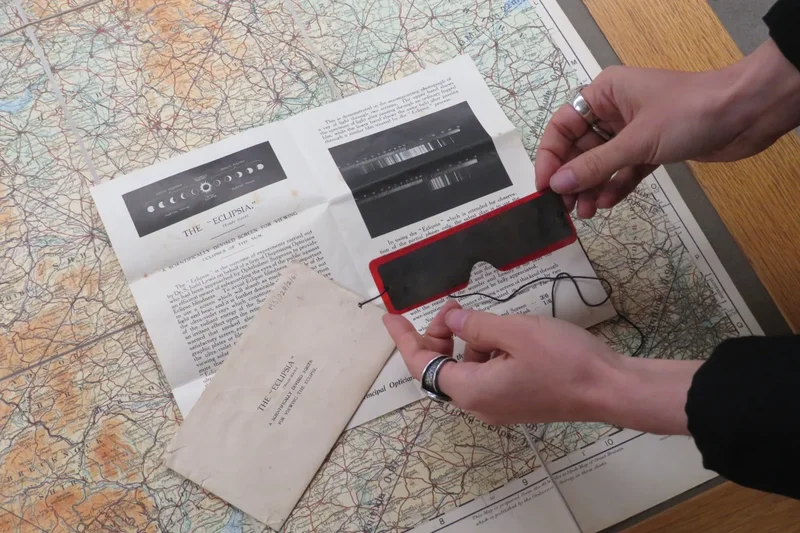
Astronomers have shared photographs of glasses used to view eclipses almost one hundred years ago, ahead of the best solar eclipse in decades.
More than 90 per cent of the sun will be obscured by the moon between 6.17pm and 8.06pm on Wednesday, the most it has been blocked above UK skies since the total eclipse in 1999.
Convenience stores, national parks and the Royal Greenwich Observatory have all exhausted their glasses supplies ahead of the eclipse, which will be the country’s fullest for the next 54 years.
The Royal Greenwich Observatory alone is said to have sold 15,000 pairs of eclipse glasses in the last month.
On Wednesday, images from the Royal Society showed “Eclipsia” glasses specially designed for viewing eclipses almost a hundred years ago.
The red and black rectangular glasses came with a book of instructions along with an Ordnance Survey map showing the areas of totality in England, the society said.
The images from the Royal Society were released on Wednesday along with others of photographic glass plates taken of a total solar eclipse in 1875.
The plates have been returned by the society to the Royal Astronomical Society in London after being rediscovered in an archive.
They include images captured by 23-year-old physicist Arthur Schuster, who joined a Royal Society expedition to Thailand, then Siam, to view the eclipse.
Meanwhile, experts have warned that only special solar eclipse glasses that are ISO 12312-2 certified for the safest eye protection should be used to view Wednesday’s eclipse and that sunglasses were not sufficient.
Following the 1999 total solar eclipse, the Royal College of Ophthalmologists reported around 70 cases of people experiencing vision problems after watching the eclipse, with around 40 per cent having looked at it for less than a minute.
Mohamed Elalfy, a consultant ophthalmologist and president of the Royal College of Ophthalmologists, said: “The safest way to enjoy the eclipse is to observe it indirectly, such as by watching a live broadcast.
“Looking directly at the sun during a solar eclipse can cause damage to the retina, potentially damaging the cells responsible for sharp central vision.
“Crucially, the retina has no pain receptors, so people will not feel the damage as it happens.
“Symptoms may only become apparent several hours later and can include blurred vision, a central blind or dark spot, distorted vision, reduced colour perception and increased sensitivity to light.
“While some people recover over weeks or months, others can be left with permanent visual impairment.”