Safety riding programme launched to help delivery workers navigate road risks
SINGAPORE – Delivery riders now have more help staying safe on the roads under a new safety programme designed specifically for the demands of delivery work.
The programme, launched on Aug 12, covers situations these riders encounter regularly, including riding with loaded delivery bags, frequent stop-start journeys, and navigating tight spaces.
The Advanced Riding Development Programme: Urban Rider Safety Course was jointly developed by GrabAcademy, Grab’s learning and development arm, and the Riding Safety Association of Singapore (RSAS).
It was launched by Grab, RSAS and the National Delivery Champions Association (NDCA). Riders from all platforms can sign up for the programme.
Platform workers’ safety has come under greater scrutiny following a rise in fatalities in 2026.
Four platform workers had died in the first half of the year, compared with two in the whole of 2025, said Minister of State for Manpower Dinesh Vasu Dash, at the launch in Ayer Rajah Crescent.
“Most importantly, all these accidents, if not most, are preventable,” he said.
Dinesh said improving safety involves putting the right protections in place, providing clearer guidance, and bringing the right partners together.
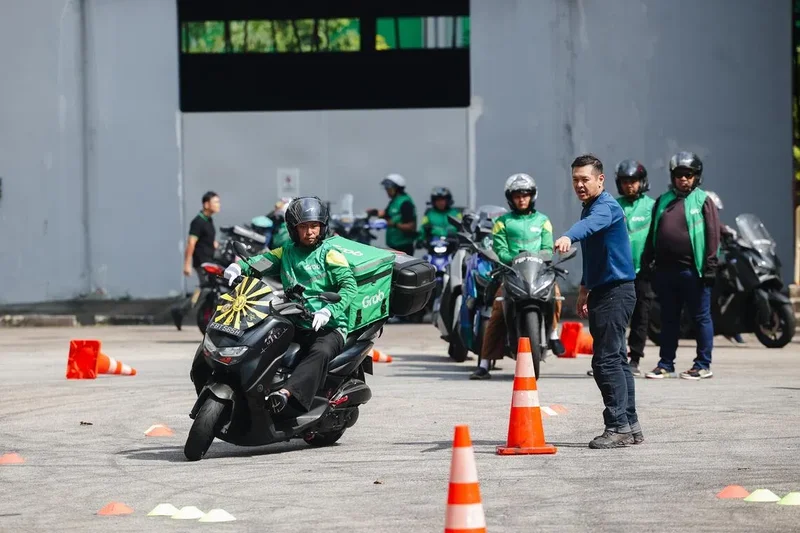
The first cohort of 40 riders took part in the new safety programme on Aug 12 at an industrial estate in Ayer Rajah. The two-hour course was taught by five volunteer instructors from RSAS.
While all licensed motorcyclists learn the fundamentals of safe riding, delivery riders operate in a different environment from most road users, said Grab.
The safety course is conducted outdoors, with participants using their own motorcycles and food delivery bags. It covers defensive riding, motorcycle handling and low-speed control, as well as emergency braking and vehicle stability while carrying delivery loads.
It also teaches riders how to better spot hazards and anticipate risks.
The 40 riders who attended the safety course on Aug 12 also wore cooling vests that are being trialled by Grab.
Gabriel Ng, Grab’s head of platform safety in Singapore, said the company is exploring cooling technology for its riders as heat becomes more extreme.
The vest is fitted with two fans and powered by a battery pack, which can be swopped out for a fully charged one when it is depleted.
Grab has produced an initial batch of 300 vests and plans to work with NDCA to distribute them to interested riders for feedback on their design and fit.
Eventually, riders in Singapore will be able to buy the vests, just as they can purchase thermal bags, delivery apparel and gear packages through Grab’s webstore.
Skills beyond everyday riding needed
Since Jan 1, 2025, the Platform Workers Act has brought platform workers under work injury compensation coverage and introduced workplace safety and health responsibilities for platform operators and workers.
The Ministry of Manpower and Workplace Safety and Health Council have also issued guidance covering road risks, fatigue and heat under the Approved Code of Practice for Platform Services.
Dinesh said the launch of the safety course showed how partnerships could translate safety priorities into practical action.
“This is exactly the kind of hands-on effort that matters because many safety decisions on the road are made within seconds,” he said.
“Courses like this allow our riders to spot risks earlier, ride more defensively, and make better decisions when they are on the road, depending on the weather and traffic conditions.”
Mr Alejandro Osorio, managing director of Grab Singapore, said the course could be refined according to feedback.
“After today’s course, we can explore what worked, what didn’t, how it could be tweaked to be more relevant over time,” he said.
He said delivery riders encounter road environments ranging from busy routes and neighbourhood streets to loading bays and multi-storey carparks, requiring skills beyond everyday riding.
Suhada Abdullah, 51, who has been a delivery rider for about eight years, said the training was useful as a refresher on safe riding.
She found the session on motorcycle braking particularly useful, as riders have to adjust how they brake when carrying heavy loads, especially food that could spill easily, such as soup.
The single mother of five children, aged between 13 and 28, regularly works 12-hour days from 10am to 10pm to support her family.
Ng Gan Poh, 35, who has been a delivery rider for 10 years, said the job can be stressful because customers expect their food to be delivered quickly. But riders cannot always speed up deliveries, particularly when they are carrying delicate orders such as cakes, he said.
The course taught him to control his motorcycle better and anticipate how other road users might behave, said Ng, who makes between 20 and 30 deliveries a day.
Ms Yeo Wan Ling, assistant secretary-general of NTUC and adviser to the NDCA, said more riders should have access to intermediate programmes tailored to delivery work.
Riders may carry large quantities of bottled drinks on their motorcycles, affecting the bike’s balance in ways ordinary riders may not encounter, she said.
She said the programme should be brought closer to where riders work and live, with two or three additional locations already being considered.