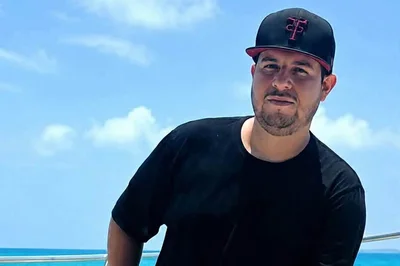
One week, four deaths and an agency under suspicion. Two of the fatalities were Mexican. The most recent name added to a list that has provoked outrage in Mexico and the United States is Juan Jairo Coronilla, 28, from Guanajuato. He had been in Orlando, Florida, for only two days when he died after being struck by a tractor-trailer while fleeing an operation by U.S. Immigration and Customs Enforcement (ICE). Coronilla’s death — he was in the country legally on a work visa and, according to his wife, planned to return to Mexico on July 18 — once again draws attention to the agency’s handling of operations and the trail of deaths that follows it.
Coronilla’s death occurred on Tuesday, July 14, shortly after 7.00 a.m. Several people who were present told local media that the man was inside a vehicle with three companions at a gas station and, upon seeing immigration agents, all tried to flee in different directions. Coronilla crossed a road, slipped on wet grass and was hit by a truck owned by Eggland’s Best.
Yezzika Alamilla, Coronilla’s wife, arrived in Orlando last Friday to identify and repatriate her partner’s body. In her first remarks to the press, who were waiting for her at the airport, she said her husband “had a tourist visa. He had been in the U.S. for three weeks. Here in Florida, two days.” However, in an audio obtained by EL PAÍS through a relative of the deceased, Alamilla clarifies that “he came with his work visa” and acknowledges that the situation has overwhelmed her.
Juan Jairo Coronilla with his wife Yezzika Alamilla and their son.CEDIDA POR LA FAMILIA
The truck driver and other witnesses tried to provide first aid to the Mexican, but he died at the scene. Sara Atkinson, a 42-year-old veterinary nurse who witnessed the incident, attempted to revive Coronilla with chest compressions for about 10 to 15 minutes before paramedics arrived. “I want his family to know he didn’t die alone that day. I was with him. Everyone at the scene fought for him,” Atkinson told the Mexican’s relatives.
According to Coronilla’s cousin, Benjamín Fonseca, the last time he saw him in San Luis de la Paz, in the state of Guanajuato, was a month and a half ago. Over a phone call, he says Coronilla’s main job was as a furniture salesman in department stores. He does not know whether Coronilla traveled to the United States for work-related business tied to that job.
Coronilla was the father of two children and, according to his cousin, a “very pleasant and sociable” person. “Even without knowing you, he would approach you and talk. He wasn’t closed off with people. He was very charismatic, honestly. A good person,” Fonseca says.
Coronilla’s family has launched a fundraiser in both the United States and Mexico to raise money for his repatriation. “She [Alamilla] tells me many people have stepped forward saying ‘We’re going to help you,’ but the support doesn’t arrive for one reason or another; or because they are asking for documentation that doesn’t yet exist, in this case the death certificate,” Fonseca explains. Neither the Mexican Consulate in Orlando, which handles repatriation procedures, nor the Secretariat of Foreign Affairs provided further details on the case when contacted by EL PAÍS.
Coronilla’s case remains surrounded by questions. “We don’t know why he ran, we don’t know if he was afraid,” activist Isaret Jeffers, spokesperson for the Colectivo Árbol, told this newspaper. The group helped Coronilla’s widow travel to Florida on Friday, July 17. According to the victim’s family, Coronilla had arrived in the United States three weeks earlier, had been in Georgia and had spent just two days in Florida. He planned to return to Mexico on Saturday, July 18. “It’s very sad and it’s not only Juan Jairo’s case; the whole community is suffering. There’s no one left here who can get away,” Jeffers added.
This new death of a Mexican during an ICE operation comes amid multiple disputes that have strained diplomatic relations between Mexico’s National Palace and the White House. At least 17 Mexicans — 14 in detention centers and three during arrest — have died in operations or while in custody of the federal agency since Donald Trump returned to power. The death of Lorenzo Salgado Araujo at the hands of U.S. immigration police on July 9 in Houston, Texas — once again surrounded by controversy over the disproportionate force and violence of law enforcement — prompted, for the first time, a strong and angry response from the government of Claudia Sheinbaum.
Both the Mexican president and the foreign ministry have moved from diplomatic complaints to criminal action via two routes: the U.S. Department of Justice and the prosecutors in the states where the deaths occurred. They have also referred the matter to the UN High Commissioner for Human Rights. On the civil side, lawsuits have been filed against private companies that operate migrant detention centers across the border.
The truck that struck Juan Jairo Coronilla as he fled ICE, near St. Augustine, Florida, on July 14.Sheriff del Condado de St. Johns (EFE)
However, the letters did not go over well in Washington. Last Friday, the U.S. government returned to the Mexican ambassador in Washington, Roberto Lazzeri, the letters that the Sheinbaum administration had sent on July 13 to the migrant detention centers where Mexicans had died. According to a social media statement from the Bureau of Western Hemisphere Affairs, Michael Kozak, the State Department diplomat who heads that bureau, returned the letters from Mexico “that seek to direct the actions of U.S. government personnel operating on U.S. sovereign territory.”
It remains to be seen how Coronilla’s case will be closed and whether his relatives, like so many others in similar situations, will obtain clear and satisfactory answers about the loss of their loved one, while Mexico’s change of strategy is tested against ICE’s actions.
Sign up for our weekly newsletter to get more English-language news coverage from EL PAÍS USA Edition