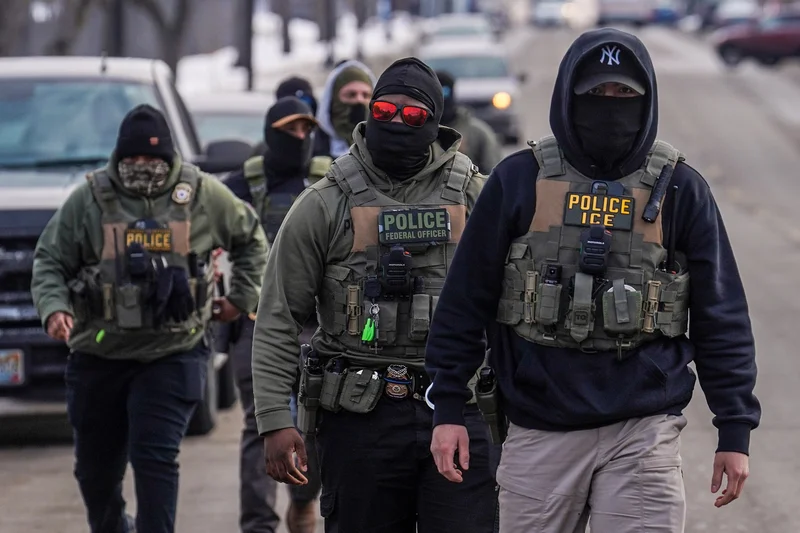
Donald Trump’s immigration police are preparing a new tool to subdue individuals who resist arrests: gloves capable of delivering painful electric shocks. U.S. Immigration and Customs Enforcement (ICE) plans to invest up to $20 million in the devices, which agents could use to physically control suspects during arrests.
At first glance the gloves look ordinary, but they can deliver painful shocks when they are in contact with the skin. They operate like a normal glove until an agent presses a switch to activate the electrical mode. ICE presented them as a tool to control people who offer physical resistance during operations, the Associated Press reported.
The Department of Homeland Security’s (DHS) plans to acquire the devices, known as G.L.O.V.E. (Generated Low Output Voltage Emitter), were published Tuesday in the federal government’s procurement forecast system.
According to the document, ICE intends to distribute the gloves to agents in the Enforcement and Removal Operations (ERO) unit, which carries out immigration arrests and detentions, as well as to officers in Homeland Security Investigations (HSI). The agency’s planned investment ranges from $10 million to $20 million, the report said.
The G.L.O.V.E. devices are manufactured by Compliant Technologies, a company based in Lexington, Kentucky. On its website the company says the devices “empower officers to de-escalate tense situations quickly and effectively,” aiming to reduce the risk of injury to both officers and civilians.
The devices have been used in recent years in some jails and by U.S. police forces. The manufacturer markets them as a “less lethal” option that allows officers to act at distances of up to three meters. According to the company, that is the range in which fatal shootings occurred for 70% of officers who died from gunshot wounds. Neither DHS nor Compliant Technologies has responded to queries about the purchase plan.
Shocks at the push of a switch
If ICE buys the devices, they would join a long list of technological tools the agency uses to carry out President Trump’s mass-deportation plan. The agency already has apps that let agents scan a person’s face and fingerprints on the street and compare them to databases. It also uses cameras that read license plates and track vehicles’ movements, as well as digital tools to extract and analyze information stored on phones and other electronic devices during investigations.
The possible addition of electric-shock gloves to their gear comes amid repeated allegations of excessive force. In some cases those actions have resulted in the deaths of immigrants and U.S. citizens during operations.
Civil rights groups warn that the new tool could worsen a problem they say has been exacerbated by insufficient oversight and accountability.
“ICE spent the last year showing this country they are too quick to use force. Now they will be able to deploy electric shocks with the slight push of a button that maybe nobody else can see them do,” said Jenn Rolnick Borchetta, deputy director of the ACLU’s policing oversight project, in statements to AP.
Borchetta said the public should not assume in advance that immigration agents will use the devices appropriately. “Introducing gloves that can so easily be used to deliver terrible pain in encounters is a recipe for harm to the public.”