The trail starts easily enough. A rough stone path winds through Altındere National Park, beech trees closing overhead, a river rushing somewhere below the trail. It feels like a pleasant walk. Then the valley narrows, the tree cover thickens, and you look up.
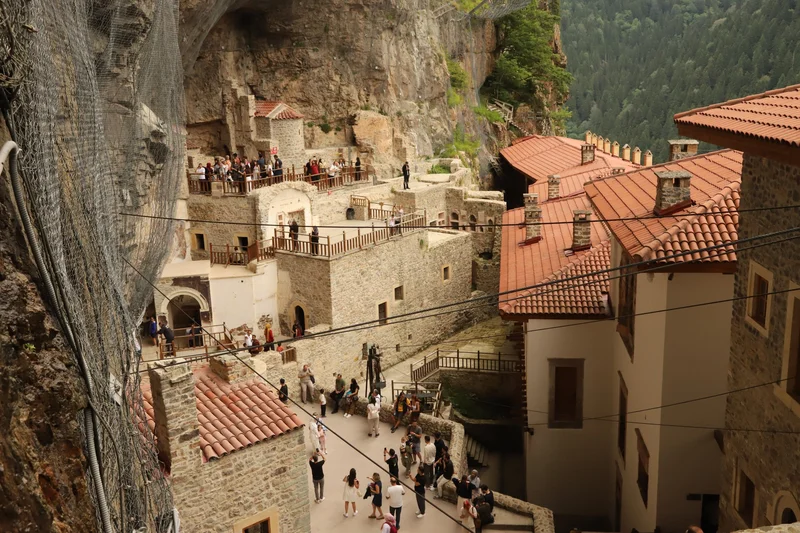
There it is: a complex of ochre and grey stone fused to the face of a cliff, 300 meters above the valley floor, as though someone simply pressed a monastery into the rock and left it there. The Sümela Monastery has stood in some form on this spot since the 4th century. Standing beneath it for the first time, you suddenly feel the weight of those 1,600 years.
The climb to reach it sharpens the experience. Steps cut into the hillside, steep in places and slick when mountain mist settles over the trail. By the time you arrive at the monastery's lower gate, you are breathing harder than you expected. That, it turns out, is part of the point. This place was never meant to be convenient.
According to tradition, Sümela was founded around A.D. 386 by two Athenian monks, Barnabas and Sophronios, who followed a vision of the Virgin Mary to this remote cliff in the Pontic Mountains. The vision led them to an icon of the Virgin Mary, traditionally attributed to the Apostle Luke and believed to have miraculously arrived at the site.
What that building cost in human effort is difficult to overstate. Stone blocks hauled up slopes without roads. Scaffolding lashed to vertical rock so that workers could plaster and paint surfaces that dropped away into nothing beneath them. A drainage system of channels and eaves designed to divert water away from the cliff face and protect the monastery's interiors. The ambition of it, viewed from inside the complex today, is almost uncomfortable to contemplate.
The complex that resulted contains 72 rooms across multiple levels: cells where monks slept, a library, a kitchen, cisterns, a network of narrow corridors connecting spaces that should not, by any reasonable calculation, exist on the side of this cliff. The main rock church is cut directly into the face of the mountain. Its walls are covered in frescoes dating from different periods between the 9th and 19th centuries, with successive generations of painters adding to the visual record.
The monastery also became closely associated with the Empire of Trebizond (Trabzon), which ruled much of the region from 1204 until the Ottoman conquest in 1461. Imperial ceremonies were held here, tying the monastery closely to the political and spiritual life of the empire. To be crowned emperor, you climbed the same cliff. The monastery's name comes from the Greek "melas," meaning black, a reference to the dark icon at its heart. That icon drew pilgrims from across the Byzantine world for over a millennium.
After the Ottoman conquest of Trebizond in 1461, the monastery continued to function. Ottoman sultans issued edicts granting the monastery various rights and privileges, allowing its monastic community to remain in place. Sümela outlasted the empire that built it, the empire that conquered it, and the political arrangements that followed. That record of survival is not incidental to what the place is; it is the whole story.
In 1923, the population exchange between Greece and Türkiye brought an end to the monastery's centuries-old monastic community. After the exchange, Sümela was evacuated and abandoned as a functioning monastery. In 1931, the monastery's icons and sacred objects were transferred to the Benaki Museum in Athens. They were later moved to the newly established New Sümela Monastery in Veria, Greece.
In the decades that followed, the monastery deteriorated. Frescoes were damaged, masonry suffered from exposure and vegetation encroached on parts of the complex. Extensive restoration and conservation work has since stabilized the site and reopened much of it to visitors. In 2010, an Orthodox Christian service was held at Sümela for the first time in 88 years, marking a symbolic moment in the monastery's modern history.
The thing that surprises most visitors, once inside, is not the scale but the detail. The frescoes in the rock church are not grand in the way of cathedral ceilings; they are close, intimate almost, painted on surfaces that press in around you. Faces of saints at eye level, narrative scenes running along walls you could reach out and touch. Centuries of hands have, in fact, touched them, which is part of why so much restoration has been necessary.
The terraces that jut out from the cliff face offer a different kind of encounter: the valley below, the forest stretching in every direction, the absolute stillness that settles in when the tour groups thin out and the mountain takes over again. It is easy to understand, standing there, why someone looked at this place and decided it was sacred. It is harder to understand how they then decided to build on it.
Sümela drew 514,596 visitors in 2025, according to data from Trabzon's Provincial Directorate of Culture and Tourism. Visitors came from Türkiye and abroad, drawn by the monastery's combination of history, architecture and dramatic setting. Yet visitor numbers feel secondary on the ground.
What registers there is something older than designation processes and visitor counts: the weight of a place that people have considered worth the extraordinary effort for sixteen centuries, and that, against all reasonable expectation, is still standing.